

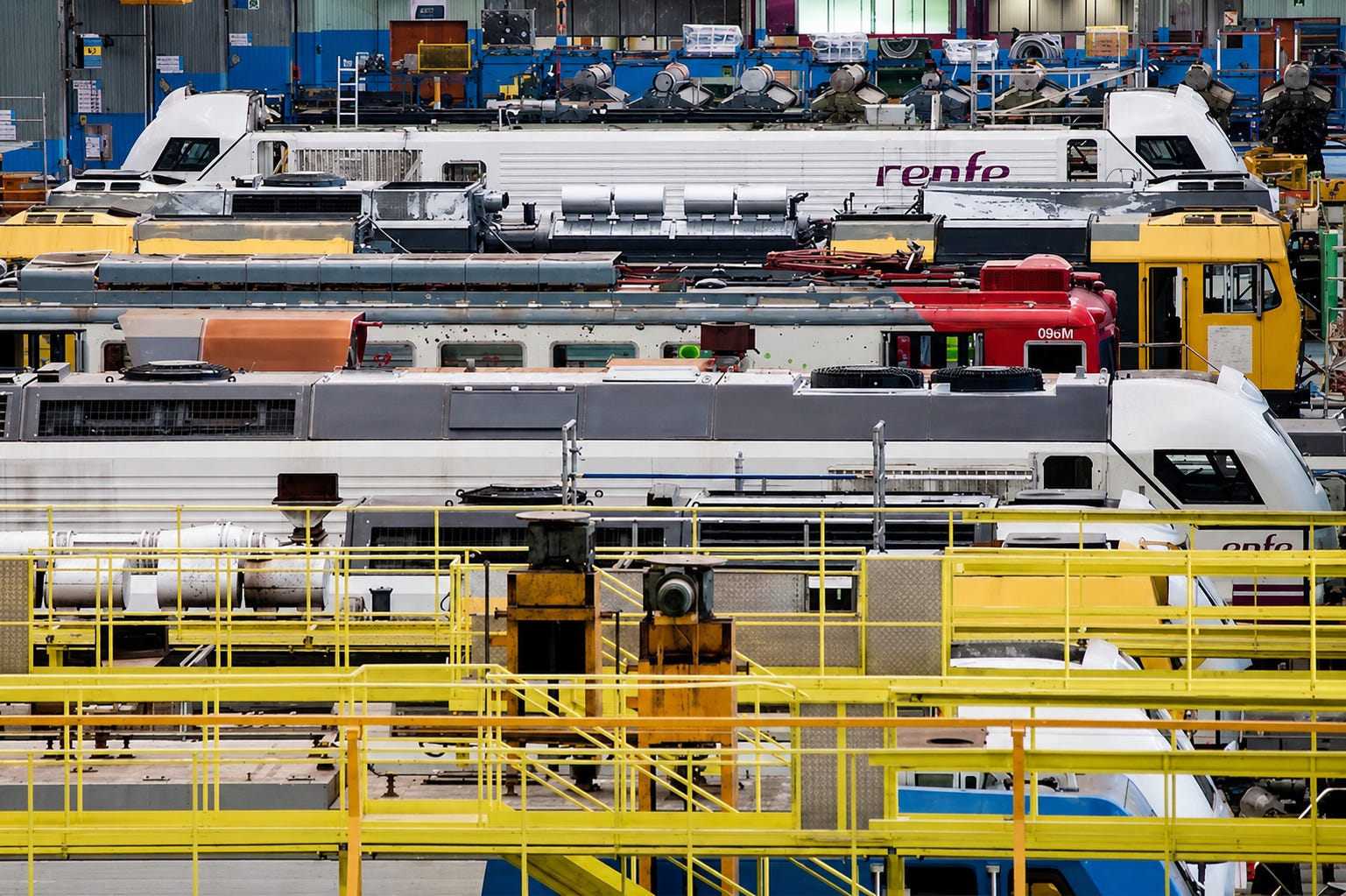
Renfe ordered to open workshops for Iryo maintenance
SPAIN: Spain’s competition authority has forced Renfe to open high-speed maintenance facilities to rival operator Iryo, after a court rejected Renfe’s emergency bid to suspend the order — the first time a regulator has compelled a Spanish incumbent to share maintenance infrastructure in real time.
Iryo’s Frecciarossa sets are approaching three million kilometres and need heavy maintenance only possible at La Sagra and Valladolid — facilities Renfe controls. The CNMC order requires Renfe to grant full access on defined economic terms, not just the bogie pit access Iryo originally requested.
The Audiencia Nacional’s refusal to suspend establishes that a competition order takes effect immediately, regardless of a pending challenge. A fuller suspension ruling is expected within weeks.
At stake is whether Spain’s open-access model functions in practice — or breaks down at the infrastructure layer incumbents still own.
Poland sets up leasing company to open HSR market
POLAND: Poland’s high-speed rail programme has taken a structural step toward market opening: state-owned project promoter Centralny Port Komunikacyjny has established a dedicated rolling stock leasing company that will own and lease three train fleets — removing the need for future operators to purchase their own.
Port Polska.KDP, formally established 2 June, will procure high-speed trainsets capable of 320 km/h, Aero Express trains for the Warsaw–airport–Łódź route, and Regio Express regional sets. Tenders for all three categories are planned before the end of 2026.
The total programme value is estimated at EUR 2.37bn through 2035. The first high-speed line, Warsaw–Łódź, is planned to open in 2032.
France clears TGV M for service — passengers wait until September
FRANCE: France’s next-generation high-speed train has cleared its final regulatory hurdle, but the first passengers will not board until September — the fourth time the commercial launch date has moved since the programme began.
ERA issued formal authorisation on 29 May. SNCF Voyageurs and Alstom announced the same day that commercial operations under the TGV INOUI brand would begin in early September, not 1 July as last communicated. Two trainsets will be delivered in June, rising to six by end of August and 13 by end of 2026.
The full order stands at 130 trainsets for SNCF Voyageurs and 30 for Eurostar. Eurostar’s cross-Channel variant requires a separate authorisation process.
European DAC project concludes: digital coupling works
FREIGHT: A six-year German research programme into digital automatic coupling for freight wagons has concluded with a formal finding of technical viability, moving Europe’s 450,000-wagon fleet one step closer to a mandatory transition decision.
The DAC4EU consortium presented its findings in Lippstadt on 2 June. Beyond the mechanical connection, DAC integrates data and power links directly into the coupler head, enabling real-time wagon monitoring and remote train control — capabilities the screw coupling, essentially unchanged for more than a century, cannot provide.
The European DAC Delivery Programme (EDDP) has already selected the coupler head type and electrical connector standard. What remains open is the binding mandatory conversion timeline and rollout sequencing across member states.
Fixing Germany’s rails is breaking its freight
Germany’s Generalsanierung concentrates all corridor disruption into single shutdown windows — fewer total disruption-days, more predictability for industry. Right now, it is producing the opposite.
By Dan Jensen
A frost delay pushed Hamburg–Berlin’s reopening past its 30 April deadline and into the Hamburg–Hannover closure window that opened 1 May. Two corridors designed to close sequentially closed simultaneously. Hamburg–Hannover alone carries approximately one in four freight wagons in Germany.
Hamburg–Berlin reopens fully on 14 June. The same day, Generalsanierung begins on the Obertraubling–Passau corridor — around 115 km of track, EUR 1.3bn, running until December.
Czech manufacturer beats Pesa in PKP Intercity shunter tender
Czech manufacturer CZ LOKO has won a contract to supply 18 diesel shunting locomotives to PKP Intercity, beating Polish rival Pesa with a bid roughly 30% below the nearest competing offer — the company’s second successive contract win with Poland’s long-distance passenger operator.
PKP Intercity signed the contract on 27 May. CZ LOKO’s bid of EUR 64.2m compared with EUR 91m from Pesa. All 18 EffiShunter 1000 units must be delivered within 48 months, with the first two due within 32 months.
CZ LOKO is also bidding in a separate SBB Cargo procurement for up to 55 dual-mode shunting locomotives, as part of a broader push into western European markets.
That’s The Rail Agenda for today. If you found this newsletter useful and relevant, please forward it to someone you know.