

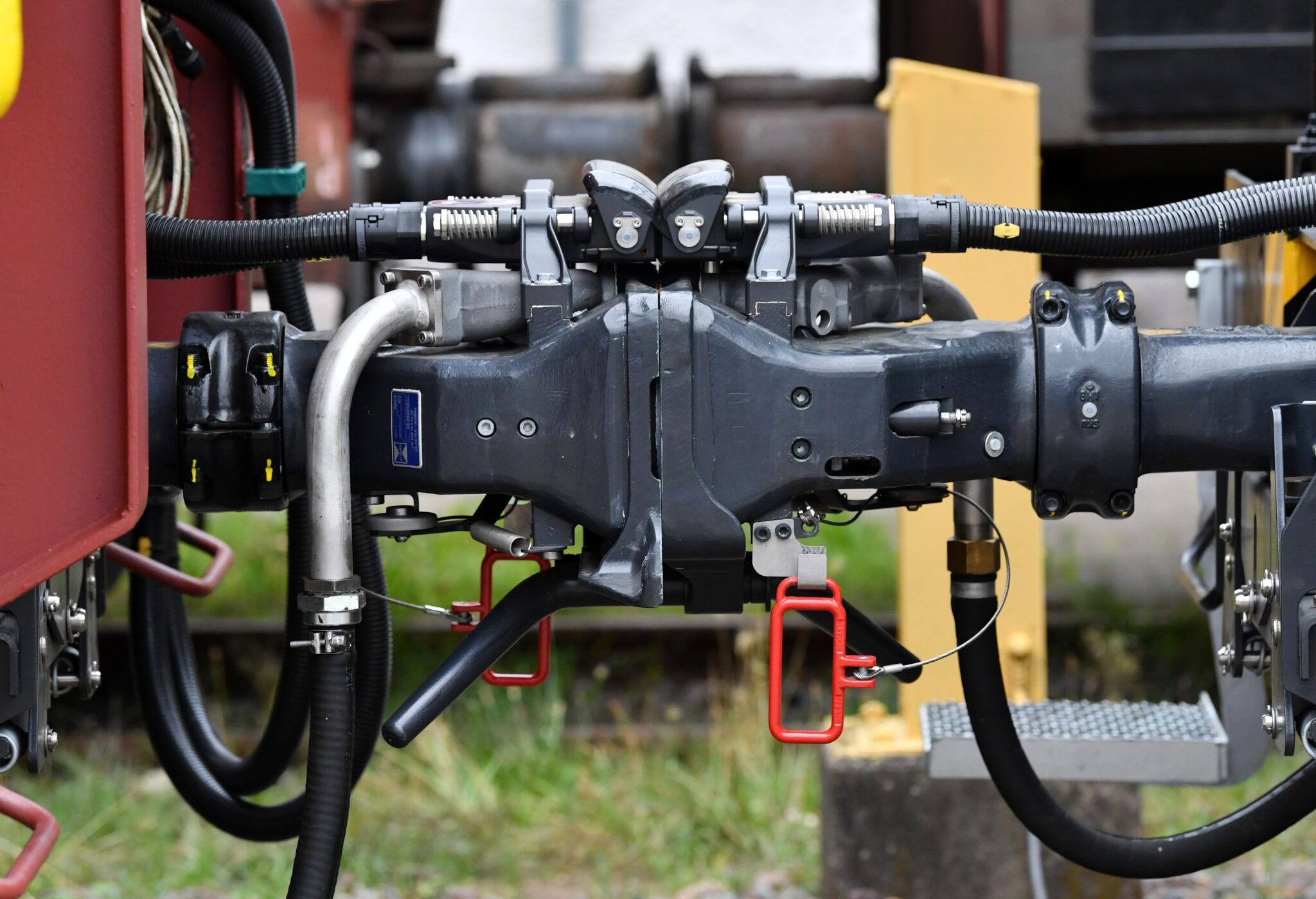
FREIGHT: A six-year German research programme into digital automatic coupling for freight wagons has concluded with a formal finding of technical viability, moving Europe’s 450,000-wagon fleet one step closer to a mandatory transition decision.
The DAC4EU consortium — led by Deutsche Bahn and including DB Cargo, SBB Cargo, Rail Cargo Austria, Ermewa, GATX and VTG — presented its findings at a closing event hosted by Westfälische Landes-Eisenbahn (WLE) in Lippstadt on 2 June. Germany’s Federal Transport Minister Patrick Schnieder attended in person.
The project, funded with approximately EUR 30 million in federal support since 2020, tested multiple digital automatic coupler (DAC) variants across marshalling yards, long-haul international services and ferry connections.
From test track to type selection
WLE ran the programme’s first commercially operated DAC train using a Hybrid-DAC system — a configuration that combines digital automatic couplers with conventional screw-coupled wagons on the same train. The hybrid approach is designed to make mixed-fleet operation viable during any transition period, when converted and unconverted wagons will run together across European networks.
Beyond the mechanical connection, DAC integrates data and power links directly into the coupler head. That enables real-time wagon monitoring and supports remote train control functions — capabilities the screw coupling, a design essentially unchanged for more than a century, cannot provide.
The competitive argument for conversion is straightforward. Manual coupling is physically demanding and slow, and the German transport ministry has identified it as a structural disadvantage against road freight. Automating the process reduces train formation times and cuts the labour required at marshalling yards.
What EDDP must now decide
The DAC4EU findings feed into the European DAC Delivery Programme (EDDP), the body responsible for preparing national rollout plans. EDDP has already selected the coupler head type — a Scharfenberg latch mechanism, chosen in 2021 — and the electrical connector standard, a Voith E-Coupler selected in 2024. What remains open is the binding mandatory conversion timeline, TSI revision and rollout sequencing across member states for some 450,000 wagons and 17,000 locomotives.