

Germany’s Generalsanierung concentrates all corridor disruption into single shutdown windows — fewer total disruption-days, more predictability for industry. Right now, it is producing the opposite.
By Dan Jensen
On 3 June, the German Steel Federation (WV Stahl) reported that ore and coal deliveries to steelworks had become “extremely critical,” with initial production impairments already under way. Its managing director, Kerstin Maria Rippel, placed direct responsibility on DB InfraGO’s inadequate preparation of diversion routes.
The immediate cause was a collision of planning and weather. A frost delay pushed Hamburg–Berlin’s reopening past its 30 April deadline and into the Hamburg–Hannover closure window that opened 1 May.
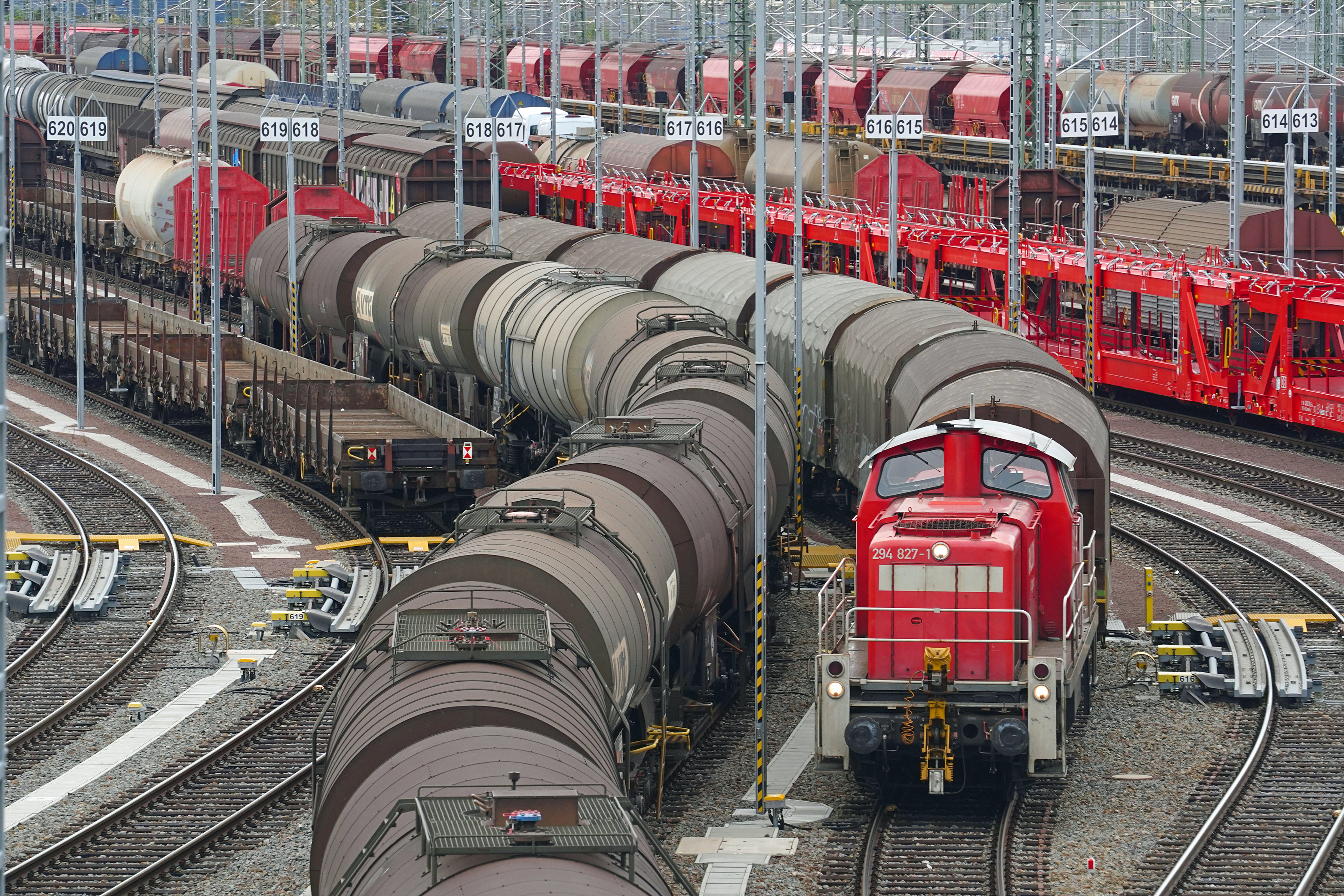
Two corridors designed to close sequentially closed simultaneously. Hamburg–Hannover alone carries approximately one in four freight wagons in Germany. When fire, a derailment, an IT outage and storm damage followed in rapid succession, an overloaded network had no capacity left to absorb them. Export delays at Hamburg reached five days. Bremerhaven was limited to night operations.
The model and its premise
The logic behind Generalsanierung is sound in principle. Germany’s network had been maintained through decades of rolling partial works — short closures, constant disruption, no sustained improvement.
The Riedbahn pilot in 2024 offered an alternative: shut the corridor completely, do everything at once, reopen it better. DB InfraGO described the result as proof of concept. Hamburg–Berlin followed the same model, at nine months a closure without modern precedent in Germany.
The deal offered to industry was explicit. Accept concentrated short-term disruption. Receive a construction-free corridor for years in return.
The buffer that was never there
The model concentrates disruption. It also concentrates risk. During a full closure window, every additional disruption — planned or unplanned — falls into a network already operating at its limit on diversion routes. There is no slack to absorb it.
In February 2025, regional operator Agilis filed a formal complaint with the Bundesnetzagentur arguing that the planned works on Nürnberg–Regensburg — 80 km of track, 40 switches, 60 km of overhead line — could be accomplished through alternating single-track operations rather than a full closure.
The Bundesnetzagentur rejected the complaint. The regulator decided the model was legally sound. Whether it was operationally resilient was not part of the question.
The Lüneburg municipal authority put the planning failure more directly: one day’s buffer between two projects of this scale is not planning. Hamburg–Berlin was scheduled to close on 30 April. Hamburg–Hannover was scheduled to open on 1 May. That sequencing assumed a level of certainty that an unusually long frost period eliminated.
The original promise of years free of major construction is already being broken. Die Güterbahnen, the association of private rail freight operators, documented in May 2026 that Köln–Wuppertal — a corridor currently undergoing Generalsanierung — faces further closures for signalling work in 2027.
The reason is structural: signalling systems are being renewed separately from corridor works, requiring return visits. The model promised to do everything in one window. In practice, it is scheduling a second one.
What opens on 14 June
Hamburg–Berlin reopens fully on 14 June. The same day, Generalsanierung begins on the Obertraubling–Passau corridor — around 115 km of track, over 90 switches, EUR 1.3 billion, running until December. For four weeks, it will overlap with the tail end of the Nürnberg–Regensburg closure.
On the Plattling–Passau section of the new closure, DB InfraGO has adopted a hybrid model: alternating between single-track and full closure to keep cross-border freight moving. Agilis made exactly that argument for Nürnberg–Regensburg eighteen months ago and was rejected. The hybrid model is now quietly in use on the next corridor down the line.
DB InfraGO has not said how it builds resilience into a programme designed without it. June 2026 is the first answer.