

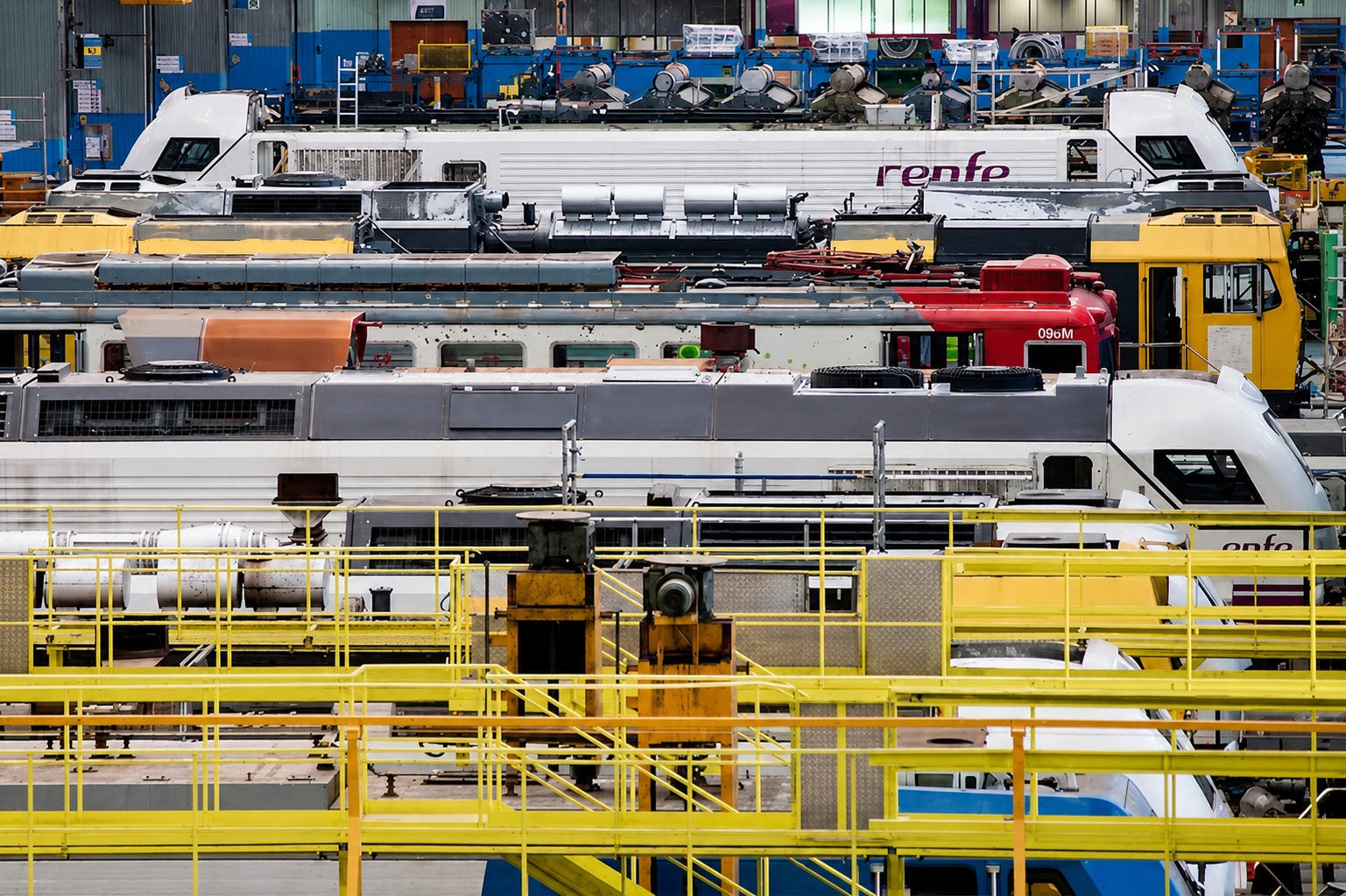
SPAIN: Spain’s competition authority has forced Renfe to open high-speed maintenance facilities to rival operator Iryo, after a court rejected Renfe’s emergency bid to suspend the order — the first time a regulator has compelled a Spanish incumbent to share maintenance infrastructure in real time.
The Audiencia Nacional’s administrative chamber rejected Renfe’s application for interim measures on or around 20 May, leaving the National Markets and Competition Commission (CNMC) order immediately enforceable. A separate suspension proceeding remains open, with a ruling expected within weeks.
The CNMC issued its order on 26 March, requiring Renfe to grant access to two facilities — its La Sagra complex near Toledo and its Valladolid workshop — for bogie removal and refitting on Iryo’s Frecciarossa fleet. Renfe challenged the order as arbitrary and sought an emergency stay. The court declined.
What the order requires
Iryo’s Frecciarossa sets — designated class 109 in Spain — are approaching three million kilometres of service. Heavy maintenance at that interval requires specialised facilities. La Sagra and Valladolid are among the very few complexes in Spain capable of handling it.
Iryo had originally requested access to a bogie drop pit at La Sagra on a self-provision basis. The CNMC rejected that specific request but imposed broader measures: full workshop access at both facilities, use of equipment, and an obligation for Renfe to carry out the work itself or allow self-provision, under defined economic conditions and deadlines.
The CNMC grounded its order in non-discriminatory access obligations under Spanish and EU rail service facility rules. Because Renfe publishes and offers heavy maintenance as a commercial service, it is required to provide that service to competitors on equal terms.
What Renfe says it stands to lose
Renfe estimates the impact at more than EUR 60m annually — not from lost maintenance revenue, but from reduced train availability and operational disruption across its own services.
The company argues that admitting Iryo’s fleet to facilities already running at capacity will cut the number of its own trains in circulation, with particular impact on the Madrid–Barcelona corridor and Avant services out of Valladolid.
Renfe also argues the CNMC imposed conditions broader than what Iryo actually sought — a point the authority’s own decision record supports, given that the specific request for a bogie drop pit was refused and replaced with wider obligations. The Audiencia Nacional was not persuaded those arguments met the threshold for emergency suspension.
A ruling with implications beyond Spain
The immediate effect is operational: Renfe must now provide access to La Sagra and Valladolid. But the enforcement logic carries weight beyond this dispute.
Spain’s high-speed market opened to competition in 2021. Iryo and Ouigo entered as new operators, but both depend on incumbents for access to maintenance infrastructure — the structural bottleneck this case now tests directly.
What the court’s refusal to suspend establishes is that a competition order of this kind does not require judicial confirmation before it takes effect. The regulator acts; the incumbent complies while the challenge proceeds.
The ordinary suspension proceeding will produce a fuller ruling within weeks. That outcome will determine whether the enforcement logic holds under closer legal scrutiny — or whether Renfe’s objections find more traction in a standard proceeding than they did in an emergency one.
