

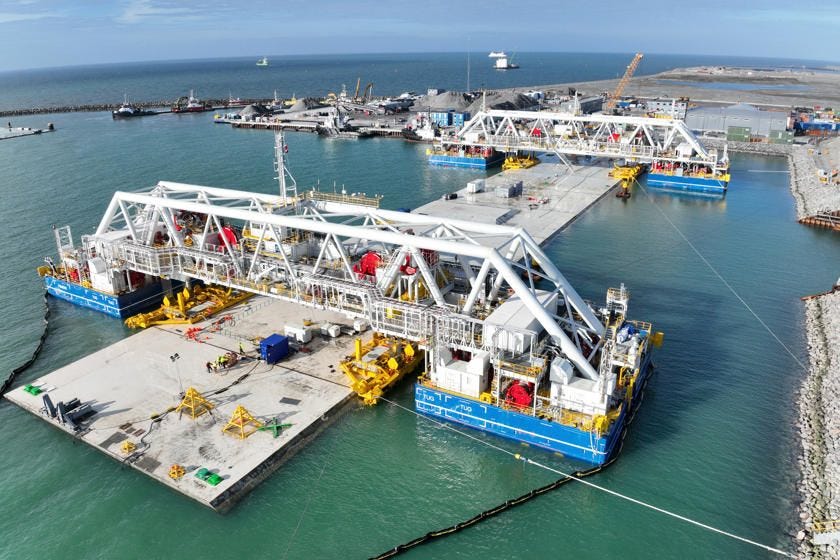
Fehmarnbelt immersion vessels enter final test phase
DENMARK: Specialised vessels built to install the Fehmarnbelt tunnel are undergoing final tests after the system was used with a completed tunnel element for the first time.
The milestone indicates that the tunnel installation system is nearing readiness for use. Focus now shifts from producing the tunnel elements to installing them offshore on the seabed.
The next phase will involve transporting the prefabricated sections from the production site, positioning them above the prepared trench and lowering them into place with high precision.
The vessels are now being tested ahead of certification by Danish maritime authorities. Regulatory approval will clear the way for the start of tunnel immersion works.
ERTMS to go live across Rome-Florence high-speed route
ITALY: The final unequipped section of the Rome–Florence high-speed railway is due to enter service with the European Rail Traffic Management System (ERTMS) in April, completing rollout of the signalling system across the entire route.
Activation will focus on the Orvieto–Settebagni section, the last stretch of the corridor where ERTMS is not yet in service.
Commissioning works are scheduled for April 11–12, with temporary closures on both the high-speed and conventional lines to complete the installation.
Sweden’s first high-speed rail section faces rising costs
SWEDEN: The first section of the country’s planned high-speed railway is facing renewed cost pressure after local authorities said the route through Norrköping could be significantly more expensive than expected.
The main issue is the route through Norrköping, where new estimates put the city section at a significantly higher cost.
The East Link (Ostlänken) forms the first segment of Sweden’s planned new main lines and is designed for speeds of up to 250 km/h.
SNCF cleared for high-speed services in Italy
ITALY: SNCF has been cleared to prepare domestic high-speed services in Italy after the competition authority required infrastructure manager RFI to guarantee access conditions for a new entrant.
The ruling makes binding a package of commitments from RFI intended to ensure stable access conditions for potential competitors.
These include reserving at least 18 high-speed train paths and maintaining the access framework for a period of 10 years.
Portugal expands Alstom commuter train order to 153 units
PORTUGAL: Portugal has expanded its commuter train procurement from 117 to 153 units after state railway operator Comboios de Portugal signed an addendum to its Alstom–DST rolling stock contract.
The amendment adds 36 electric multiple units to the existing programme agreed with the Alstom–DST consortium.
The expanded order forms part of a wider programme to renew Portugal’s regional and suburban passenger fleet.
Automated train tested on Nordic ETCS main line
FINLAND: Siemens Mobility has demonstrated automated train operation using Automatic Train Operation integrated with the European Train Control System Level 2 on a Finnish main line.
The test took place on the 19 km Juurikorpi–Hamina branch line using a modernised electric multiple unit.
The demonstration forms part of Finland’s Digirail programme to replace legacy signalling systems.
Thank you for reading The Rail Agenda — and if you found it useful, please share it with someone who might, too.