

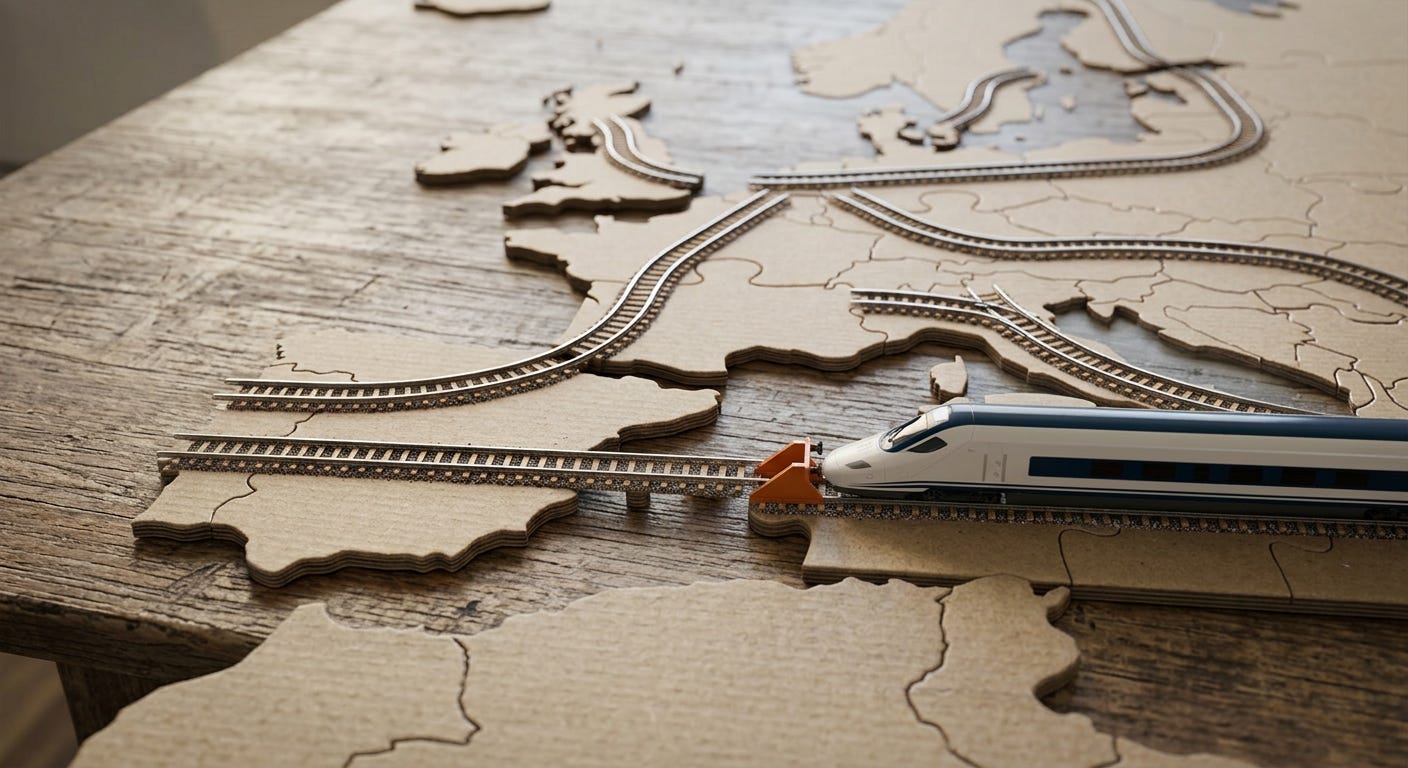
Spain and Portugal run most of their railways on track 233 mm wider than the European standard – a choice made in 1844 that still decides which trains can cross the Pyrenees and what Spain pays to connect its own network.
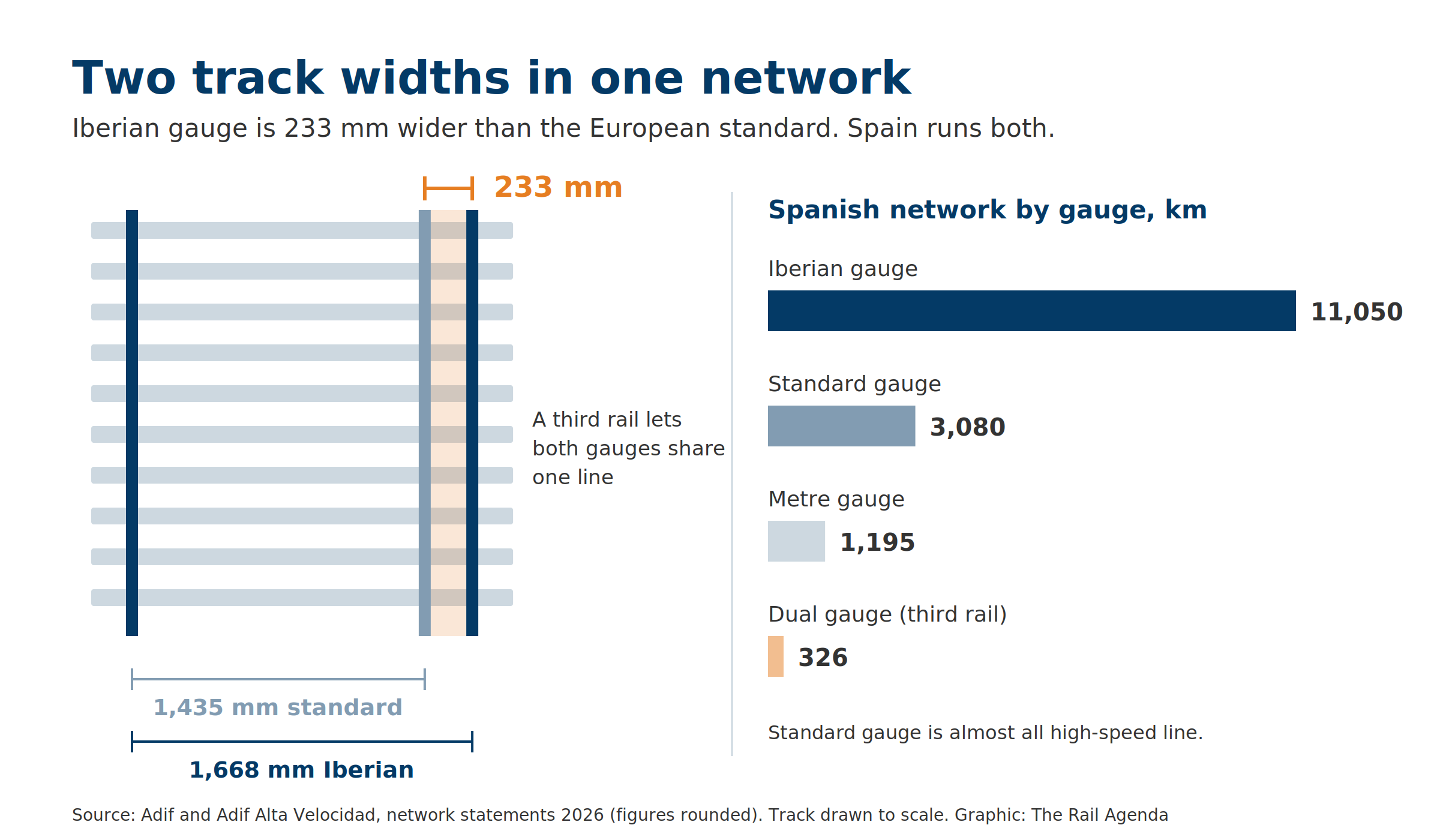
Spain’s two infrastructure managers list roughly 11,050 km of Iberian-gauge track, with the rails 1,668 mm apart. The standard gauge of 1,435 mm, used across most of the EU, covers about 3,080 km, and another 326 km carry a third rail for both, according to the 2026 network statements of Adif and Adif Alta Velocidad.
Almost all of the standard-gauge track is high-speed line. Regional and commuter trains and most freight run on the wider track, and Portugal’s network is Iberian gauge almost throughout. Metre-gauge lines in the north of Spain add a third system.
A choice made in 1844
In 1844, a commission of Spanish engineers led by Juan Subercase recommended a gauge of six Castilian feet, about 1,672 mm. Their argument was technical: a wider track left room for larger boilers and more powerful locomotives on Spain’s gradients. The more familiar explanation, that Spain wanted to stop a French army using its railways, is often repeated and supported by little evidence.
Portugal’s first line, opened in 1856, was built to standard gauge and converted to a Spanish-compatible broad gauge within a few years. Portugal settled on five Portuguese feet, about 1,664 mm.
In 1955, the two countries split the 8 mm difference and fixed a common Iberian gauge of 1,668 mm. Their networks had been compatible long before that, and both were separated from the rest of Europe at every crossing into France.
Two networks in one country
From 1992, Spain built its new high-speed lines to standard gauge, starting with Madrid–Seville. That created a second national network beside the first. Trains that continue from a high-speed line to a city on the conventional network have to change gauge on the way, through installations Adif operates where the two networks meet.
The technology that makes this possible was developed for the French border. In June 1969, Talgo’s variable-gauge trainsets entered service between Barcelona and Geneva, shifting their wheels to the new track width while rolling slowly through a fixed installation, and passengers stayed seated. Variable gauge is still Talgo’s signature technology.
The split still shapes what the national operator buys. In July 2026, Renfe agreed to pay Talgo EUR 132m to convert 15 fixed-gauge Avril high-speed sets to variable gauge. The work runs over 37 months and will let the sets leave the standard-gauge lines they were built for.
What it costs freight
A wagon loaded in Spain cannot run onto the French network without changing its bogies or having its cargo transferred at the border. The older crossings at Irun–Hendaye and Portbou–Cerbère were built around that transfer, with yards on both sides of the frontier.
The 44 km Figueres–Perpignan line, opened to freight in December 2010, is the only standard-gauge rail link between Spain and France. It carries high-speed passenger trains as well as freight and connects to the Spanish high-speed network towards Barcelona and Madrid. At its opening, the Spanish government said the route would cut border transit time by six hours.
Adif Alta Velocidad is now extending standard gauge south along the Mediterranean coast. In February 2026, it tendered the supply of rail fastenings to install standard gauge on the section between Castellón, Vinaròs, Vandellós and La Boella.
What EU law now requires
The trans-European transport network (TEN-T) is the EU’s set of priority transport routes, and its regulation changes the default. New lines on its core network, due by 2030, and its extended core network, due by 2040, must provide for 1,435 mm. Member states with a different gauge must plan the migration of existing lines on the European transport corridors.
A Commission implementing decision of 30 October 2025 applies the rule to Lisbon–Madrid. It sets a direct service of about five hours by the end of 2030 and about three hours by the end of 2034. Portugal and Spain must draw up coordinated national plans by the end of 2027 for standard gauge on the high-speed line between the two capitals.
Portugal is still ordering for the wider track. In May 2026, national operator CP launched a tender for 12 high-speed trains for the planned Lisbon–Porto line. The trains must run on Iberian gauge, matching the 1,668 mm planned for Portugal’s future high-speed network.
Why the gap stays
Converting a line means changing the track and, at the same moment, every train, wagon, siding and workshop that uses it. On a network where passenger and freight services share most lines, that requires long closures and a replacement fleet ready on the day. A third rail avoids both, at the cost of more complex switches and two fleets in service on the same line.
The EU’s other isolated networks run on 1,524 mm in Finland, 1,520 mm in Estonia, Latvia and Lithuania, and 1,600 mm in Ireland, which has no rail link to the continent. The Baltic states chose to build Rail Baltica as a new standard-gauge line instead of converting the old one, and its main line has been delayed to 2034.
Spain has chosen a mix: standard gauge for new high-speed lines, third rails and conversions on freight corridors, and variable-gauge trains for the journeys between them. The 1844 decision has not been reversed. The break between the gauges now runs through Spanish stations as well as the Pyrenees.
Sources:
Adif – Declaración sobre la Red 2026
Regulation (EU) 2024/1679 on the trans-European transport network, 13 June 2024
Adif Alta Velocidad – tender 78239-2026, standard gauge Castellón–Vinaròs–Vandellós–La Boella