

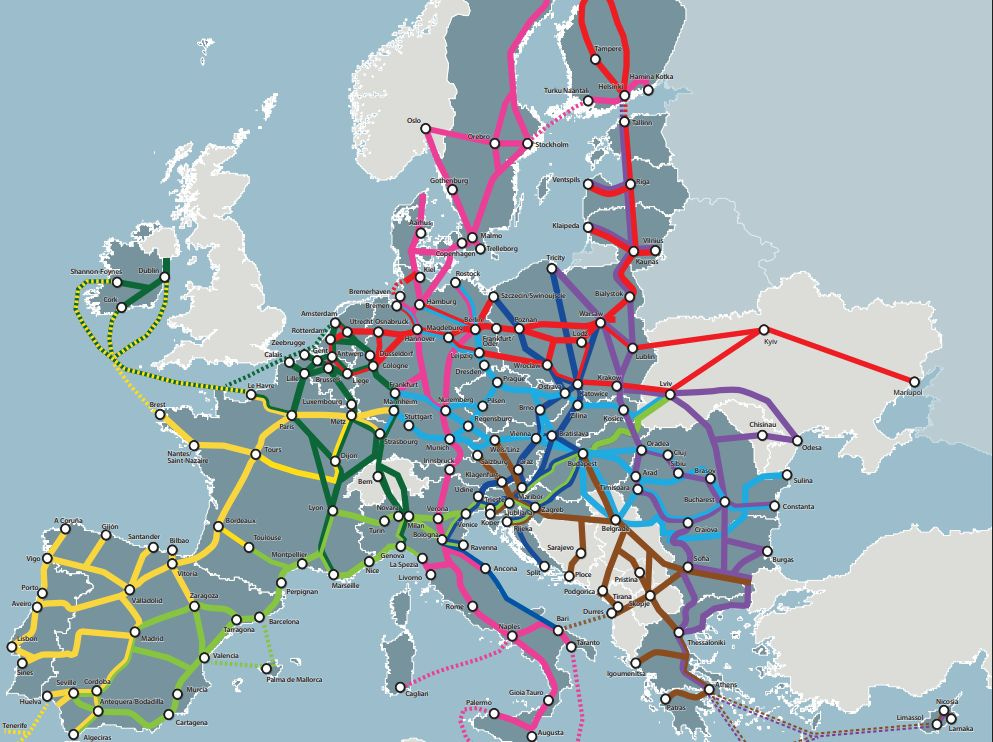
The trans-European transport network (TEN-T) is the EU’s plan for the railways, roads, waterways, ports and airports that connect its member states. The European Commission has estimated that completing its core layer alone will cost about EUR 500bn over the decade to 2030.
The EU’s own transport fund, the Connecting Europe Facility (CEF), has EUR 25.8bn for transport in 2021–2027. Member states build, own and pay for most of the infrastructure, and EU money covers a fraction of the need.
The network is defined in the TEN-T Regulation, Regulation (EU) 2024/1679, which entered into force on 18 July 2024 and replaced the 2013 rules. It sets deadlines and technical standards. The corridors, coordinators and funding rules around it exist to get those standards built.
Three layers, three deadlines
The regulation divides the network into three layers, each with a fixed completion date:
Core network, by 31 December 2030 – the most important connections between major cities and transport nodes.
Extended core network, by 31 December 2040 – a layer added in 2024 to bring large cross-border projects forward from the 2050 horizon.
Comprehensive network, by 31 December 2050 – the wider network that connects every region of the EU to the core.
The three layers are nested. The core and extended core networks are part of the comprehensive network and carry its strategically most important nodes and connections.
The deadlines are legal obligations on member states, which remain responsible for planning, financing and building the infrastructure on their territory.
What the network requires of rail
For railways, the regulation sets technical standards that apply layer by layer. The main ones are:
Signalling – the European Rail Traffic Management System (ERTMS) on the entire network, with national systems phased out. At the end of 2024, its train control component covered 10,600 km of the core network, 17% of it, against a legal target of 62,960 km by 2030.
Passenger speed – lines on the core and extended core networks must allow passenger trains to run at 160 km/h or faster by 2040.
Freight – lines must take trains of 740 metres, with axle loads of 22.5 tonnes and a line speed of 100 km/h for freight.
Electrification – the core network is to be fully electrified by 2030.
Airports – airports handling more than 12 million passengers a year must be connected by long-distance rail.
Most of these requirements build on the 2013 regulation. The 2024 text added the extended core layer, the 2040 speed standard and firmer obligations on phasing out national signalling. How the signalling requirement works in practice is covered in how ERTMS works.
The standards matter for cross-border traffic. A freight train built to 740 metres can only run at that length if every section on its route accepts it. The same applies to signalling and electrification, which is why European trains struggle to run across borders where national networks still differ.
Corridors and coordinators
Nine European Transport Corridors organise the core and extended core networks along Europe’s main traffic flows: Atlantic, Baltic Sea–Adriatic Sea, Mediterranean, North Sea–Baltic, Baltic Sea–Black Sea–Aegean Sea, Western Balkans–Eastern Mediterranean, North Sea–Rhine–Mediterranean, Rhine–Danube and Scandinavian–Mediterranean.
Two horizontal priorities sit alongside them, one for ERTMS and one for maritime links. The Commission appoints a European Coordinator for each corridor and priority, 11 in total.
The coordinators are tasked by the Commission to work with member states on completing TEN-T investments by the applicable deadlines. They lead the dialogue between governments, regions, infrastructure managers and other stakeholders along each corridor, and draw up work plans that set out what remains to be done.
The 2024 regulation also merged the former Rail Freight Corridors into the European Transport Corridors, mainly to coordinate infrastructure investment planning for freight and passenger traffic in one structure.
The corridors extend beyond the EU. After Russia’s invasion of Ukraine, the Commission proposed in July 2022 to extend four corridors to Ukraine and Moldova and to remove Russia and Belarus from the TEN-T maps.
The 2024 regulation carried this through and downgraded the remaining cross-border links with Russia and Belarus to the comprehensive network, moving their deadline from 2030 to 2050. The six Western Balkan partners are also integrated into the corridor structure, mainly through the Western Balkans–Eastern Mediterranean corridor.
Funding and permits
CEF grants are awarded through competitive calls managed by the European Climate, Infrastructure and Environment Executive Agency (CINEA). Of the EUR 25.8bn for 2021–2027, EUR 11.3bn is earmarked for countries eligible for the Cohesion Fund. Priority goes to missing links and cross-border projects.
More than half of the 2021–2027 budget was awarded in the calls of 2021–2023. In the previous period, 2014–2020, CEF awarded EUR 23.2bn in transport grants, of which EUR 11.3bn was transferred from the Cohesion Fund.
Transport infrastructure is increasingly planned for military as well as civilian use. EUR 1.69bn from the current budget has co-funded 95 dual-use projects. The EU has also identified four priority military mobility corridors, covering rail, road, inland waterways, sea and air, with around 500 bottleneck projects along them.
For 2028–2034, the Commission proposed in July 2025 a CEF budget of EUR 81.4bn, including EUR 33.9bn for transport and EUR 17.6bn for military mobility. The budget is still under negotiation.
Permits are a separate bottleneck. The Commission has acknowledged that complex procedures have delayed TEN-T projects, especially across borders. The Streamlining Directive (EU) 2021/1187 limits permit procedures to four years for pre-identified cross-border sections and missing links on the core network corridors, and for corridor projects above EUR 300m. Member states must designate one authority for each such project.
The Commission’s EUR 500bn estimate for the core network dates from 2018, when it put the cost of the comprehensive network and other transport investment at about EUR 1,500bn. Both figures predate the 2024 regulation, which added the extended core layer and new technical requirements. The first deadline, for the core network, falls on 31 December 2030.
Cross-border rail in Europe: how it works

Running a train across a European border requires four separate processes to align — infrastructure access, vehicle authorisation, crew certification and traffic management — each governed by different bodies on different timelines.