

Four major European operators have independently chosen the same Spanish long-distance train — and together they have created a default no one declared.
By Dan Jensen
DB, DSB, FlixTrain and Swedish infrastructure authority Trafikverket have all contracted Spanish manufacturer Talgo for its 230 platform — a lightweight, locomotive-hauled intercity train built around a single-axle running gear system first patented in 1941.
The platform is already in service — between Copenhagen and Hamburg with DSB, and on domestic German routes with DB. Routes from Berlin to Amsterdam and Stockholm to Narvik are in preparation — putting Talgo at the centre of Europe's emerging long-distance intercity network, on conventional infrastructure, at 200–230 km/h. No one chose it as a default. It became one.
From Basque workshop to European backbone
In 1940, a Basque engineer named Alejandro Goicoechea began working on a problem that had frustrated railway designers for a century: how to build a train that was light enough to be cheap, low enough to be accessible, and flexible enough to cross borders without stopping.
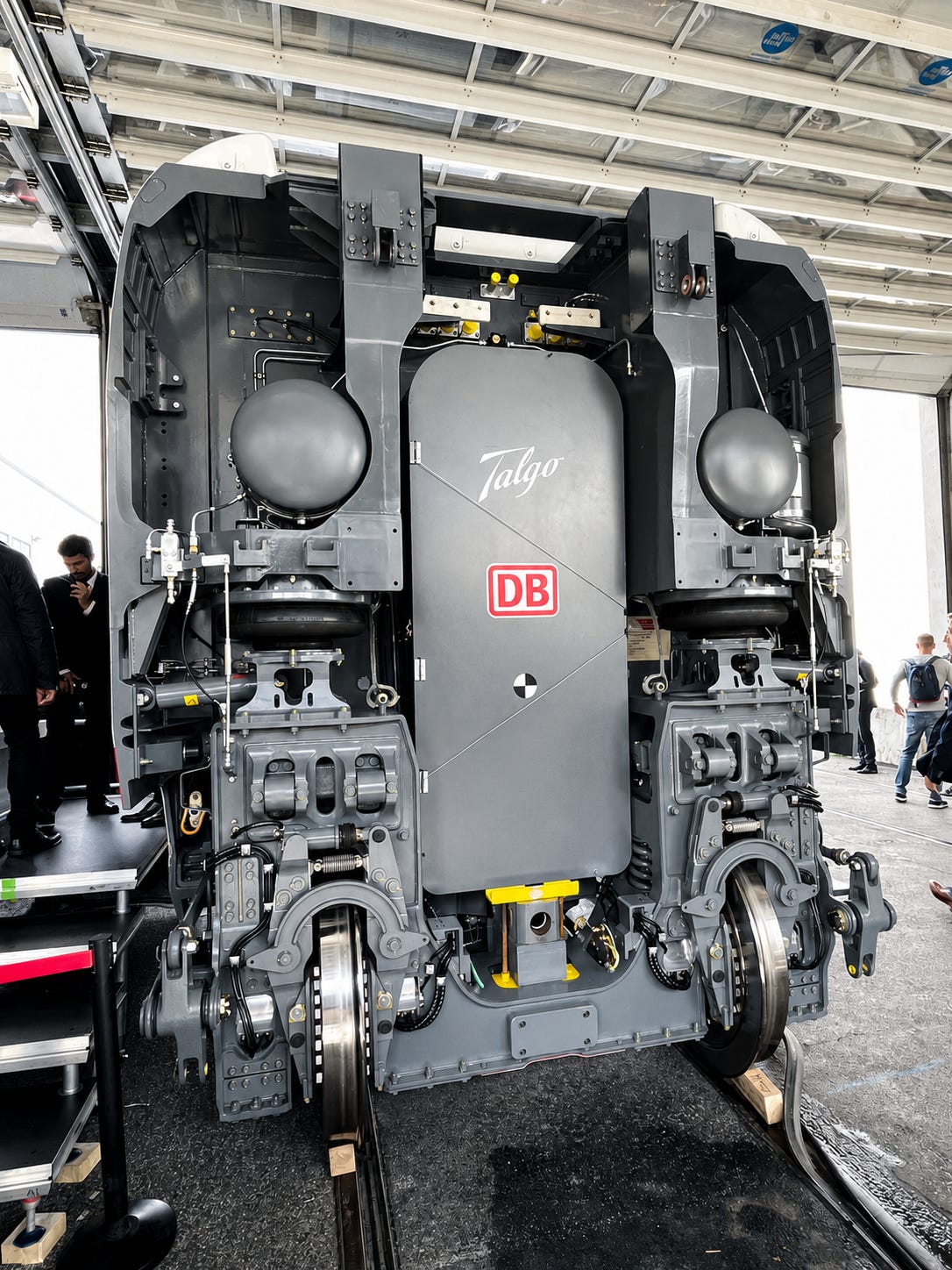
His solution was radical. Instead of placing a four-wheel bogie under each carriage, he put a single shared axle between two carriages. The carriages became shorter, lighter and lower. The train could be pulled by whatever locomotive was available at the border. Passengers stayed seated.
Goicoechea patented the design in 1941. Talgo — Tren Articulado Ligero Goicoechea Oriol — was named after him. Eighty-four years later, the principle is unchanged.
Why four operators reached the same conclusion
DB signed its framework contract in 2019. DSB followed in 2020. FlixTrain contracted up to 65 sets in 2025. Trafikverket signed in April 2026 for 20 Talgo 230 sets — nine day trains and eleven night trains — plus ten Siemens Vectron locomotives, at roughly EUR 756m.
The explanation is straightforward. Europe’s long-distance intercity segment — routes of four to fifteen hours on conventional infrastructure, crossing two or more borders, at 200–230 km/h — had no good solution.
High-speed sets require dedicated infrastructure and multi-country type approval processes that can take years. Conventional rolling stock lacks the cross-border flexibility. Talgo 230 solved both problems at a price none of its competitors matched.
DB’s ICE L contract covered up to 100 sets at roughly EUR 24m per set. That is cheap for international long-distance material. The cross-border logic was equally clear: swap the locomotive at the border, passengers stay seated, the carriages require fewer separate approvals than an integrated trainset — but each area of use still requires its own authorisation.
VHS won on the same terms. Not because it was the best format. Because it was good enough, available and cheaper than the alternative.
What the tender documents did not say
Three friction points have emerged since the contracts were signed.
DSB put its first EC sets into service on Copenhagen–Hamburg with no reserve fleet. The monthly reliability figures reported to the Danish transport ministry have varied sharply — from under 2,000 km between technical failures in January 2026 to over 4,600 km in February.
The range reflects an operator running new and complex material at full stretch from day one, with no buffer fleet available.
DB’s position has shifted. The original framework covered up to 100 ICE L sets. The active order stood at 79. DB is now negotiating a reduction to 60 — a cut of roughly 25 percent.
Production delays and certification obstacles have pushed delivery timelines. The Berlin–Amsterdam route, flagged as a core ICE L corridor, continues to operate with ICE 3neo because the Talgo platform has not yet cleared Dutch infrastructure approval.
In Spain, Talgo’s Avril high-speed fleet — a different platform, but the same manufacturer and the same engineering philosophy — was withdrawn from the Madrid–Barcelona corridor in July 2025 after cracks were found in bogie frames. Separately, 479 technical failures had been recorded across the Avril fleet between May and August 2023.
Talgo booked a EUR 116m provision linked to Renfe’s penalties for delayed Avril deliveries, reporting a net loss of approximately EUR 108m for the year. Spanish and Basque regional authorities have subsequently become involved in the company’s ownership structure.
Avril is not Talgo 230. The platforms are distinct. But they share a producer, a philosophy and a supply chain.
One patent, one factory, one question
VHS did not stay a single-company format. Once it won the market, manufacturers from Sony to Panasonic to JVC produced VHS machines. The standard became open in practice. Competition drove prices down and quality up.
Talgo 230 is not that kind of standard. It is a patent. The carriages are built at Talgo’s facilities in Spain. No other manufacturer produces or maintains them. The system is proven and — for now — winning. It is also entirely dependent on one company remaining capable of building and supporting it.
That dependency has already attracted attention. In 2024, a consortium called Ganz-MagVag Europe — Magyar Vagon holding 55 percent, Hungarian state fund Corvinus the remainder, with documented links to Russian manufacturer Transmashholding — made a takeover bid for Talgo.
The Spanish government blocked it on national security grounds. The argument was that Talgo is critical infrastructure for Spanish railways.
That argument is now considerably stronger — and considerably more European. The EU has spent years and significant political capital ensuring that Europe does not become dependent on Chinese rolling stock through instruments like the Foreign Subsidies Regulation. The irony is precise: while protecting against one form of single-supplier dependency, Europe has quietly built another.
Talgo’s order book has never been larger. Its financial position has rarely been more fragile. Those two facts coexist because orders have outpaced Talgo’s production capacity and financial resilience.
Who owns the standard?
The question is not whether Talgo 230 is a good train. It is. The question is what happens to Europe’s long-distance intercity network if the company that builds and maintains it runs into serious trouble — or if ownership changes in ways that make European governments uncomfortable.
The Spanish state has already signalled it considers Talgo strategically significant. Whether that signal extends to the European level — and whether European institutions are thinking about this at all — is not yet clear.
VHS did not win in the cinema. It won in the living room. Talgo does not win on the high-speed corridors — it wins everywhere else. And everywhere else is most of Europe’s rail network.
Related:
Direct Oslo–Copenhagen–Berlin service to launch in 2028

CROSS-BORDER: Norwegian operator Vy, Denmark’s DSB and Deutsche Bahn have announced a direct rail service linking Oslo, Copenhagen, Hamburg and Berlin from summer 2028. The service will be one …
Sweden’s night train has a fleet but no operator

COMMENTARY: Trafikverket has signed a EUR 485m contract for new night train rolling stock — and has no operator lined up to run it.
Spanish Talgo wins Swedish night train rolling stock order

SWEDEN: Trafikverket has selected Talgo to supply new night train rolling stock for northern Sweden in a EUR 485m contract, with delivery from 2030.
Sources:
Primary sources — Talgo
Trafikverket contract, 20 April 2026
ERA/EBA authorisation Talgo 230 (ICE L)
Talgo full-year results 2024 — net loss EUR 107.9m, provision EUR 116m
Avril — bogie cracks and withdrawal
Trenvista — first report, 25 July 2025
RollingStockWorld — confirmation and 479 failures figure
Ganz-MagVag / takeover bid
Euronews — Spanish veto, August 2024
Linklaters — legal analysis of the veto
DB order reduction
Ingeniøren — “DSB struggling with new carriages: now Germany drops large order”
DSB operational reliability
Background — not cited in article
Reuters via MarketScreener — Talgo net loss confirmation