

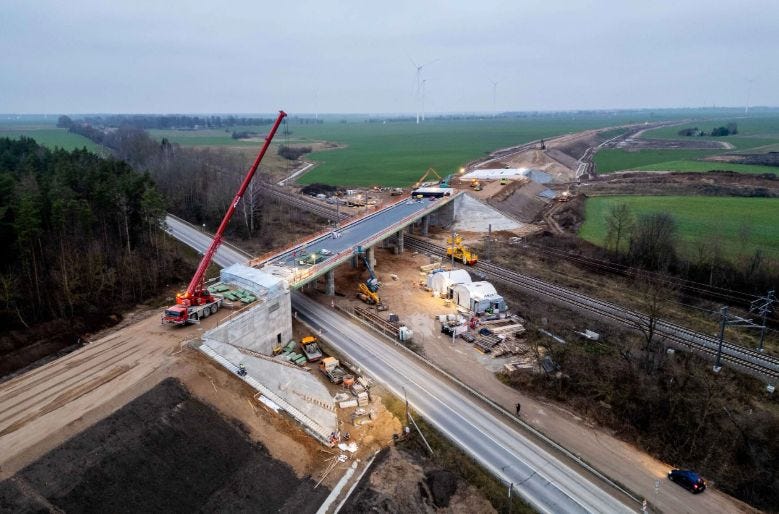
CROSS-BORDER: Estonia, Latvia and Lithuania have agreed that the Rail Baltica main line will miss its 2030 deadline and now aim for 2034, according to Latvia’s prime minister. They will push for at least EUR 10bn in EU funding.
In a joint declaration published on 22 September, the three governments commit to having the line operational within the EU’s next long-term budget, which runs from 2028 to 2034.
The same day, Latvian Prime Minister Andris Kulbergs told journalists that the 2030 deadline was not realistic and that all three countries had agreed on 2034 for the first phase, Latvian public broadcaster LSM reported. He said it was the first time the three countries had officially acknowledged this.
The deadline is set in Commission Implementing Decision (EU) 2025/1332, which gives the first phase until 31 December 2030. The declaration names no completion year and keeps the ambition to build as close as possible to that schedule. No formal amendment is being made, Matīss Paegle, chair of the supervisory board of joint venture RB Rail, told the broadcaster.
What the three governments ask for
The EUR 10bn is the position the three governments will take into negotiations on the budget, the Multiannual Financial Framework (MFF), with the European Commission and the other member states. No allocation has been made. The declaration sets out three funding demands:
A dedicated allocation of at least EUR 10bn for Rail Baltica in the three countries, in particular through dedicated funding under the Connecting Europe Facility (CEF).
Bridge financing to keep construction going without interruption from 2026 until the next MFF begins.
An EU co-financing rate of up to 85% for the project, maintained through the next MFF.
The governments say the arrangement would let them keep up the pace of construction and control costs. The declaration grounds the request in security and military mobility, and in the pressure defence spending puts on the budgets of the EU’s eastern flank.
Cost and responsibility
The declaration states that the cost of the first phase of the main line must be cut substantially. The countries will review technical solutions to cut costs without changing the agreed core operational requirements. The Rail Baltica Design guidelines remain the common parameters, with deviations allowed in justified cases as long as interoperability along the corridor is kept.
The three countries will also try to align construction, material and workforce capacity to limit inflation and overheating of the market. They will set construction schedules, investment priorities and national commitments in coordination with the Commission and Poland.
Each country remains responsible for its own implementation and financing commitments. According to the declaration, this creates no additional obligations or liabilities for the other participating states.
Construction status and national decisions
RB Rail, cited by the broadcaster, put construction at more than 100 km in Estonia and 114 km in Lithuania, with only preparatory work on a 30 km section in Latvia. Latvia’s government ordered cuts to the technical requirements and cost of its section in August.
The implementing decision sets the same first-phase deadline for Poland. Infrastructure manager PKP PLK signed the contract for the Białystok–Ełk section of the route there in September.