

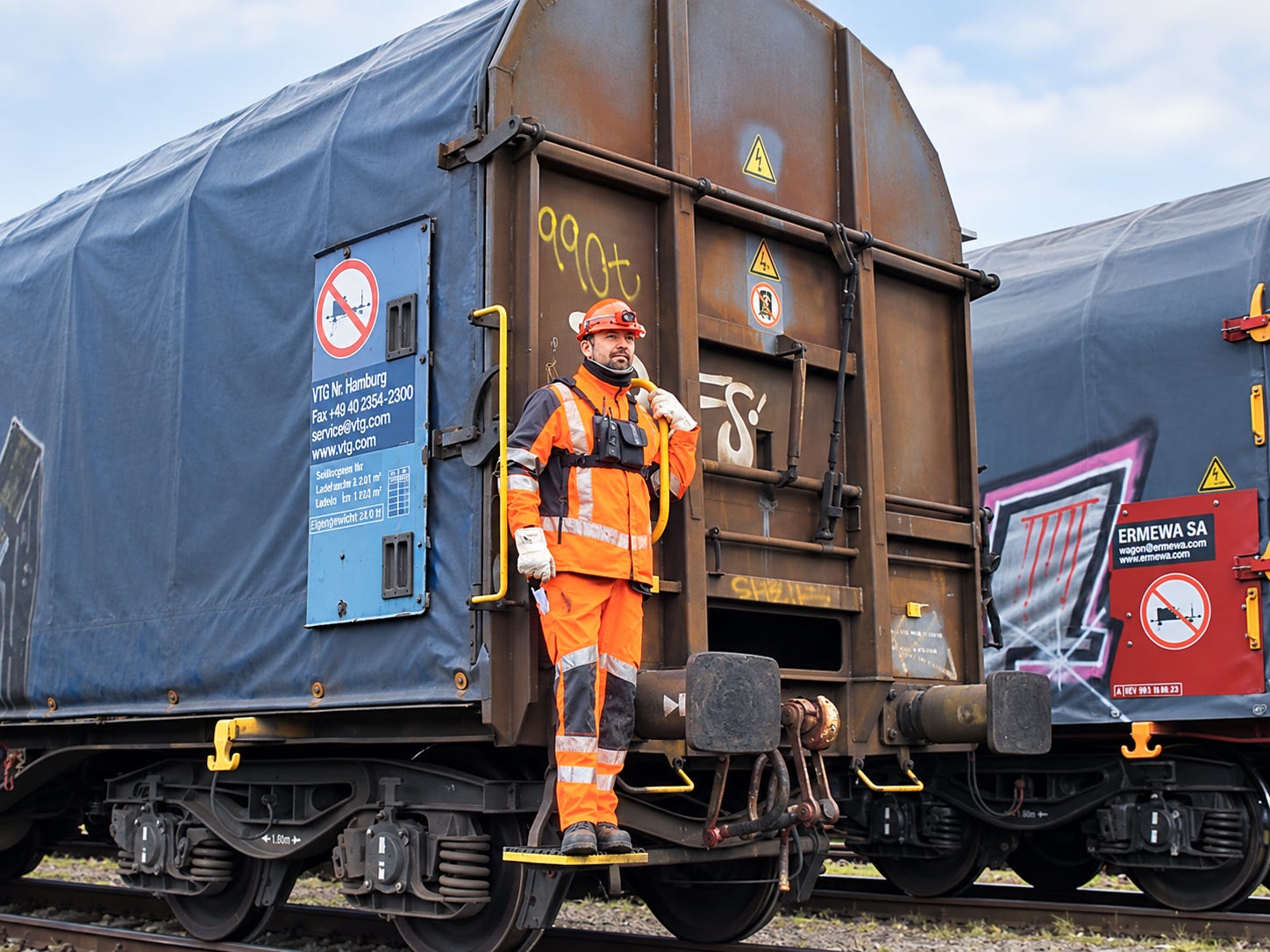
InnoTrans opens in Berlin on 22 September with more than 3,100 exhibitors and 180 world premieres – eight days after Eurostat reported that rail freight in the EU fell for a fourth consecutive year.
Rail carried 368.2 billion tonne-kilometres of freight in the EU in 2025, 1.8% less than the year before. Road haulage grew the same year.
The European Commission’s mobility strategy of December 2020 promised 50% more rail freight by 2030 and twice as much by 2050. Since then rail freight has risen once and fallen four times. The EU’s own auditors called the target unrealistic in 2023.
The vision
The vision is simple. A train moves a tonne of freight with a fraction of the emissions of a truck, and every freight train takes trucks off congested roads. The EU has tried since 2011 to turn that advantage into market share.
The European Court of Auditors examined the targets in a special report in 2023. It found them built on assumptions rather than on simulations of how much freight could realistically move. One calculation assumed trains twice as long as the network allows. Another assumed that a large annual investment gap would close, without saying how.
The targets bind no member state. They were not agreed with the member states and were never broken down by country or corridor. Nobody owns them.
Does rail freight still matter
Truck makers now argue that the premise has expired. The European vehicle manufacturers’ association ACEA published a study on 15 April this year, commissioned from Transport & Mobility Leuven and Panteia. It concludes that battery and hydrogen trucks will narrow or close the environmental gap with rail on many routes, and ACEA wants a mode-neutral freight policy in place of modal shift.
The French and German councils of economic advisers made a related point in a joint statement in 2025. Most freight in Europe travels short distances, where rail cannot compete, and the realistic potential for moving road freight to rail is small.
Both points hold as far as they go. Rail does not compete for the short haul and never did. Its market is the long, heavy, regular flow: steel, chemicals, containers from the ports, trailers across the Alps.
“The climate argument for rail weakens as trucks electrify, though at the pace the fleet is renewed that will take until the 2040s.”
The counter-argument is pace. Fewer than one in twenty new trucks registered in the EU in the first half of 2026 was electric, by ACEA’s own count, and a truck stays on the road for well over a decade. The EU’s CO2 limits for trucks apply to new sales, not to the fleet. Diesel will dominate European roads through the 2030s.
The second argument is physics. A steel wheel on a steel rail needs far less energy than a tyre on asphalt, whatever powers it, as the International Energy Agency has pointed out. An electric truck removes the exhaust pipe. It does not remove the truck from the motorway or its demand from the grid.
The climate argument for rail weakens as trucks electrify, though at the pace the fleet is renewed that will take until the 2040s. What remains is energy, road space and the long, heavy flows that trucks handle badly. That is a case for making rail work on its main corridors.
Why road wins
Road wins on price, flexibility and reliability.
The Court of Auditors’ report starts with price. Without subsidy, moving a container by rail and truck costs roughly half as much again as moving it by truck alone. The truck goes door to door. The train needs a terminal at each end, and a truck anyway for the first and last leg.
The rules widen the gap. A train pays for every kilometre of track it uses, while member states may leave road sections untolled. Several allow heavier trucks in domestic traffic, which cancels the weight advantage meant for combined transport.
The network widens it further. Passenger trains come first when paths are allocated. Maintenance is done at night, when freight runs. A freight train thrown off its path by a disruption waits for the next free one, sometimes for days.
Then comes the border. A driver needs the language of every country the train crosses, and national rules on brake tests and train composition differ. A freight train can stand at a border for a day. A truck inside Schengen does not stop.
“Road’s advantage is made by rules as much as by the market.”
Long trains are what make rail cheap, and only about half of the core corridors can take them.
None of this is new. The auditors’ previous report on rail freight, in 2016, carried the title “still not on the right track”.
The weeks before the fair in Berlin brought examples. Deutsche Bahn chief executive Evelyn Palla said on 10 September that the company will run two, at most three, corridor renovations a year instead of four.
The European Investment Bank signed a loan on 14 September for a Romanian corridor line that is little more than half built after six years. Serbia and Romania plan back-to-back closures on the two lines that carry rail freight between Central Europe and Turkey.
Road’s advantage is made by rules as much as by the market. Track pricing, path priority and border procedures are political decisions, and each of them currently favours the truck. That is a case for changing the rules before adding the trains.
The operators
The economics of the previous section land in the operators’ accounts. A freight operator carries high fixed costs for locomotives, wagons, drivers and yards, and sells against a truck that carries none of rail’s handicaps. When volumes fall, the costs stay.
For decades the state-owned incumbents had their losses covered by their parent groups. EU state aid rules have ended that. DB Cargo has stood on its own finances since 1 January 2025 and must show the Commission lasting profitability by the end of 2026, a condition of its state aid. It is cutting nearly half its German workforce.
“That is a case for deciding which rail freight services Europe wants, and paying for them openly.”
The pattern repeats. PKP Cargo is in court-supervised restructuring. ÖBB’s freight arm has reported a loss, the Belgian state has taken over Lineas, and SBB Cargo is closing freight points.
What goes first is single-wagon traffic, the service that collects individual wagons from factory sidings and costs structurally more to run than a truck. Every siding that closes sends its freight to the road.
The operators’ losses are the cost of the rules, carried by the companies. Told to break even, they shrink to the traffic that pays, and the capacity to carry 50% more goes with it. That is a case for deciding which rail freight services Europe wants, and paying for them openly.
What would change it
The remedies are known, and most are already on paper:
Capacity: freight needs paths that are planned across borders and years ahead. The regulation on the use of railway infrastructure capacity, adopted in May, requires that from the timetable of December 2030.
Train length: the core network must take 740-metre freight trains by the end of 2030.
Combined transport: the EU rules date from 1992. Two revisions have been withdrawn, and the Commission has signalled that it will withdraw the third.
Language: a revision of the train drivers directive was announced in 2022. No proposal had been tabled by June this year.
Price: either road pays for distance as rail does, or rail pays less. Sweden has chosen the second and cuts freight track charges from 2028.
Coupling: digital automatic coupling automates shunting and allows longer trains. Germany has opened funding for the first trains in commercial service.
Road rules are moving too. The revision of the directive on truck weights and dimensions is in trilogue.
On show in Berlin
The fair shows what the industry can build. Messe Berlin counts 180 world premieres, most of them in railway technology.
Transport Commissioner Apostolos Tzitzikostas opens it. When Czech MEP Ondřej Krutílek asked him in writing this summer why rail freight is losing ground, his answer for single-wagon traffic was the coupler, the news site Eunews reported.
The coupler is progress. It does not change who pays for the track, who gets the path or what happens at the border.
The bind
The EU and its governments ask two things of rail freight. They want operators that stand on their own in a market, and they want them to carry far more freight for the climate. The first demand is enforced, with state aid rules and profitability deadlines. The second is a target nobody owns.
The two work against each other. Operators told to break even cut the services that lose money, and capacity leaves a network that is supposed to grow. Road keeps the advantages the rules give it.
“The EU and its governments ask two things of rail freight.”
Parts of rail freight do not pay their way under those conditions and will not. The transport commissioner said as much about single wagons in his written answer this summer. Neither the Commission nor any government has drawn the conclusion and said which of those services it wants anyway, which it will let go, or who pays.
Nobody exhibiting in Berlin can settle that. Governments and EU legislators can, and their own calendar gives them until 2030. The capacity rules take effect with the timetable of December 2030. The 740-metre requirement falls due the same month. So does the freight target.
Main sources
European Court of Auditors: Special report 08/2023, Intermodal freight transport: EU still far from getting freight off the road (March 2023)
European Court of Auditors: Special report 08/2016, Rail freight transport in the EU: still not on the right track (2016)
Eurostat: EU rail freight transport, 2025 data (14 September 2026)
ACEA: Time to rethink modal shift: zero-emission trucks change the game, with the study by Transport & Mobility Leuven and Panteia (15 April 2026)
ACEA: New commercial vehicle registrations, first half of 2026
French Council of Economic Analysis and German Council of Economic Experts: Decarbonising road freight transport, joint statement (2025)
International Energy Agency: The Future of Rail (2019)