

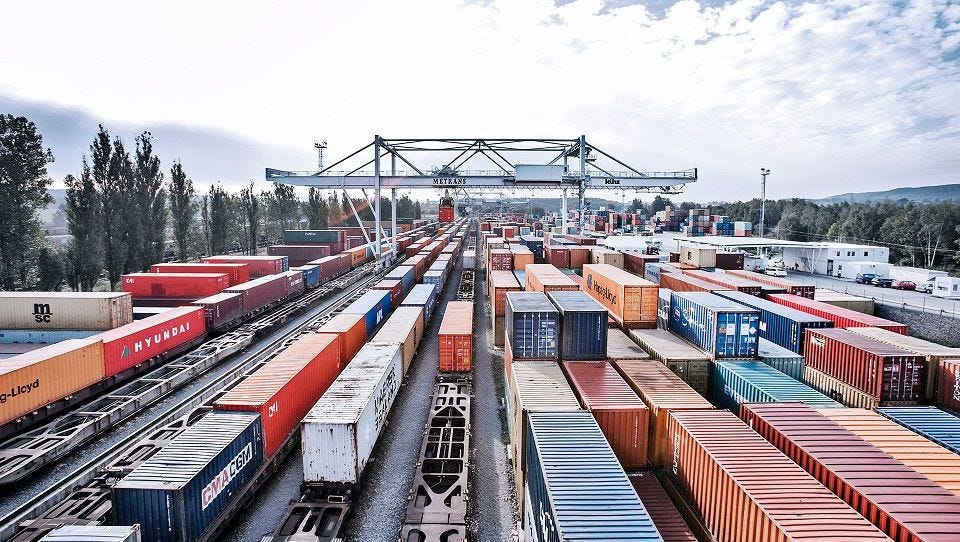
EU: Freight carried by rail across the EU fell 1.8% in 2025 to 368.2 billion tonne-kilometres, the fourth consecutive annual decline, according to Eurostat data published on 14 September. Volumes fell in 16 of the 24 member states with reported data and rose in eight.
Germany accounted for a third of the EU total with 123.5 billion tonne-kilometres, down from around 126 billion in 2024. Poland followed with 54.3 billion, or 14.7% of the total, and France with 34.4 billion, or 9.3%. The three markets together carry 57.5% of the EU’s rail freight.
Road freight grew over the same period. The release of 31 July put road haulage up 0.9% in 2025, and figures published on 29 July showed freight on inland waterways down 3.0%.
Where the volumes fell
The sharpest falls were in Ireland, down 35.2%, Latvia, down 18.8%, and Estonia, down 17.3%. Both Baltic countries had already lost heavily the year before, Latvia by 32.4% and Estonia by 22.9%. The 2024 report attributed those declines to the end of freight traffic with Russia after the invasion of Ukraine.
Greece recorded the largest increase at 9.3%, followed by Portugal at 8.4% and France at 6.6%. The French growth comes on top of a 9.7% rise in 2024, when France added more tonne-kilometres than any other member state.
Measured against population, Luxembourg carried the most rail freight at 10.7 tonnes per inhabitant, ahead of Austria at 10.5 and Lithuania at 8.5. Ireland carried 0.03 tonnes per inhabitant, Greece 0.06 and Spain 0.5.
The 2018 peak and the German works
EU rail freight peaked at 410 billion tonne-kilometres in 2018. After a recovery in 2021, it has fallen every year since. The 2025 volume is roughly 10% below the peak and close to the level of 2020, when pandemic restrictions cut traffic by 8.4%.
The largest market has spent the period under a rolling programme of corridor closures. DB InfraGO’s renewal works have taken key freight routes out of service for months at a time. In a survey published on 8 September by the German operator associations, two thirds of the 36 responding companies said network capacity had fallen, and only one of the 36 reported better operational quality.
The September release does not break the German figure down by cause. The corridor programme is scheduled to run for several more years.
The modal shift target
The European Commission’s 2020 mobility strategy set a target of increasing rail freight traffic by 50% by 2030 and doubling it by 2050. Road’s share of EU freight rose 3.3 percentage points between 2014 and 2024. Rail’s share fell 0.3 points.
The 2025 figures arrive as the EU negotiates the next Connecting Europe Facility budget, the funding instrument for the freight corridors on which the target depends. The Council set out a partial negotiating position on the 2028–2034 instrument in December 2025.
The data cover only main railway undertakings, defined as companies carrying at least 200 million tonne-kilometres or 500,000 tonnes a year. Belgium’s figures are excluded for confidentiality.