
The main rail route between Central Europe and Turkey closes for around 200 days from September 2026, and the main alternative follows with a nine-month interruption from April 2027. The three countries that own the tracks have not agreed on what freight traffic should do in the meantime.
By Frank Andersson
On 28 August, Bulgaria’s transport minister Georgi Peev convened an online meeting with Radu Dinel Miruță, Romania’s deputy prime minister and acting transport minister, and Aleksandra Sofronijević, Serbia’s minister of construction, transport and infrastructure. According to the ministry’s account, the Bulgarian minister told the meeting that preserving the connection is of strategic importance, warned that restricting both routes at the same time will severely affect freight flows between Central Europe, the Balkans and Turkey, and proposed pre-allocated slots for freight trains instead of a full interruption. The three sides agreed to continue at infrastructure manager level.
The warning concerns two national projects, decided separately, on either side of the Bulgarian border.
The Serbian closure
Serbia plans to close Niš–Dimitrovgrad for around 200 days from September 2026. The figure comes from the Bulgarian ministry’s account of the meeting; neither the Serbian ministry nor infrastructure manager Infrastruktura železnice Srbije has published a closure period.
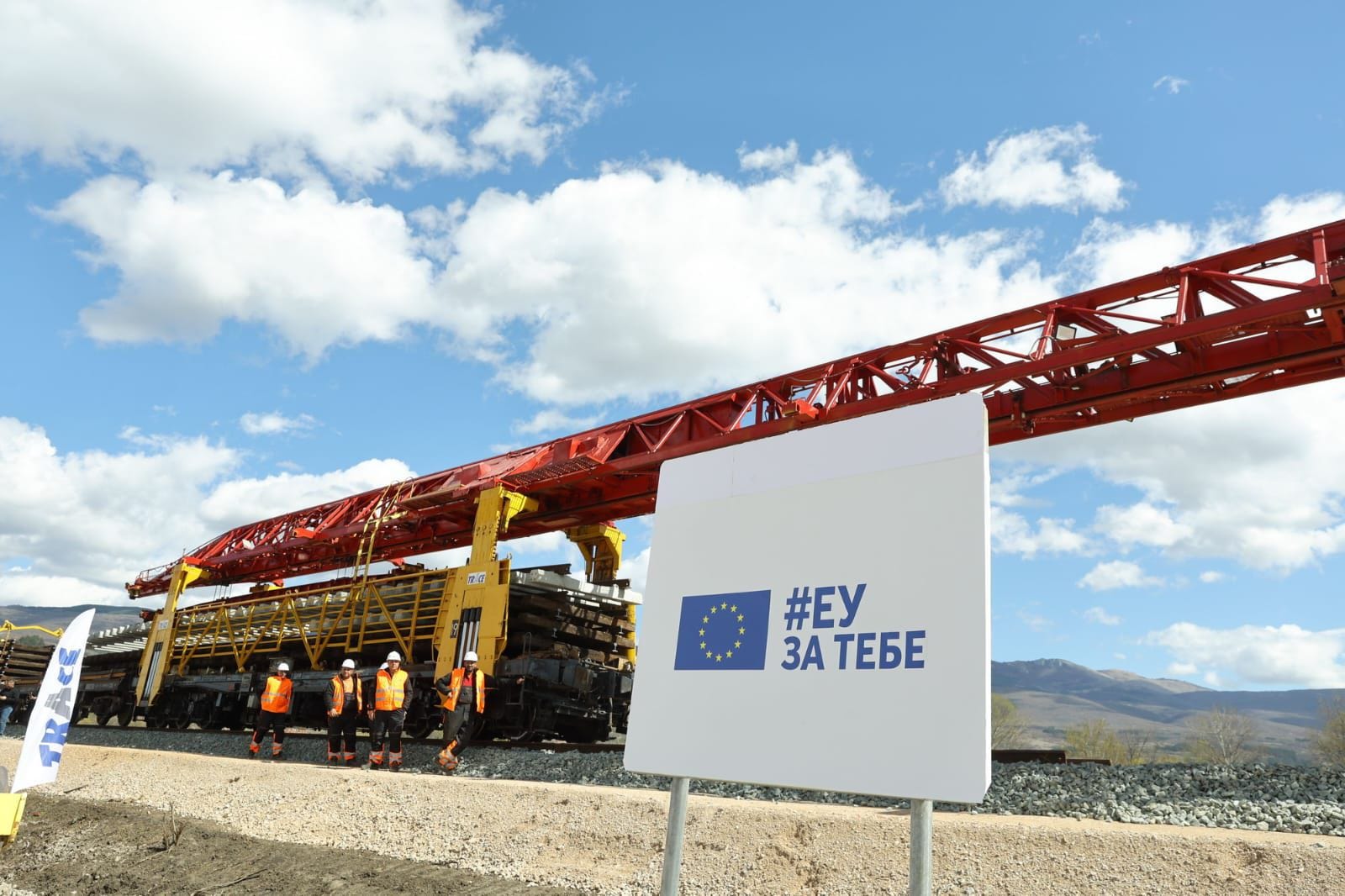
The project behind it is the reconstruction and electrification of the 86-kilometre Sićevo–Dimitrovgrad section, including structures, signalling and telecommunications. The contract, announced by the Bulgarian contractor Trace Group Hold on the Bulgarian stock exchange on 12 October 2022, is valued at approximately EUR 169.7 million. Trace Group Hold leads a consortium with Start Engineering and Consorzio Armatori Ferroviari, with the Serbian infrastructure manager as client.
“Serbia plans to close Niš–Dimitrovgrad for around 200 days from September 2026.”
Construction began on 11 November 2023. The works are divided into Prosek–Staničenje and Staničenje–Dimitrovgrad, the latter in three subsections, and the first phases were carried out under 36-hour possessions.
The wider modernisation of the line also covers a new 22-kilometre single-track electrified bypass around Niš. The programme is financed by a EUR 134 million loan from the European Investment Bank and EUR 108.6 million in EU grants through the Western Balkans Investment Framework. Serbian president Aleksandar Vučić has said the line will be finished by the end of 2027.
The section is the only non-electrified stretch of Corridor X. According to the EU Delegation to Serbia, freight volumes are expected to grow from 3.2 million to around 6.2 million tonnes a year after the rebuild.
The Romanian closure
Infrastructure manager CFR SA has decided to interrupt Giurgiu Nord–Ruse from April to December 2027 as part of Lot 2 of the modernisation between București Nord, Jilava and the border station Giurgiu Nord. Reopening is planned for September 2028.
The contract was signed on 14 August 2025 with the RailWorks consortium of Arcada and Alstom at RON 2.1 billion (approximately EUR 400 million) excluding VAT. Financing combines the Connecting Europe Facility — grant agreement 101122601, signed on 11 October 2023 — and the Romanian state budget.
Design work has been under way since September 2025, and the building permit was issued in March 2026. Traffic on the Jilava–Frătești section has been suspended since 16 March 2026.
Lot 1, the Vidra–Comana section including the rebuilt Grădiștea bridge, was completed in May 2024, and the route reopened in June 2024, nineteen years after the bridge collapsed in 2005. In the years between, freight traffic ran via Videle.
CFR SA has proposed two alternatives to operators: Golenți–Vidin in the west and Negru Vodă–Kardam in the east. The western option depends on the Danube crossing at Vidin–Calafat, which has limited capacity.
The money is being cut
The government that has scheduled a 200-day closure to rebuild the line is at the same time reducing the money for the rebuild. Serbia’s Fiscal Council puts the 2025 plan for Niš–Dimitrovgrad at RSD 13 billion (approximately EUR 111 million). In November 2025, the government moved RSD 2.5 billion (approximately EUR 21 million) out of that allocation to the finance ministry’s budget reserve. RSD 6.3 billion (approximately EUR 54 million) was spent on the line over the year.
“No common schedule for the works exists across the EU external border at Dimitrovgrad.”
The 2026 budget allocated RSD 10.87 billion (approximately EUR 93 million) to the line. On 24 August, the Fiscal Council reported that this year’s budget revision cuts around RSD 21 billion (approximately EUR 179 million) from infrastructure projects, with the largest reductions on Belgrade–Budapest, Niš–Dimitrovgrad and the Fruškogorski corridor. The council has not published a figure for Niš–Dimitrovgrad alone.
On the published dates, the closures follow one another: the roughly 200 Serbian days from September 2026 end close to April 2027, when Giurgiu Nord–Ruse shuts. Two years of underfunding point the Serbian schedule in one direction. If the works slip past April 2027, both routes are closed at once — the outcome the three ministers met to avert.
No shared schedule
None of the three countries has authority over the others’ tracks. The corridor is EU-financed at both ends: an EIB loan and EU grants in Serbia, the Connecting Europe Facility in Romania. No common schedule for the works exists across the EU external border at Dimitrovgrad.
In August, the International Union for Road-Rail Combined Transport (UIRR) warned in a statement on LinkedIn that the timing of the two projects risks closing both the main corridor and its most efficient alternative at the same time. That would break established intermodal services between Turkey and the EU, push volumes back onto the road, and raise transport costs and transit times. The association called on the European Commission and the European Transport Corridor and rail freight corridor coordinators to review the planned works and timelines with the infrastructure managers and national authorities, and asked for a sequence that keeps at least one viable rail corridor open.
That sequencing decision rests with the same infrastructure managers the three ministries have referred the matter to. The slot proposal from the Bulgarian minister is the only measure the ministers themselves put forward, and it requires the same decisions. The next meeting, on concrete operational solutions and the use of existing capacity, will take place at infrastructure manager level.

