

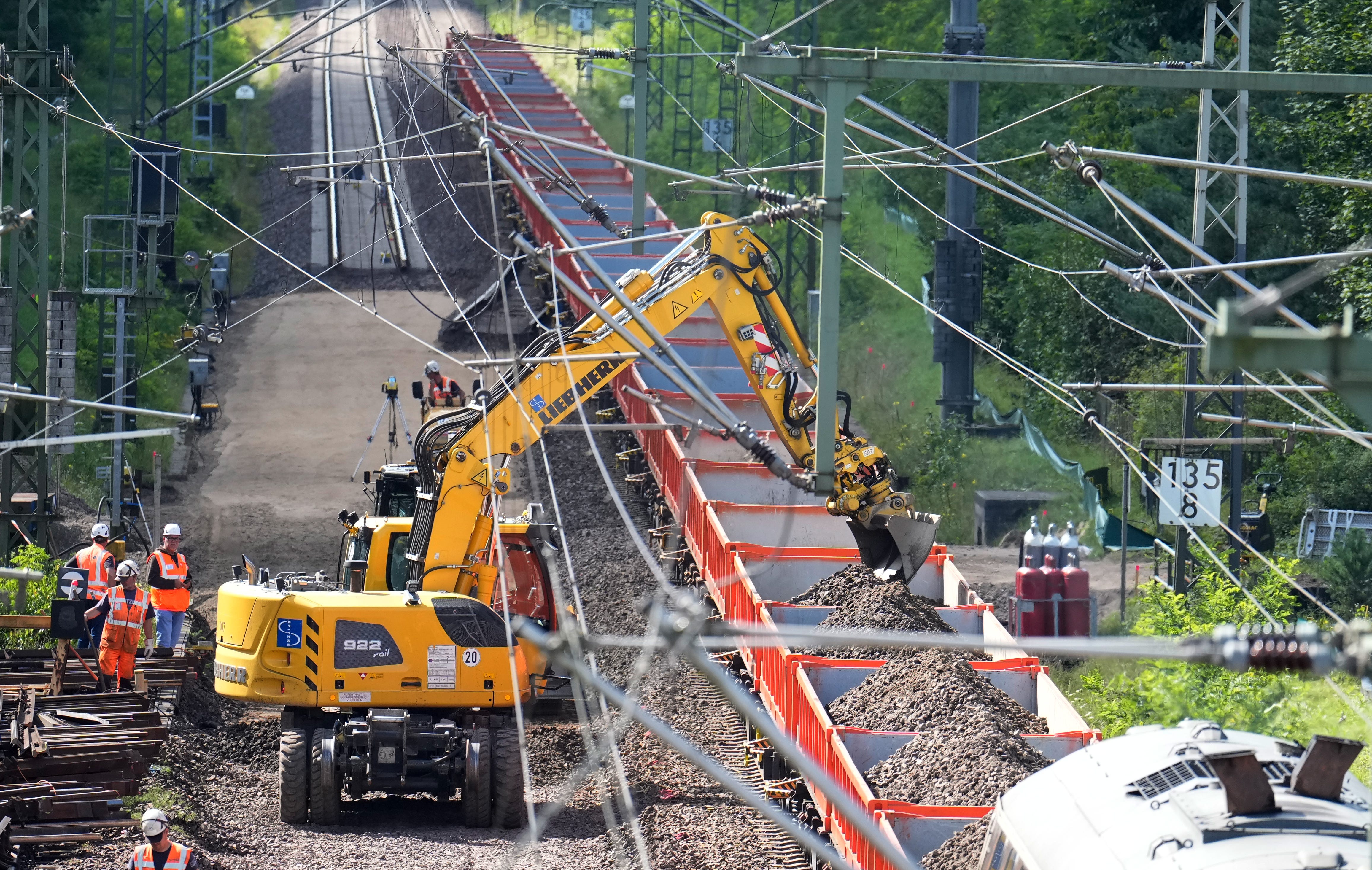
GERMANY: Deutsche Bahn will run two, at most three, corridor renovations a year instead of four, chief executive Evelyn Palla has said. She linked the cut to the federal infrastructure fund and to the capacity four renovations a year take out of the network.
She set out the new pace for the so-called Generalsanierung, the full-closure renovation of one corridor at a time, to journalists in Berlin, in remarks carried in matching form by dpa and the Swiss agency awp. Deutsche Bahn has not published a statement, and the federal transport ministry has not commented. Four renovations a year, she said, are too many.
The revised concept is being agreed with the transport ministry and is to be presented shortly. She gave no year for completing the programme. Under the earlier plan, as the agency reports it, around 40 corridors were listed for renovation, with a finish date first set for the early 2030s and most recently given as 2036.
Geography, sequence and diversion routes
Each renovation closes a heavily used corridor completely for months and renews track, signalling and stations in one pass. The number of corridors treated each year will now follow the total the federal infrastructure fund makes available, she said. She did not state that figure.
She named three further conditions. They are where the renovations sit on the network, how they follow one another in time, and whether the diversion routes are ready for the extra traffic before a closure starts. All three are to be settled in the revised concept.
Consequences for freight and diversion lines
Each closure moves the corridor’s traffic onto parallel lines for its duration. Freight operators carry most of that shift, and their room on the diversion routes depends on how many corridors are shut at once.
Fewer parallel closures reduce the load on the alternative lines, and the sequencing Palla describes decides where that load lands. Regional transport authorities face the same question on the lines they contract.
The statement comes days after the associations mofair, Die Güterbahnen and Pro Bahn rated DB InfraGO’s performance as insufficient. In the survey behind that rating, run by the two operator associations, no freight operator reported improved operating quality since the infrastructure manager was formed, and two thirds said network capacity had fallen. The transport ministry said at the same event that it would review the corridor renovations this year.
Track access charges and the timetable change
The revised plan is due while the Federal Network Agency (Bundesnetzagentur) decides track access charges for 2027, which it has said it will rule on before the timetable change on 13 December. DB InfraGO is contesting the regulator’s earlier ruling on those charges in court. Whether a slower renovation pace alters the charge basis has not been addressed by either side.
Palla’s remarks have not been confirmed in writing by DB, and the ministry has not said whether it has signed off on the revised concept. Which of the roughly 40 corridors will be pushed back, and by how long, is not disclosed.