

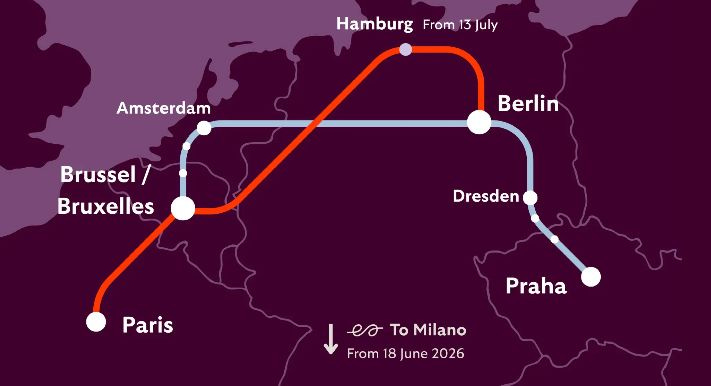
European Sleeper adds Hamburg stop
European Sleeper has added a Hamburg stop to its night-train services, expanding the city’s role as a northern hub in the operator’s cross-border network.
The additional call improves access for passengers travelling between Germany, the Netherlands and Belgium, and adds more interchange options to northern Germany and Scandinavia.
The move is part of European Sleeper’s step-by-step expansion strategy, where new stops are used to widen the catchment area without changing the core route logic. For travellers, the practical effect is simpler boarding and better connections at one of Germany’s key long-distance rail nodes.
Siemens and Newag team up in Poland
Siemens Mobility and Newag have signed a memorandum of understanding to expand their co-operation in the Polish rail market, extending an existing metro partnership into the high-speed segment.
The move positions the two companies for upcoming tenders as Poland prepares large-scale fleet renewal linked to its high-speed rail programme, and reflects a wider pattern of international suppliers pairing with domestic manufacturers to meet local requirements and industrial expectations.
Tampere to test longer trams from Škoda
Tampere will test extended trams from Škoda Group as part of preparations to increase capacity on the city’s light rail network. The longer vehicles will be trialled before any decision on series production.
The tests will focus on compatibility with existing infrastructure and operations, with Tampere exploring modular capacity growth rather than higher service frequency.
SNCF’s first-class rule sparks backlash
SNCF has triggered a public backlash after enforcing a rule that restricts young children from travelling in certain first-class areas on high-speed services.
The policy, intended to preserve a quieter onboard environment, has reignited debate in France over comfort standards, pricing, and who premium rail products are designed for.
Critics argue the rule risks excluding families who pay for first-class tickets, while SNCF maintains that differentiated spaces are necessary to meet diverse passenger expectations. The controversy highlights a wider tension facing European operators: how to segment onboard products without crossing into social or political flashpoints.
Thank you for reading The Rail Agenda’s newsletter. If you found it valuable, consider sharing it with someone who might find it useful.