

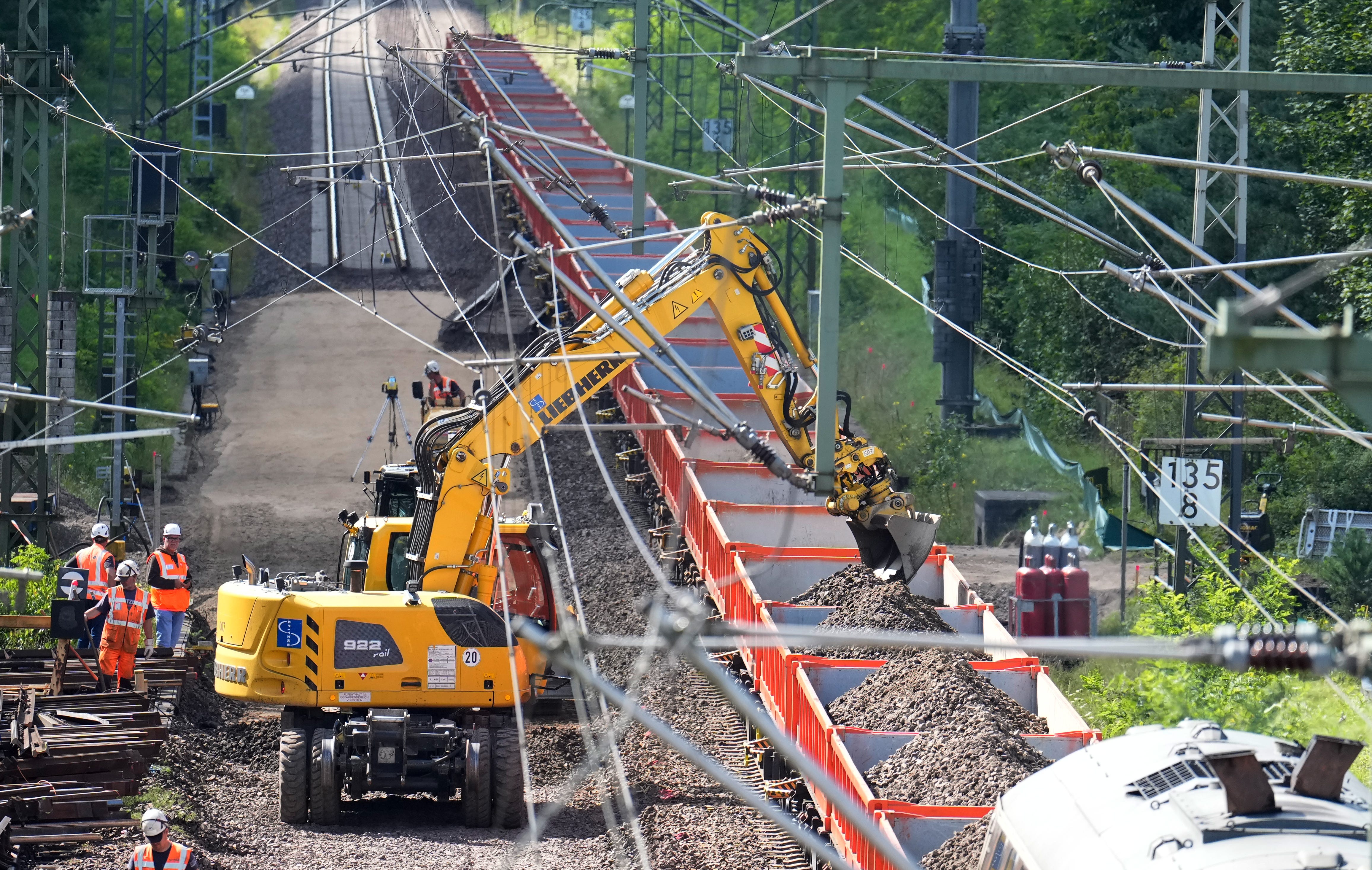
DB’s Generalsanierung review changes little - and answers less
The review Deutsche Bahn chief executive Evelyn Palla ordered of the corridor renovation programme has produced its first key points — and they confirm more than they change.
The revision keeps the programme’s structure: no named project has been removed or rescheduled, and the calendar to 2036 stands for now. The five points cover reprioritising projects, tighter coordination of closures, preparing every corridor for later digitalisation, stepwise returns to service, and clearer commitments on how long lines stay untouched after renovation.
The revised concept itself is still unpublished. Its presentation, expected within weeks, is when operators and freight customers learn whether any closure shifts — or any corridor falls out of the plan.
Four consortia chase the prize in Europe’s biggest rail tender wave
POLAND: Centralny Port Komunikacyjny (CPK) has opened the decisive phase of the competitive dialogue for the rail station and six-kilometre tunnel beneath the Port Polska airport, with the four shortlisted consortia invited to submit bids in the fourth quarter of 2026. CPK plans to sign the contract in the first quarter of 2027.
The four shortlisted groups — eleven companies in total, each with Polish ownership or a Polish base — are bidding for both parts of the contract. The partly underground station hall will reach 1.6 million cubic metres, nearly three times Warszawa Centralna.
Construction is due to start in late 2027, with the station and tunnel opening at the end of 2032 alongside the first Warsaw–Łódź high-speed section.
Night train concept puts Warszawa at the centre of Europe’s map
POLAND: Port Polska has published a preliminary concept for a year-round night train network of 16 relations — four domestic and twelve international — drawn for the high-speed infrastructure the state planner expects to be in place by 2035.
The concept assumes trains formed mainly of sleeper and couchette stock — a departure from Poland’s seated night services — and sets no dates for tenders or launches.
Most relations are expected to run under multi-year public service contracts awarded by competitive tender, with new sleeping-car stock procured within each contract, reflecting doubts that such vehicles can be financed commercially.
Mitsubishi Electric to buy out Polish supplier Medcom
POLAND: Mitsubishi Electric has agreed to buy the remaining shares in Medcom, taking full ownership of the Warsaw-based power electronics manufacturer after a decade as minority shareholder. The transaction is expected to complete by the end of September.
Mitsubishi Electric has held a minority stake since 2016. The buyout runs through its European subsidiary, requires regulatory approval, and carries no disclosed price.
The group plans to use the Warsaw manufacturer as a development and production base for power electronics beyond transport, anchoring a rail business centred on Europe.
Poland’s rail programme accelerates through its own leadership crisis
Poland’s Port Polska programme is putting 87 tenders worth more than PLN 54 billion (around EUR 12.6 billion) into the market this year. On 30 July, the company delivering it dismissed its chief executive in an announcement that gave no reason — and the tender machine did not miss a beat.
By Dan Jensen
CPK launched 29 procedures worth around EUR 3.3 billion between January and the end of July, with 58 more planned before year-end. The 2032 target for opening the airport and the first high-speed section is unchanged.
Board member Marcin Michalski is running the company on an acting basis, with an updated tender plan reported to be due shortly.
Italy authorises first narrow-gauge battery train
INDUSTRY: Stadler’s SRBe 312 battery trainset has been approved for Ferrovie Appulo Lucane by Italy’s rail safety authority, the Agenzia Nazionale per la Sicurezza delle Ferrovie e delle Infrastrutture Stradali e Autostradali (ANSFISA), clearing the first battery-only narrow-gauge rail vehicle authorised in Italy.
The type authorisation, issued on 31 July, covers the operator’s isolated 950 mm network, starting with the 27.4 km Altamura–Matera line. Seven two-car units are on order from 2023 and 2024.
Passenger service awaits fast-charging stations now being built at both ends of the line; no start date has been announced.
That’s The Rail Agenda for today. If you found this newsletter useful and relevant, please forward it to someone you know.