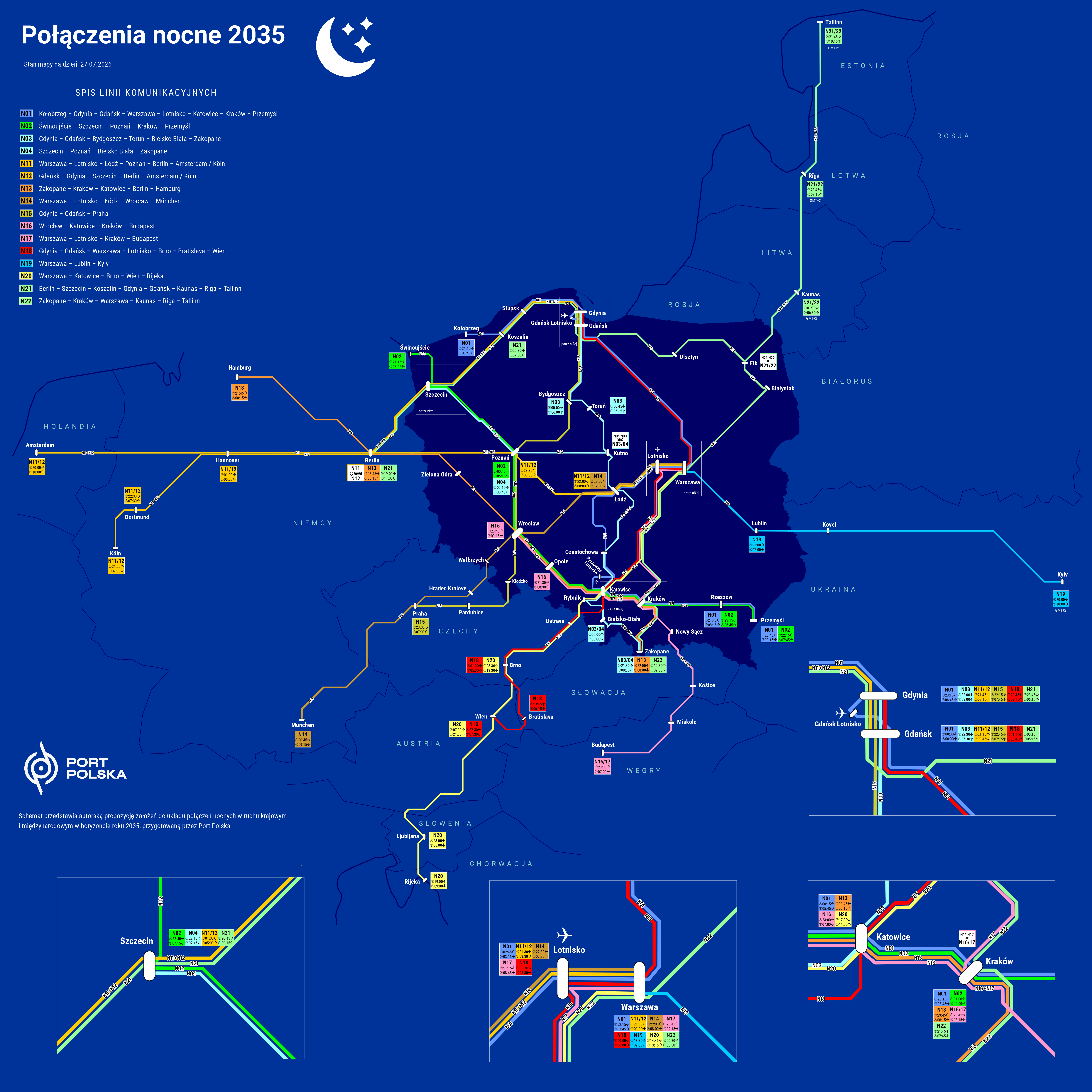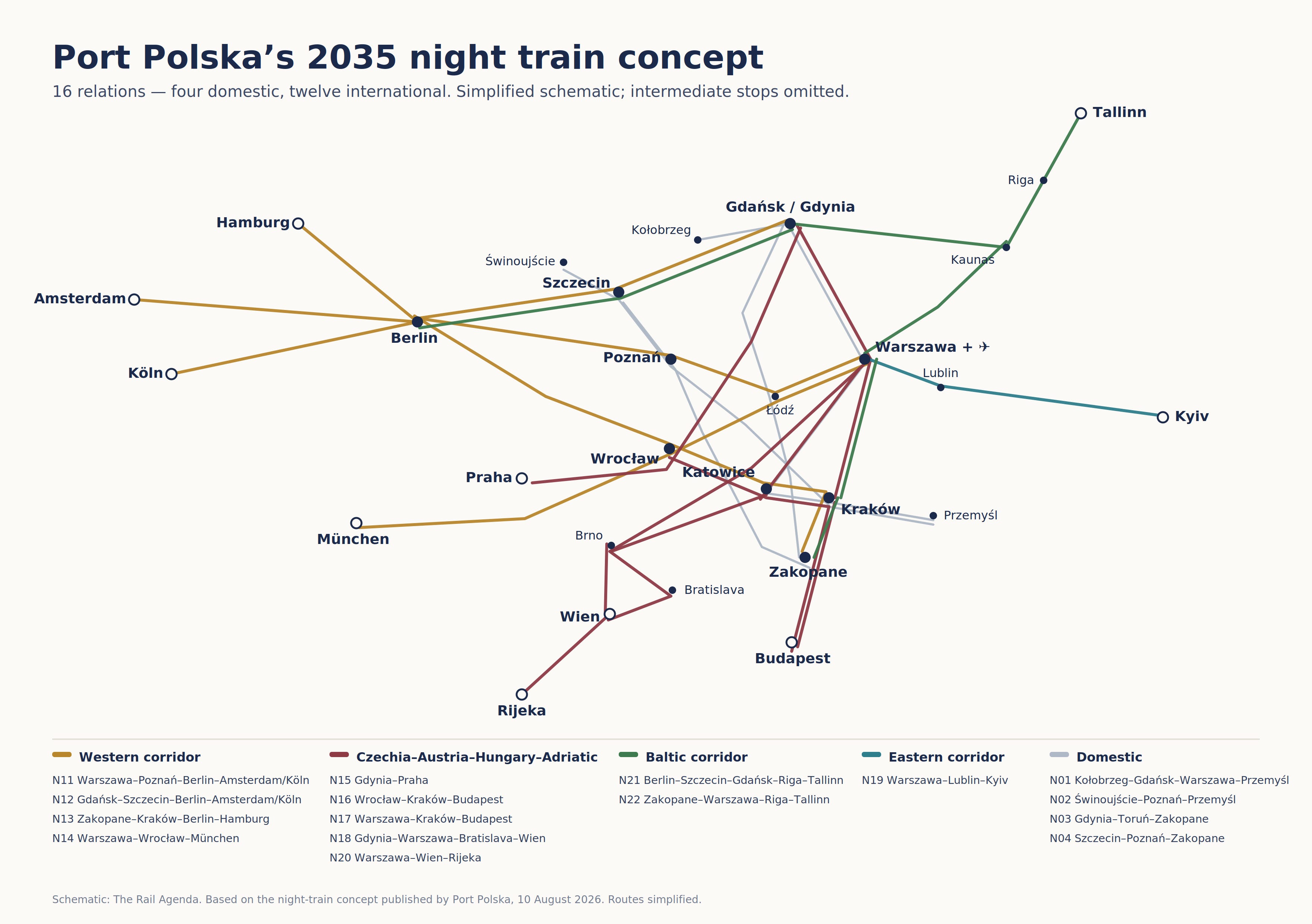
POLAND: Port Polska has published a preliminary concept for a year-round night train network of 16 relations — four domestic and twelve international — drawn for the high-speed infrastructure the state planner expects to be in place by 2035.
The concept, released on 10 August by analysts in Port Polska’s strategy implementation and rail planning office, is framed as an opening contribution to a debate rather than a plan. It is not part of the company’s Horizontal Timetable 2035 report, and it does not represent the position of the Ministry of Infrastructure.
The network assumes infrastructure Poland has yet to complete: the Central Rail Line upgraded for higher speeds and the Y-shaped high-speed line from Warszawa via the new airport and Łódź to Poznań and Wrocław in service. The concept sets no dates for tenders or service starts.
Sleepers first, speed second
The starting assumption is that the night network should operate independently of daytime services, with trains formed predominantly of sleeper and couchette cars. That is a break with Polish practice, where seated cars dominate night services, and it draws on an analysis of night operations in Czechia, Italy and Austria.
For domestic relations, the concept sets a threshold: a night train is justified where the daytime journey — direct or with a connection — exceeds five hours. The optimal night journey is put at seven to eight hours, long enough to spend the whole night on board. Longer routings are treated as acceptable where they produce better departure and arrival times, and airport stations are served in selected relations because demand there peaks at hours the daytime network handles poorly.
Most trains under public service contracts
Port Polska expects the majority of the network to sit in the public service segment. The concept states that under the Fourth Railway Package this means competitive tenders leading to multi-year public service contracts with operators. The reason is rolling stock: new sleeper and couchette cars may not be financeable on commercial terms, so procurement would be settled within the contract — with a longer mobilisation period between signature and service start, reflecting a thin market for night stock.
Commercial operators are moving on a different model: European Sleeper opens Brussels–Milan on 9 September under open access. Sweden shows what the PSC route looks like in practice: Trafikverket awarded SJ a two-year contract in June for Stockholm–Narvik and Stockholm–Umeå, with the new fleet it ordered from Talgo due from 2030.
Drawn for the railway after 2035
Warszawa is where the network converges most densely, with more relations passing through the capital than through any other point on the map. The twelve international relations run west to Amsterdam, Köln, Hamburg and Berlin, south to Praha, Wien, Bratislava, Brno, Budapest and Rijeka, east to Kyiv via Lublin, and north through Kaunas to Riga and Tallinn (full network schematic). The four domestic lines link the Baltic coast — Kołobrzeg, Świnoujście and Gdynia — plus Szczecin further up the Odra, with Przemyśl and Zakopane in the south.
High-speed rail cuts both ways in the analysis. Shorter daytime journeys weaken the case for domestic night trains, while higher speeds extend the reach of international ones — the segment where the concept sees night services as rail’s only competitive answer to aviation. The concept follows the same planning work behind Poland’s 4,700 km rail expansion programme.