

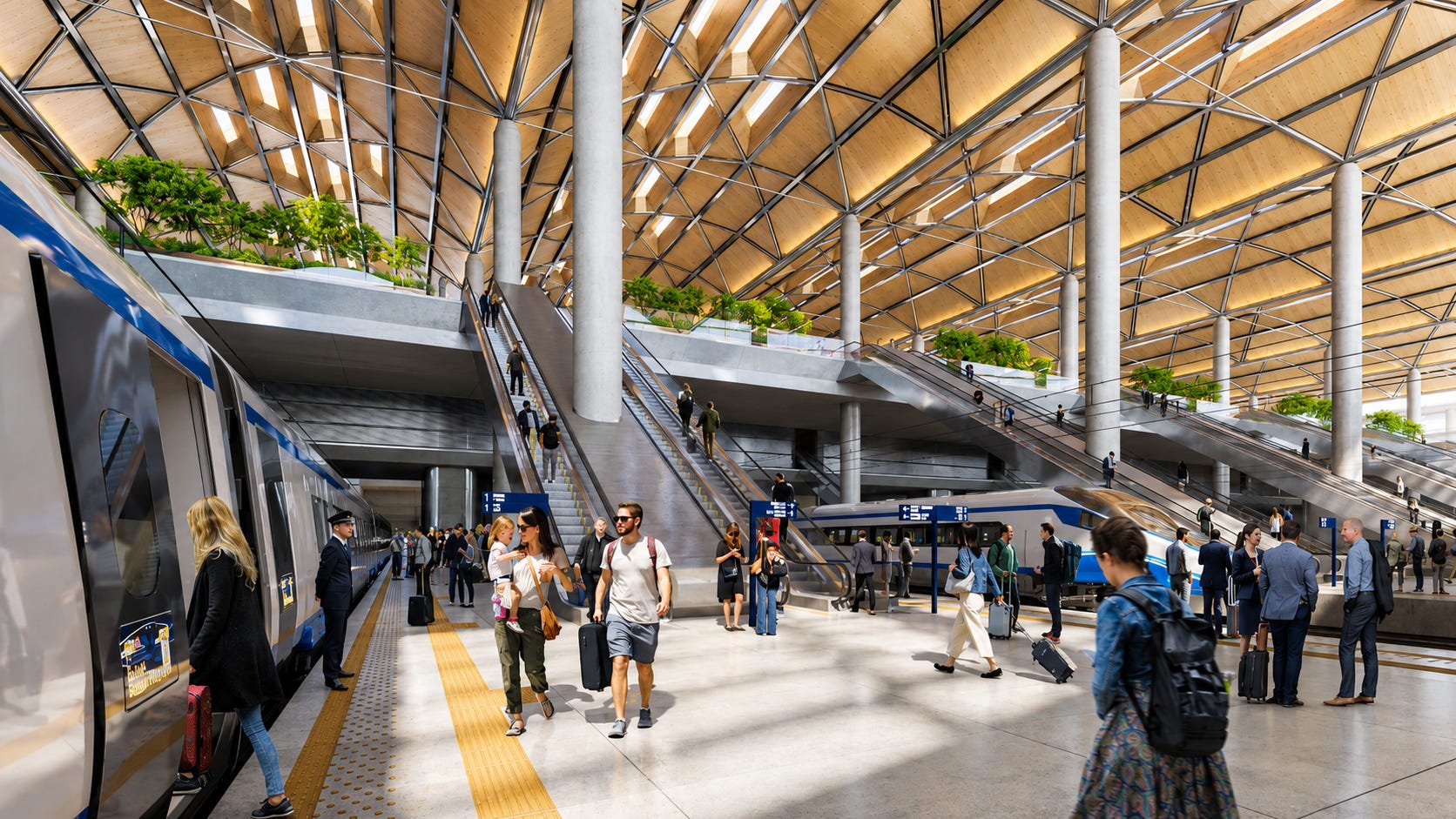
Poland’s Port Polska programme is putting 87 tenders worth more than PLN 54 billion (around EUR 12.6 billion) into the market this year. On 30 July, the company delivering it dismissed its chief executive in an announcement that gave no reason — and the tender machine did not miss a beat.
By Dan Jensen
Centralny Port Komunikacyjny (CPK), the state-owned company behind the programme, launched 29 investment procedures worth over PLN 14 billion (around EUR 3.3 billion) between January and the end of July. It plans 58 more before the end of the year, worth over PLN 40 billion (around EUR 9.3 billion). The total covers both the airport and the rail component — and two of the three largest packages in the plan sit on the rail side.
The programme combines a new hub airport between Warsaw and Łódź with the first lines of a high-speed network that forms part of the 4,700 km expansion plan Poland intends to deliver jointly through CPK and infrastructure manager PKP Polskie Linie Kolejowe (PKP PLK). The company maintains its 2032 target for opening both the airport and the first high-speed section — a target it is now pursuing under an acting chief executive.
What is in the market
The foundations contract for the passenger terminal went to Budimex in June, worth around PLN 146 million (EUR 34 million), with groundworks starting in September. Procedures for baggage handling, security screening, access roads and power supply are signed or in advanced stages. A competitive dialogue is running with four consortia for the tunnel and rail station beneath the airport — one of the largest prizes in this year’s wave.
On the high-speed side, six consortia bid for the first 13 km section between Kotowice and the airport, with award expected in 2027. A second tender on the Warsaw–Łódź line followed in April.
The largest packages planned before year-end each exceed PLN 5 billion (around EUR 1.2 billion): civil works for the first Warsaw–Łódź high-speed section, train control systems, and a framework agreement for airport infrastructure. Procedures worth over PLN 24 billion (around EUR 5.6 billion) follow in 2027.
None of this paused in the last week of July, when the company’s leadership fell apart.
The dismissals of 30 July
CPK’s supervisory board dismissed chief executive Filip Czernicki and board member Dariusz Kuś on 30 July; the announcement followed a day later and gave no reason. The company subsequently told Rzeczpospolita that the change reflects the project entering a new phase, including design and preparatory work on the rail link connecting the airport with Warsaw and Łódź.
On the day the board decided, Polish outlet Money.pl published internal correspondence showing a year-long dispute between CPK and the infrastructure ministry over EU funding for the high-speed programme. In one letter, two board members warned that the funding gap could stall the rail investments by mid-2026. That horizon has since passed, and the procedures have continued to launch through it.
One of the two signatories, Marcin Michalski, is now acting chief executive. The man who put the risk in writing has been handed the machine — and Rzeczpospolita reports that an updated tender plan is due shortly, with the rail component potentially gaining weight under the new leadership.
How the market has responded
The market is behaving as if the crisis were a footnote. The rolling stock segment moved first: Hitachi Rail and Pesa Bydgoszcz teamed up for Poland’s first high-speed fleet tender in June, months after Siemens Mobility and Newag formed their own alliance. The civil works packages now coming to market will test whether European contractors have the capacity to match the schedule.
Pace compared with other new-build programmes
Port Polska’s investment programme to 2032 is put at PLN 131.7 billion (around EUR 30.7 billion), with further high-speed sections towards Wrocław and Poznań lying beyond that horizon. The rail component accounts for over PLN 76.8 billion (around EUR 17.9 billion).
Rail Baltica, the Baltic states’ largest infrastructure project since independence in 1991, is estimated at just under EUR 24 billion in two phases. The first, at EUR 15.3 billion, is targeted for 2030; the second, at EUR 8.5 billion, is neither funded nor scheduled. The difference is pace: CPK’s 2026 tender plan alone, airport and rail combined, is worth around EUR 12.6 billion, and its rail packages are in tender this year.
The comparison applies to new-build programmes. National renewal budgets are a market of their own — PKP PLK plans tenders worth PLN 11.5 billion (around EUR 2.7 billion) on the existing network this year.
Elsewhere in Europe, the pattern runs the other way. Stuttgart 21 has dropped its December 2026 opening date. Sweden’s Ostlänken, the first leg of its planned new main lines and under construction since 2024, carries a plan cost of SEK 91.4 billion in 2021 prices — equivalent to SEK 102.8 billion (around EUR 9.3 billion) in 2025 prices, according to Trafikverket — with opening planned for 2035.
Its two major civil works tenders were abandoned in March 2025, when the agency’s own cost estimate exceeded the budget, and awarded only in early 2026. A further tender, for the Kolmården section, was cancelled in May when only two bidders qualified.
What the contracts lock in
Poland is not debating whether to build. It is opening tenders and signing the first contracts — and every signed contract narrows the room for any future government, or any future board, to change course. That is the quiet logic of the acceleration: the programme is being made harder to stop than its own leadership is to replace.
Three things will show whether it holds: the award of the first high-speed construction package, the content of the updated tender plan, and the name of the next permanent chief executive. The tenders have outlasted the man who launched them. The test is whether they outlast the crisis that removed him.

