


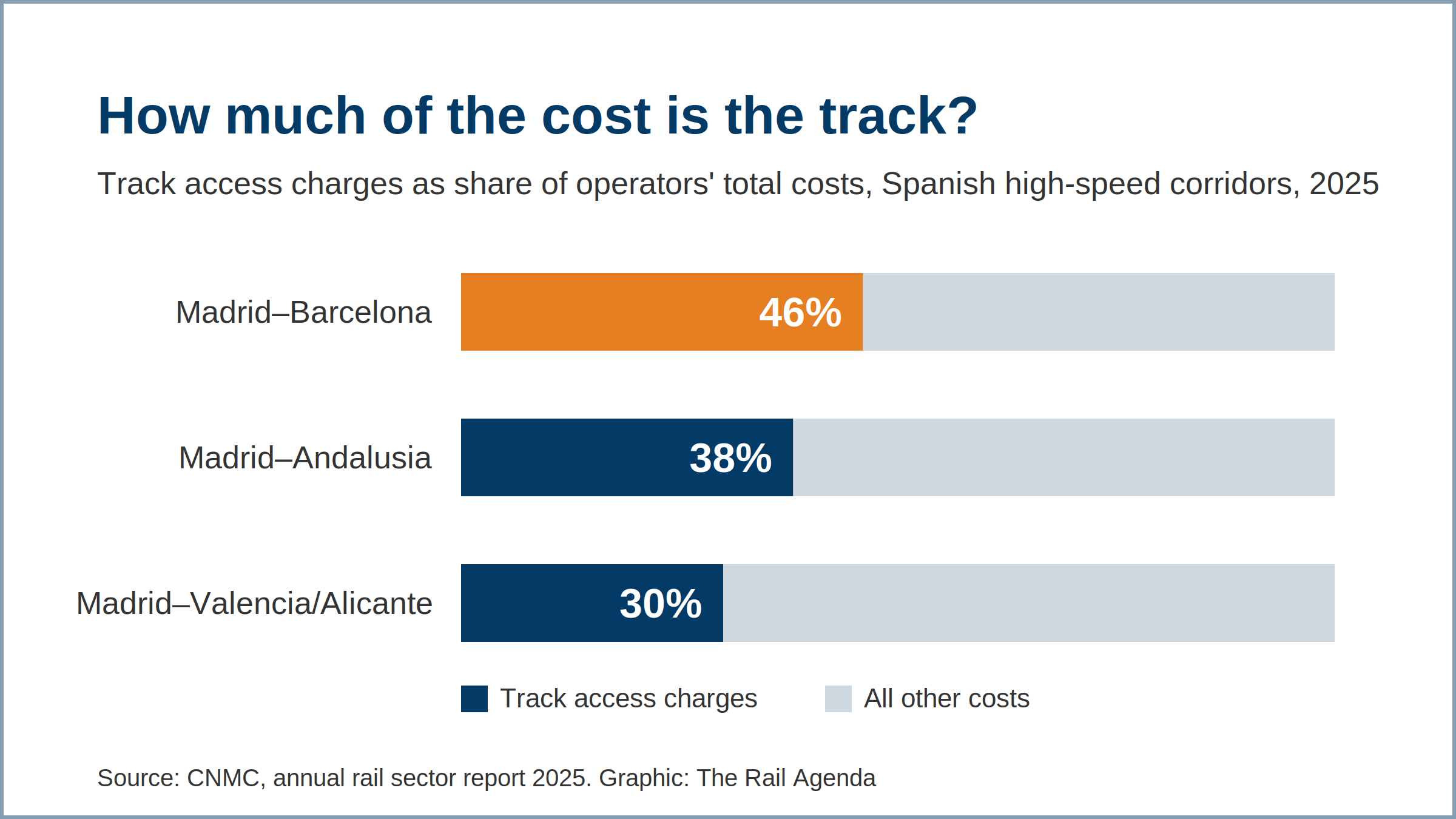
On Madrid–Barcelona, Spain’s busiest high-speed route, the fees operators pay to use the track made up 46% of their total costs in 2025. On busy high-speed routes, a large part of the fare is committed to the network before the first seat is sold.
The figure comes from Spain’s markets and competition regulator, the CNMC, in its annual report on the rail sector. Madrid–Barcelona carried 14.4 million passengers that year, more than any other Spanish corridor. On the corridors to Andalusia the charges made up 38% of costs, and on the eastern corridors to Valencia and Alicante 30%.
The charges go to the infrastructure manager, in Spain Adif, the body that owns and runs the track. Operators pay them for every train they run, whether it leaves full or half empty. Everything else in the fare has to fit around them.
What goes into a ticket
Across Europe, track access charges took almost a quarter of passenger operators’ revenue in 2024, according to the Independent Regulators’ Group – Rail (IRG-Rail), which pools data from national rail regulators. In France, Germany and Spain the share was above 25%. In Austria, the Netherlands, Sweden and six other countries it was below 10%.
Energy is a smaller item. Fuel and electricity took about 8% of operators’ revenue on average, and 5% or less in France and Italy. The rest of the fare pays for the trains, the crews, maintenance, sales and the operator’s margin.
Passengers pay directly for much of this. Fares made up just over 60% of passenger operators’ revenue in 2024, with public compensation for contracted services covering the rest. Commercial high-speed services run without a public service contract, so their costs have to be recovered from ticket sales.
Who sets the charge
EU rules set the floor. Under the Recast Directive (2012/34/EU), the basic charge for running a train is set at the cost directly incurred by operating it. Charges cover only a minority of most infrastructure managers’ costs, the regulators’ report notes, and public subsidies make up the difference.
Article 32 of the directive allows member states to add mark-ups to recover full costs, where the market segment can bear them. Commercial passenger services paid on average 75% more per train-km (each kilometre a train runs) than services run under public service contracts in 2024. The regulators attribute the gap largely to the smaller amount of public money that flows into commercial services’ charges.
The level of charges also depends on how much each government funds its infrastructure manager directly, the regulators note. Some countries pay almost all of their infrastructure manager’s costs and keep charges low. Others split the bill more evenly between taxpayers and operators.
Why France runs fewer, bigger trains
France is the outlier. Commercial services there paid over EUR 21 per train-km in 2024, against EUR 1 or less in the Netherlands, Norway, Bulgaria and Romania. Across all French train services, freight included, the average was EUR 15.92, about three times the European level.
France carries almost twice as many passengers per train-km as the European average, and the regulators link that to the high charges, which have pushed operators towards high-capacity trains running less often. A charge levied per train costs less per passenger as the train fills. Each extra departure costs the full amount again.
Double-deck TGV sets coupled in pairs offer more than 1,000 seats, and Ouigo’s low-cost trains around 1,200, according to ART, the French transport regulator. ART has approved the charges of SNCF Réseau, which runs the network, for 2027–2029 while noting their high level for commercial services, and said no unit charge should in future rise faster than inflation unless the infrastructure manager shows it is sustainable. Entry is costly as well, and a French Senate report put the price of entering the French high-speed market at no less than EUR 1bn.
What competition has done in Spain
Spain let competing operators onto its high-speed lines after EU rules opened domestic commercial passenger services in December 2020. By 2025 Renfe shared the main corridors with Iryo and Ouigo, and fares were around 40% lower in real terms than in 2019, and half on Madrid–Valencia. The number of high-speed passengers doubled to 44.5 million in 2025.
New operators have to bring their own trains before they can sell a ticket. In Andalusia, Ouigo’s arrival as the third operator in January 2025 cut average fares by 12% and lifted passenger numbers by more than 10%.
Only one of the competing Spanish corridors covered its costs in 2025. Ticket revenue on Madrid–Barcelona exceeded costs by 6%, after the average fare rose 15.2% to EUR 52.89. Operators on the other corridors, including those to Valencia, Alicante and Andalusia, ran at a loss.
Why the price keeps moving
Average fares hide a wide range. The Spanish regulator calculates its average as total revenue divided by passengers, so the cheapest and the most expensive seats on the same train end up in one figure. Behind that figure, operators price each seat against demand, and fares typically rise as a train fills and the departure date approaches.
The charge per train is fixed, so the operator’s task is to fill the train at the highest average fare it can. In France, Ouigo’s average revenue per passenger-km rose 5% in 2025, above inflation, while other domestic commercial services held steady, according to the French regulator. Across borders, fares are set by separate operators and sales systems, one reason there is no single European rail ticket.
The fare on a given train is in the end the result of three decisions made elsewhere: how much the state funds the network, how the infrastructure manager sets its charges, and how many operators compete on the route. The operator’s pricing system decides how that total is spread across the seats. Those decisions differ from country to country and change slowly, because network charges are set years ahead and a new operator needs trains before it can compete.
Sources:
CNMC – Informe anual del sector ferroviario 2025 (INF/DTSP/039/26), 17 July 2026
CNMC – Informe trimestral, first quarter 2026, 29 June 2026
IRG-Rail – 14th Annual Market Monitoring Working Document, March 2026
Directive 2012/34/EU establishing a single European railway area (recast) – EUR-Lex
ART – Marché français du transport ferroviaire, premiers chiffres 2025
ART – Péages ferroviaires 2027–2029
Sénat – Rapport d’information n° 633 (2025-2026), 19 May 2026