


Independent booking sites hold an estimated 3% of EU rail ticket sales, according to a European Commission estimate published in May 2026. The main online ticket shops belong to the railways themselves, and a journey across two operators can mean two tickets with no EU right to continue if a connection is missed.
EU law does not oblige a railway to let other platforms sell its tickets, or to sell a competitor’s. The European Commission proposed three regulations on 13 May 2026 to change that. They have been with the European Parliament and the Council since then.
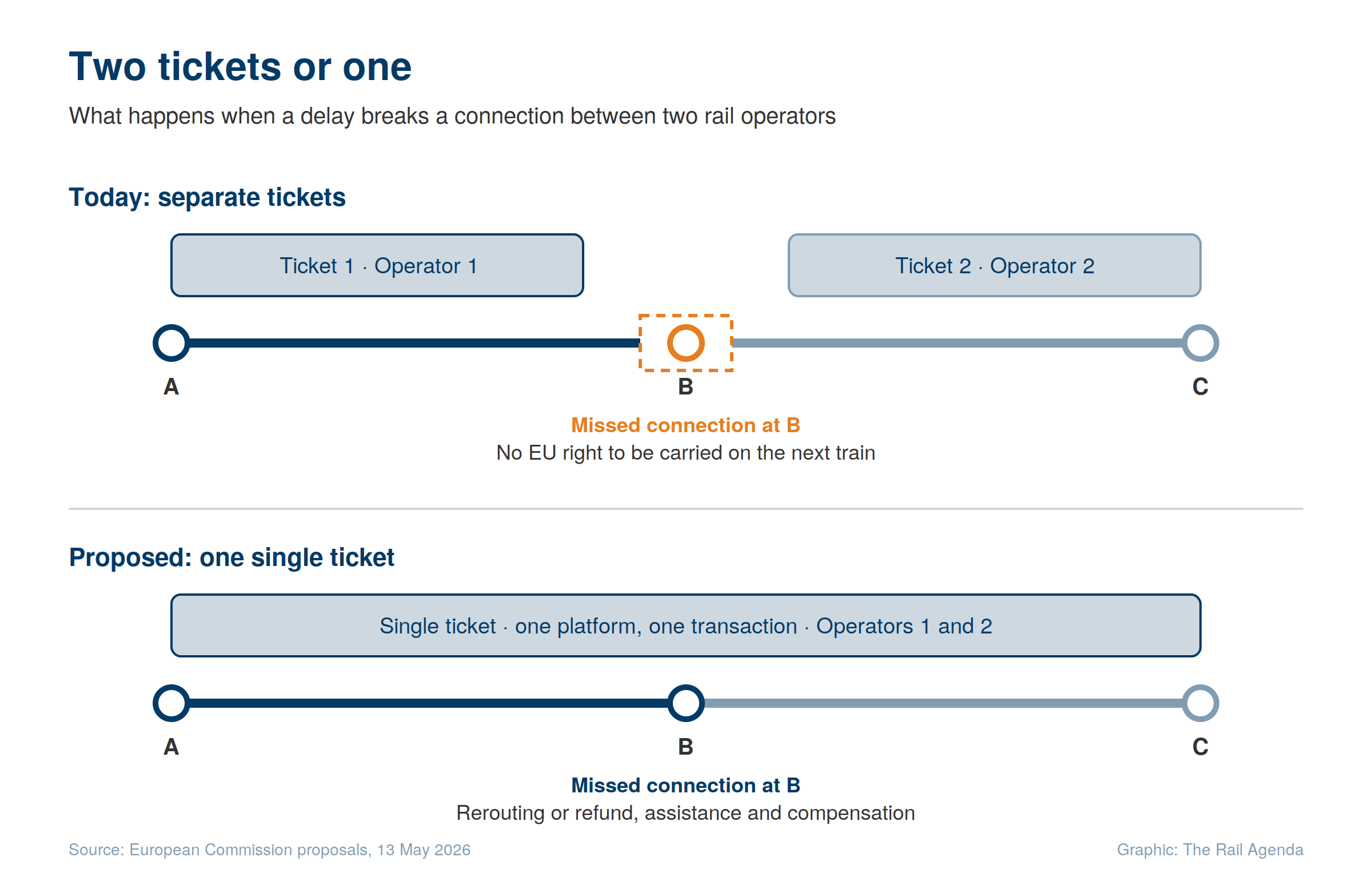
A passenger holding separate tickets who misses the second train because the first ran late has no EU right to be carried on the next one. Ticketing is the commercial side of the problem of running trains across borders. Interoperability rules deal with the technical side.
What counts as a through-ticket
The current rules are set by Regulation (EU) 2021/782 on rail passengers’ rights, which has applied since June 2023. Protection for missed connections covers only through-tickets – journeys sold by a single operator, or by operators that have agreed to cooperate on through-ticketing.
The regulation obliges operators under the same ownership to offer through-tickets. Other operators are only encouraged to do so. According to the Commission, a multi-operator journey bought in one transaction on one website often still does not qualify.
Some railways have filled part of the gap voluntarily. The Agreement on Journey Continuation and Hop On The Next Available Train are cooperation schemes that let passengers who miss a connection continue on a later service. Membership is optional, and coverage varies by operator.
Who sells the tickets
The Commission argues that operator-owned ticket shops have little reason to show a direct competitor’s train, and that operators with their own sales channels have little reason to hand their tickets to independent sellers. The result is an incomplete offer on both sides.
New entrants feel this most. A new railway undertaking running a commercial service at its own risk, without a public contract, often struggles to get its tickets into the dominant domestic app, according to the Commission. Competition cases have already required Deutsche Bahn to give outside platforms access to its real-time data, and Renfe to open its full ticket range and data to outside sellers.
The sector’s own answer is the Open Sales and Distribution Model (OSDM), a common interface for selling fares and reservations across operators, developed by the International Union of Railways (UIC) with ticket vendor associations. Sweden has adopted it as its national distribution standard. The Community of European Railway and Infrastructure Companies (CER) says OSDM lifted international digital ticket sales in Germany by as much as 75% in early 2026 compared with a year earlier.
What the Commission has proposed
The package has three parts. A regulation on multimodal booking sets rules for all ticket platforms and replaces the 2009 code of conduct for reservation systems. A regulation on rail ticketing governs who must sell what, and an amendment to the 2021 passenger rights regulation creates rights for single tickets.
The case rests partly on a 2024 Eurobarometer survey of 26,000 EU citizens. More than a third of those who book multi-operator journeys reported barriers, such as not being able to buy all tickets in one place, and the barriers were greater in rail. The rail ticketing proposal answers with four obligations:
Availability – every railway undertaking must make its tickets available to online platforms that request them. Small and medium-sized operators, heritage and tourist services, and standalone urban or suburban networks are exempt.
Sales window – tickets must go on sale at least five months before the service runs, once it is in the working timetable.
Hosting – ticket platforms owned by operators with 50% or more of their domestic rail market must list all rail services in their country within 12 months of entry into force. On request, they must sell rivals’ tickets or link to the rival’s own shop.
Dispute resolution – distribution agreements must be fair, reasonable and non-discriminatory, including on fees. If no agreement is reached within eight months, the national regulator can set the terms within six months of a complaint.
What a single ticket would cover
A single ticket is a multi-operator journey bought on one platform in one transaction. If a connection is missed, the operator that caused the delay must offer rerouting or a refund, assistance and compensation. Platforms may not split a journey from A to C into separate tickets for A to B and B to C.
Liability depends on minimum connection times. If a ticket vendor or tour operator sells a connection shorter than the minimum, the railways are released from responsibility. The seller must then either refund the ticket in full or cover the cost of continuing the journey, and pay compensation of 75% of the ticket value.
The proposals do not create a single European fare or one official booking site. Passengers would still choose where to buy, from an independent platform or an operator’s own shop. Each operator would still set its own fares and could change them after sales open.
Where the resistance is
CER argues that mandatory distribution will hand market power to digital platforms, leave railways carrying the liability and push up ticket prices. The association also points to the Commission’s own Regulatory Scrutiny Board, which questioned the evidence of market failure and the cost-benefit analysis.
In consultations for the Commission’s impact assessment, new entrant operators backed the obligation on dominant railways to sell competitors’ tickets, and most incumbents opposed it. National authorities, consumer groups and NGOs mostly supported it. The Commission chose that option over a stricter alternative that would have forced dominant railways to separate ticket sales from train operations. The impact assessment puts the total costs of that option at EUR 306m and its net benefits at EUR 37.3bn in present value over 2028–2050.
In July 2026, several member states in the Council asked how the 50% threshold is measured and whether regional and suburban lines fall inside the scope, according to working documents reported by Agence Europe. Until the three regulations are adopted, the 2021 through-ticket rules remain the only EU protection for a passenger who changes operator mid-journey.