

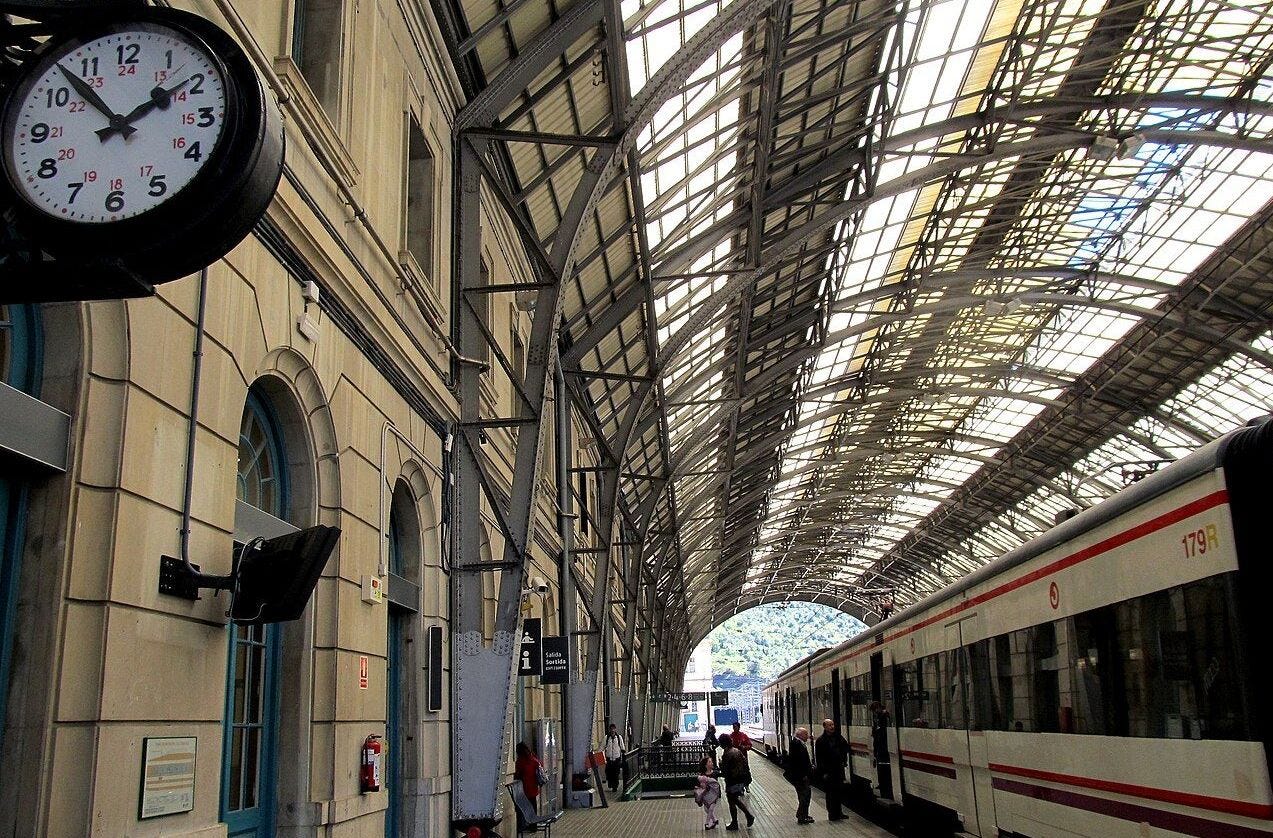
Europe’s railways run on four principal electrification systems, three main track gauges and more than 20 national signalling systems. A train that crosses a border has to be built, certified and crewed for every one of them it meets.
Each country built its network for its own market, with its own engineering choices and its own safety rules. The European Union Agency for Railways (ERA) now authorises vehicles for use in more than one member state, and EU law sets common technical standards for new infrastructure and rolling stock.
The track, the overhead wires and the signals in the ground still reflect national decisions taken over a century and a half.
Where the tracks stop matching
Most of Europe runs on standard gauge, 1,435 mm between the rails. Spain and Portugal built their conventional networks to 1,668 mm. Finland and the Baltic states use the broad gauge inherited from the Russian network. For most of the 20th century, trains from Spain stopped at Port Bou and Irún. Passengers changed trains, and freight was transshipped or moved onto new wheelsets.
Spanish manufacturer Talgo developed variable-gauge trains that adjust their wheel spacing while rolling slowly through a gauge-changing installation. Renfe uses them on routes that combine high-speed and conventional track, with gauge changers built on Talgo and CAF technology.
Spain built its high-speed network to standard gauge, and trains now run through to France on it. The conventional broad-gauge network remains.
Rail Baltica is building a new standard-gauge line through Estonia, Latvia and Lithuania to connect the three countries to Poland.
Four voltages on one continent
Europe electrified country by country, using the technology available at the time. Four systems dominate, and where two of them meet, the line has a neutral section that the train coasts through while it switches. France, Denmark and Finland use 25 kV AC at 50 Hz, as do most high-speed lines across the continent. Germany, Austria, Switzerland, Sweden and Norway use 15 kV AC at 16.7 Hz. Belgium, Italy, Poland and Spain’s conventional network use 3 kV DC. The Netherlands and parts of southern France use 1.5 kV DC.
A high-speed train from Germany to Brussels uses three of them: 15 kV in Germany, 25 kV on Belgium’s high-speed lines and 3 kV DC on the conventional network into Brussels. Deutsche Bahn’s ICE 3neo, authorised for Germany, the Netherlands and Belgium, is built for all four.
Trains built for several systems carry extra transformers, converters and pantographs. They are heavier, more expensive to buy and more expensive to certify than single-system trains. An operator planning a new cross-border service has to buy or lease that capability before the first ticket is sold. [LINK: suite nr. 4, Why Europe has four railway voltages – indsættes ved publicering]
Signalling and train protection
Each country developed its own train protection system. Germany uses PZB and LZB, France KVB and TVM, Belgium TBL, the Netherlands ATB and Spain ASFA. EU law groups them as class B systems. A train needs onboard equipment for every class B system on its route, and a driver trained to use each one. Eurostar, which runs in five countries, carries equipment for several.
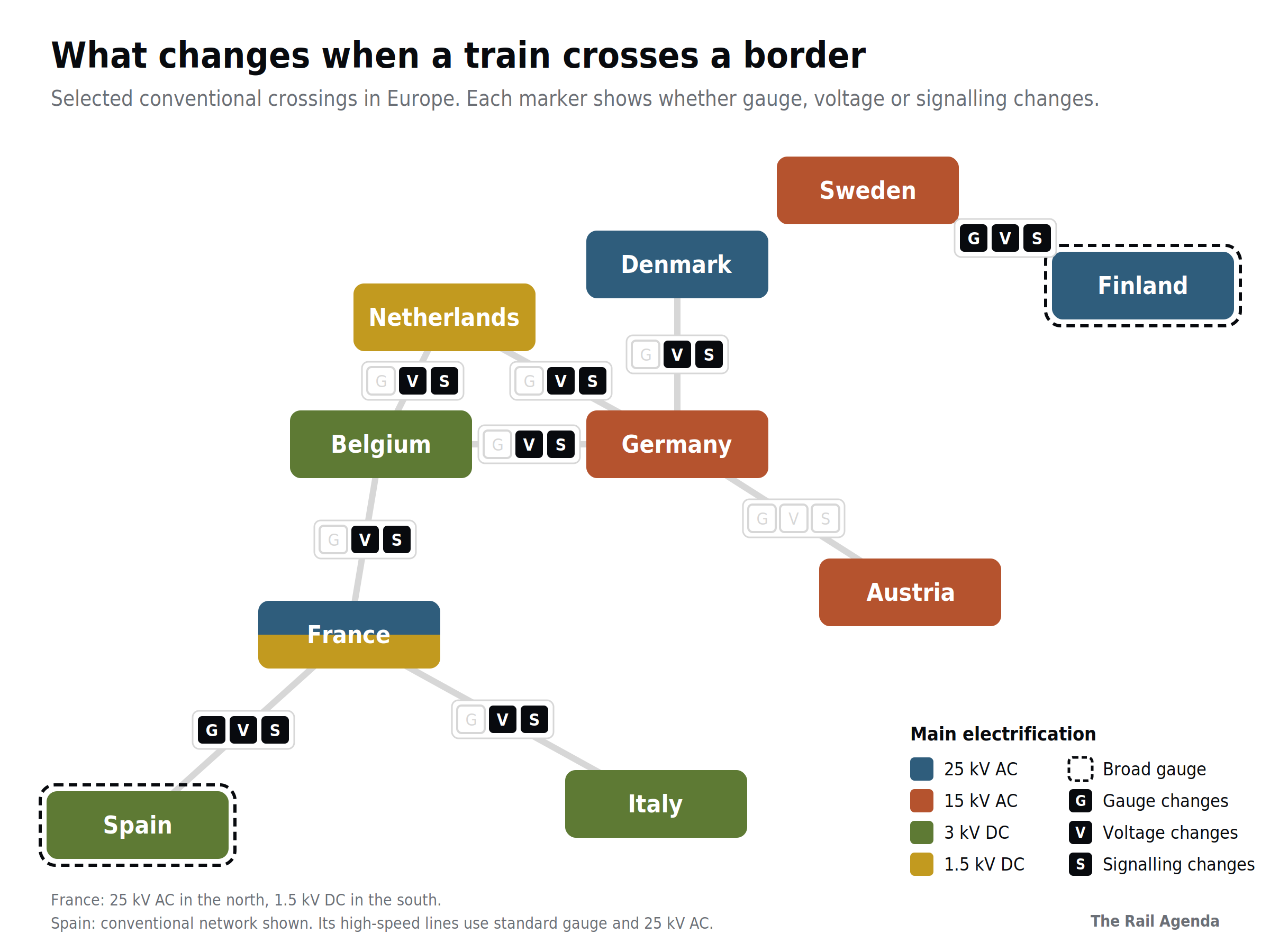
The EU’s answer is the European Train Control System (ETCS), the signalling component of ERTMS. ETCS puts a single, standardised signalling display in the cab and is designed to replace the national systems over time. ETCS has itself been issued in several baselines, and trains and trackside equipment must be checked for compatibility between versions.
Deployment is slow and expensive. Infrastructure managers must fit trackside equipment, operators must fit or retrofit every train, and many lines will run both systems in parallel for years. Member states filed 163 requests to be exempted from parts of the EU signalling specification between 2017 and 2023, against 25 between 2009 and 2015, according to a 2025 Commission report.
Rules, approvals and crews
Behind the hardware sits a second layer of national rules. In January 2016, member states had 13,459 national rules covering vehicle authorisation and fixed installations. By June 2024, the figure had fallen to 796, according to the same report. The Technical Specifications for Interoperability (TSIs) replace them with common requirements for rolling stock, infrastructure, energy, signalling and operations. For infrastructure, they apply to new and upgraded lines. Existing lines keep their national characteristics until they are renewed.
Since the Fourth Railway Package took effect in 2019 and 2020, ERA has acted as a single authorising body for vehicles used in more than one member state. By June 2024, the agency had received 7,825 applications for vehicle authorisation. A manufacturer can apply once for a multi-country area of use. National rules still apply where the TSIs leave open points.
Crews are a separate constraint. A driver needs a certificate listing each infrastructure the holder may drive on. Drivers who communicate with an infrastructure manager on safety matters must speak one of its designated languages at level B1 of the European language framework.
Timetables are planned by each national infrastructure manager. International passenger services have been open to competition since January 2010. A new operator still has to secure train paths from every infrastructure manager on its route.
What the EU is changing
The TEN-T Regulation sets fixed deadlines for the trans-European network: the core network by 2030, the extended core network by 2040 and the comprehensive network by 2050. By 2040, passenger lines on the core and extended core networks must allow speeds of at least 160 km/h. ERTMS is to cover the whole network, and national signalling systems are to be phased out. The network is organised into nine European Transport Corridors, each with a coordinator accountable for cross-border progress.
Freight lines on the core network must accept trains of 740 metres by 2030, and the extended core network by 2040. Freight trains crossing a border between member states should wait no more than 25 minutes on average by 2030. Large cross-border projects such as Rail Baltica and the Brenner Base Tunnel between Austria and Italy are built to close the physical gaps.
Existing lines keep their national systems until they are upgraded or renewed. Until then, a train that crosses a border still needs equipment, authorisation and crew certificates for every system on its route. The first TEN-T deadline, for the core network, falls on 31 December 2030.
Rail interoperability in Europe explained

European rail interoperability is the legal and technical framework that determines whether a train authorised in one country can operate across borders — and why, in most cases, it still cannot without…
What TEN-T corridors actually do

Europe’s nine transport corridors set the infrastructure standards, governance structures and funding priorities for the cross-border network connecting the continen…
Cross-border rail in Europe: how it works

Running a train across a European border requires four separate processes to align — infrastructure access, vehicle authorisation, crew certification and traffic management — each governed by different bodies on different timelines.