

Rail interoperability is the set of EU rules that decides whether a train approved in one country can run in another. Three decades of legislation have narrowed the gaps between national networks. Crossing a border by train can still require extra equipment, extra approvals or both.
In June 2024, 796 national rules still applied to vehicle authorisation and fixed installations across EU member states, according to a European Commission report on interoperability published in July 2025. In January 2016 there were 13,459.
The EU began legislating in 1991, when Directive 91/440 required member states to separate infrastructure from train operations. Directive 96/48 followed in 1996 with common technical requirements for high-speed rail. Today’s framework is the Interoperability Directive (EU) 2016/797, part of the Fourth Railway Package, which all member states had to apply by 31 October 2020.
What the technical specifications do
The working tool is a set of 11 Technical Specifications for Interoperability (TSIs), binding EU regulations that define what each part of the rail system must do.
Eight cover physical subsystems: infrastructure, energy, tunnel safety, accessibility, locomotives and passenger rolling stock, freight wagons, noise, and control-command and signalling. Three cover operations and the telematics systems for passenger and freight services.
A train that meets the relevant TSIs can be placed on the EU market without being re-engineered for each country. The TSIs do not override every national requirement. Each contains specific cases, which are derogations for particular national conditions, and open points, where no EU standard exists yet and national rules still apply.
The TSIs are revised in cycles. All of them were aligned with the Fourth Railway Package in 2019, and eight were revised in 2023. Member states can also ask the Commission not to apply a TSI to a specific project, for example one already at an advanced stage of development or where compliance would not be economically viable.
How a train gets approved
The European Union Agency for Railways (ERA), based in Valenciennes in France, was set up under a 2004 regulation. Under the Fourth Railway Package it became the authorising body for locomotives and passenger trains that will run in more than one member state. A manufacturer files one application, and ERA assesses it together with the national safety authorities of the countries in the planned area of use.
For a train used in one country only, the applicant can choose between ERA and the national authority. By 30 June 2024, ERA had received 7,825 applications for vehicle authorisations. Since 2023, passenger coaches can receive a single Europe-wide authorisation without national involvement when no national rules need to be checked, as freight wagons already could.
An authorisation covers a defined area of use, and extending it to a new country is a new step. Austrian operator ÖBB’s regional trains were cleared for three countries in this way, and the EuroDual locomotive was authorised for Slovenia and Croatia. The Talgo 230 trains now ordered by four European buyers need authorisation country by country in the same way.
The registers behind the system
ERA keeps three registers that make the rules work in practice. The European Vehicle Register, fully operational since November 2021, records individual vehicles, and 833,445 had a valid registration in June 2024. The register of authorised vehicle types holds more than 6,000 type authorisations.
The Register of Infrastructure describes the characteristics of each section of line. Operators use it together with the type register to check whether a train is compatible with a route before running it there. By early 2024, at least one parameter had been entered for around 92% of member states’ networks.
The Commission found the accuracy of the infrastructure data, which infrastructure managers enter, to be variable. It also describes the registers as held back by low levels of digitalisation.
The barriers that remain
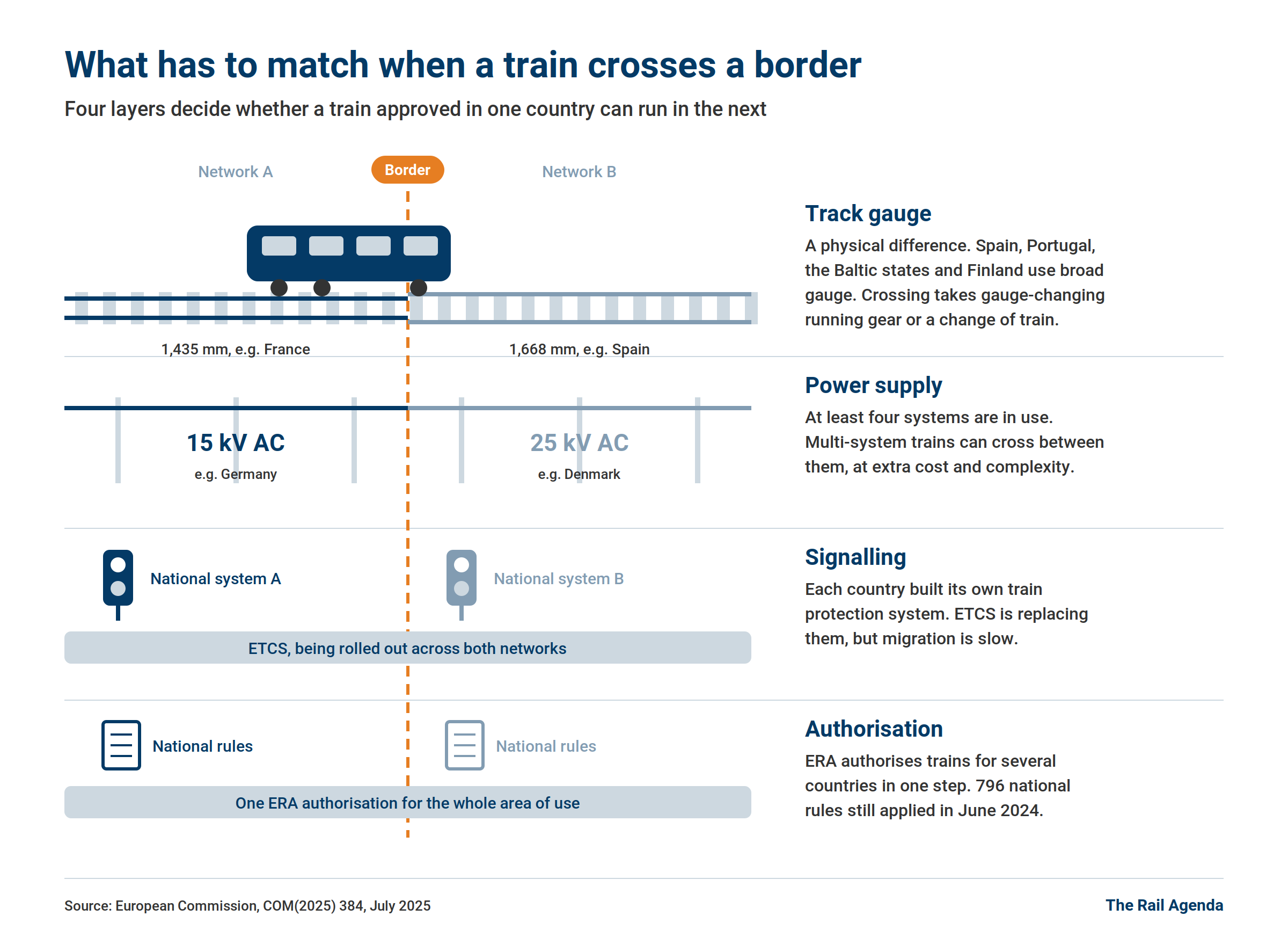
Some differences between national networks pre-date the EU and cannot be legislated away. Most of Europe runs on 1,435 mm standard gauge, but Spain and Portugal use 1,668 mm, and the Baltic states and Finland use the broad gauge inherited from the Russian network. Crossing between them takes gauge-changing running gear or a change of train.
At least four electrification systems are in use: 25 kV AC, 15 kV AC, 3 kV DC and 1.5 kV DC. Trains built for several systems can cross between them, but they are more complex and more expensive to build and maintain than single-system vehicles.
Signalling was the original driver of the interoperability project. Each country built its own train protection system, and trains running across borders had to carry several. The European Train Control System (ETCS), part of the ERTMS framework, is replacing them, but migration is slow and national systems remain in use on most networks.
National rules and exemptions
National rules are the fourth barrier. The remaining ones should cover only open points in the TSIs, compatibility between vehicle and network, and a few limited cases set out in the directive. The Commission report describes the clean-up as still in its infancy, with ERA still assessing the first rules notified by some countries.
Requests for exemption from the TSIs have grown. Member states submitted 102 between 2009 and 2015 and 228 between 2017 and 2023, and requests concerning the signalling TSI rose from 25 to 163 over the same periods.
The same report points to the rising number of requests for exemption from the signalling TSI as a sign of difficulty in implementing it. It also found that member states’ different ways of applying the directive leave national variation in how authorisations are handled.
Sources:
What TEN-T corridors actually do

Europe’s nine transport corridors set the infrastructure standards, governance structures and funding priorities for the cross-border network connecting the continen…