

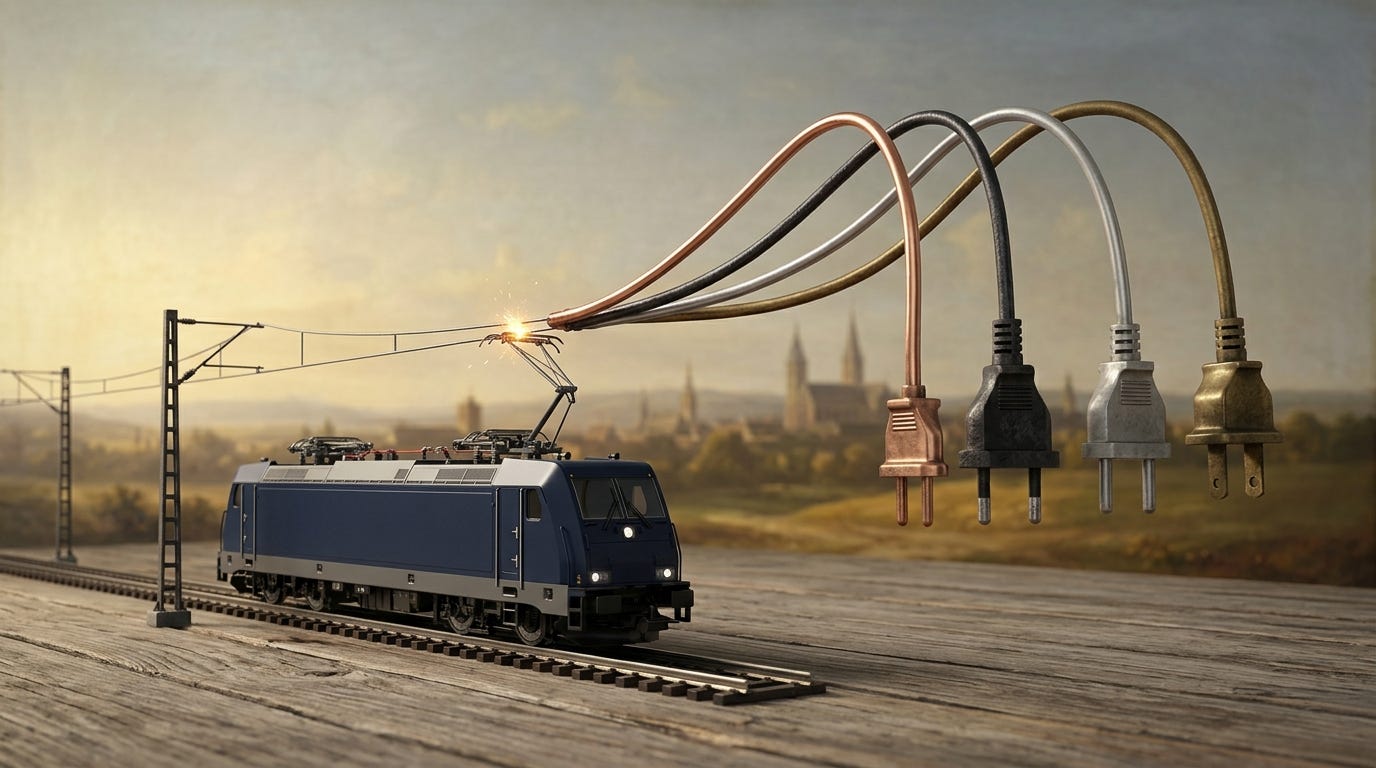
Three power systems each supply roughly a third of the EU’s electrified railway lines, and a fourth covers most of the rest. A train crossing Europe must either change locomotive at the border or carry equipment for several systems on board.
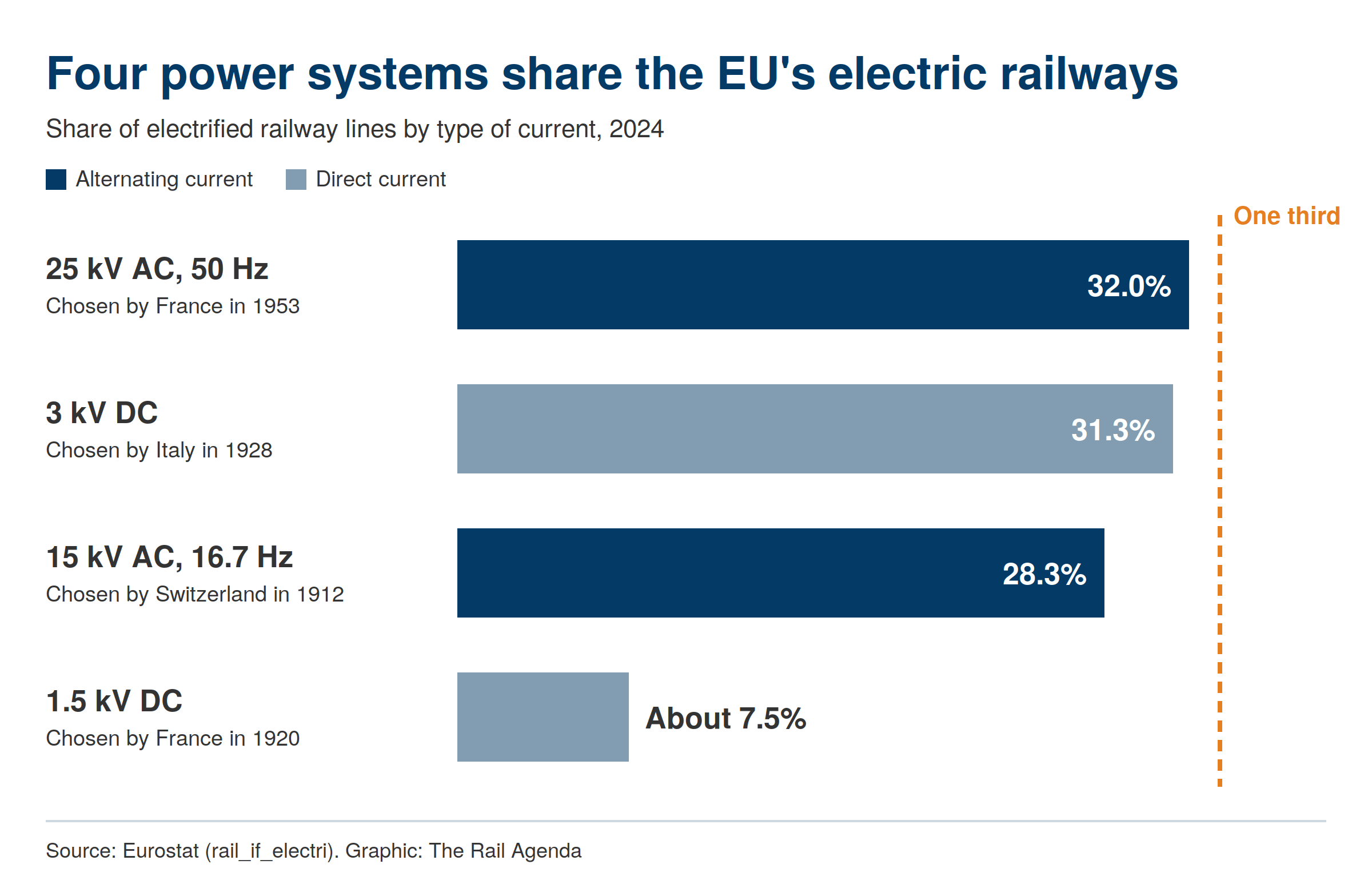
According to Eurostat, 25 kV alternating current (AC) at 50 Hz supplied 32.0% of the EU’s electrified lines in 2024. Direct current (DC) at 3 kV supplied 31.3% and 15 kV AC at 16.7 Hz 28.3%, while 1.5 kV DC accounted for about 7.5%. Of the 201,314 km of railway lines in the EU, 57.6% were electrified, up from 39.9% in 1990.
The four systems are the result of national decisions taken between 1910 and 1953, long before cross-border electric traction was planned. Each choice fitted the motors, power sources and traffic of its time. EU rules now accept all four, and the European Union Agency for Railways (ERA) considers a move to one system unlikely to pay off.
Where each system runs
Switzerland, Germany, Austria and Sweden use 15 kV AC at low frequency on their main lines, Germany and Austria alongside a small share of DC. In 2024, seven EU countries used AC on all their electrified lines: Bulgaria, Finland, Greece, Lithuania, Luxembourg, Romania and Sweden. Estonia, Ireland, Latvia and Poland used DC only.
The DC countries also included Italy, where 6% of electrified lines ran on AC, and Slovenia, at 1.5%. The Netherlands and Belgium were mainly DC, with AC shares of 12.7% and 16.4%. In France, AC covered 65.4% of electrified lines and 1.5 kV DC most of the rest.
The Technical Specifications for Interoperability (TSI) for energy list the four as the only permitted systems for new, upgraded and renewed lines. Above 250 km/h only the two AC systems are allowed, because of the high power demand of high-speed trains. The rules set a common frame for interoperability without choosing a single system.
Switzerland and Germany choose 15 kV
Between 1905 and 1909, Maschinenfabrik Oerlikon tested single-phase 15 kV at 15 Hz on a line between Zurich-Seebach and Wettingen. In 1910 the Bern-Lötschberg-Simplon railway chose the same system for its Lötschberg line, and a Swiss study commission recommended it for the country’s main lines in 1912. Germany, Austria and Sweden followed, Sweden first on the ore line from Kiruna to the Norwegian border, electrified in 1915.
The low frequency solved a motor problem. The single-phase series motor of the period suffered commutation problems that grew with frequency, according to French rail historian Jean Cuynet. Railways therefore built their own power stations and grids instead of drawing from the public supply, a cost that Swiss and Swedish hydropower helped carry.
The final figure, 16⅔ Hz, was exactly a third of 50 Hz. Walter Boveri, co-founder of the Swiss engineering group Brown Boveri, opposed running railway and public grids at unrelated frequencies, and his intervention was among those that led to the compromise. Germany, Austria and Switzerland moved to 16.7 Hz in 1995.
France and Italy choose DC
In 1920 a French ministerial decision imposed 1.5 kV DC, while Switzerland and Germany were electrifying at 15 kV. DC traction motors were well understood and gave a strong starting torque. The cost was a low line voltage that required many substations, heavy overhead wiring and significant losses in the line.
Italy began electrifying with three-phase AC in the first quarter of the 20th century. The system needs two overhead wires and complicates every set of points. In 1928 the state railway FS opened a 3 kV DC trial on the Benevento–Foggia line.
After the trial, Italy chose 3 kV DC for all new electrification, and between 1933 and 1939 the system reached main lines including Bologna–Florence and Rome–Naples. The conversion of the remaining three-phase network to DC was completed in 1976. Doubling the French voltage halved the current needed for the same power, although substations were still needed at short intervals because DC cannot be stepped up and down with transformers along the line.
The 50 Hz system came last
The Deutsche Reichsbahn tested 50 Hz, the frequency of the public grid, on the Höllental line near Freiburg at 20 kV, with four prototype locomotives delivered in 1936. The aim was to avoid building a separate railway power network. After 1945 the line lay in the French occupation zone, and SNCF took up the idea.
France had required its electricity companies to distribute three-phase power at 50 Hz since 1922. SNCF electrified the line between Aix-les-Bains and La Roche-sur-Foron at 20 kV and 50 Hz and raised the voltage to 25 kV in 1953. Power from the public grid made electrification affordable on lines with too little traffic to justify 1.5 kV DC.
Germany did not follow. A wide spread of 25 kV into Germany, expected in 1951, never happened. The Höllental line itself was converted to 15 kV in 1960, after 15 kV electrification of the main line from Basel had reached Freiburg and two systems met there.
Why the systems stay
ERA gives two reasons in its guidance on the energy TSI. The existing systems are widespread, and trains built for more than one system are now standard technology. Together, the agency writes, these could make migration to a single system economically unviable.
French multi-system prototypes of the 1950s and 1960s were often stopped at the border or allowed only short runs into neighbouring networks. Power electronics made such trains easier to build, as converters feeding three-phase induction motors made a train’s drive largely independent of the supply on the overhead wire. Because of the four systems, modern European electric locomotives are often designed as multi-system units, according to Eurostat.
Power supply is one of several layers where Europe’s networks still differ, alongside signalling. The TSI also carries national exceptions, such as a maximum of 4 kV on the 3 kV DC lines in Estonia and Latvia. Where two systems meet, the overhead line carries a separation section so that a passing train never bridges the two supplies.