

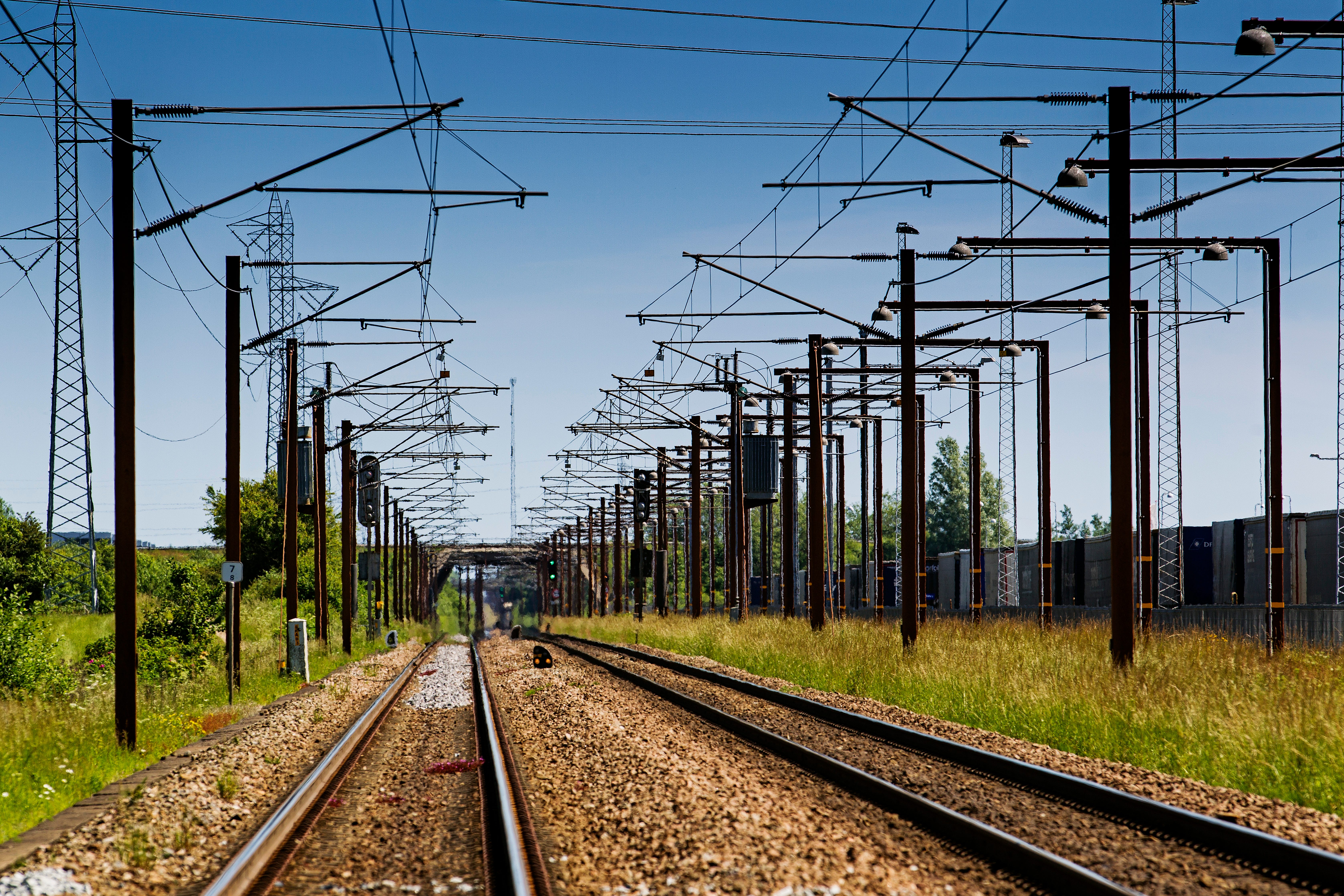
Every electric train in Europe depends on a chain of fixed infrastructure stretching from the national transmission grid to the overhead wire above the track — a chain built in four incompatible configurations across a century of independent national decisions.
European mainline electrification runs on four distinct systems, inherited from national choices taken between the 1890s and the 1960s. Each has its own voltage, its own substation logic, and its own consequences for any train crossing a border.
Electrification systems in Europe
The 25 kV AC, 50 Hz system — introduced in France in the 1950s and now used on high-speed lines and most new electrification across the continent — takes power directly from the three-phase utility grid. At the traction substation, a single-phase transformer steps grid voltage, typically 110–400 kV, down to 25 kV and feeds the overhead contact system.
Substation spacing on conventional 25 kV lines is typically 20–50 km; a higher-voltage autotransformer variant of the same system extends that spacing to 60–80 km, at the cost of additional trackside equipment.
The 15 kV AC, 16.7 Hz system operates in Germany, Austria, Switzerland, Sweden, and Norway. Its non-standard frequency — a legacy of early motor technology — required separate generation or conversion from the national grid, producing self-contained traction power networks that still depend on dedicated frequency converters or modern static converter substations.
DC at 3 kV serves Italy, Poland, Belgium, and parts of Spain; DC at 1.5 kV is used in France, the Netherlands, and some urban networks. DC substation spacing is substantially shorter — as little as 2–5 km on 1.5 kV systems — because higher currents in low-voltage distribution increase resistive losses rapidly with distance.
Electrification coverage
According to Eurostat data, 57.6% of EU railway lines were electrified in 2024, up from 39.9% in 1990. Luxembourg leads at 96.7%, Belgium at 88.0%, and Sweden at 75.1%, while Ireland, Lithuania, Estonia, and Latvia remain below 15%.
According to the Community of European Railway and Infrastructure Companies (CER), electrified lines carried around 80% of European rail traffic in 2022, when 56.9% of EU lines were electrified — reflecting the concentration of electrification on high-traffic routes. Around 52% of the electricity used by European railways came from renewables in 2022, per the same source.
Multi-system rolling stock
The coexistence of four electrification systems makes cross-border electric operation technically complex. Multi-system electric multiple units and locomotives carry onboard equipment for two, three, or four supply systems, switching automatically at system boundaries.
A four-system platform — capable of operating under 25 kV AC, 15 kV AC, 3 kV DC, and 1.5 kV DC — costs 5–8% more than a single-system unit, a premium that has fallen as the electronics have matured. Conversion of older DC networks to 25 kV is technically possible but expensive.
Power quality and grid interaction
Railway traction loads are single-phase and highly variable, drawing power in sharp pulses as trains accelerate and returning energy to the network during braking. This load profile creates voltage fluctuations, harmonic distortion, and phase imbalance on the utility grid connection.
EN 50163 specifies the permissible voltage range at the pantograph for each electrification system. EN 50388-1:2022 addresses the technical coordination between power supply systems and rolling stock needed to manage these interactions.
On AC systems operating at 16.7 Hz, the traction network is isolated from the 50 Hz grid and requires frequency conversion — historically handled by large rotating machines, now by static power electronics in modern installations.
Energy recovery
Modern electric traction returns braking energy to the supply, but AC and DC networks handle it differently. AC substations can feed that energy straight back into the utility grid.
DC networks cannot: the catenary is a passive conductor, so braking energy needs a receptive load or storage nearby, or it is lost to resistor banks. That asymmetry is why wayside battery and supercapacitor storage is increasingly installed at DC substations.