

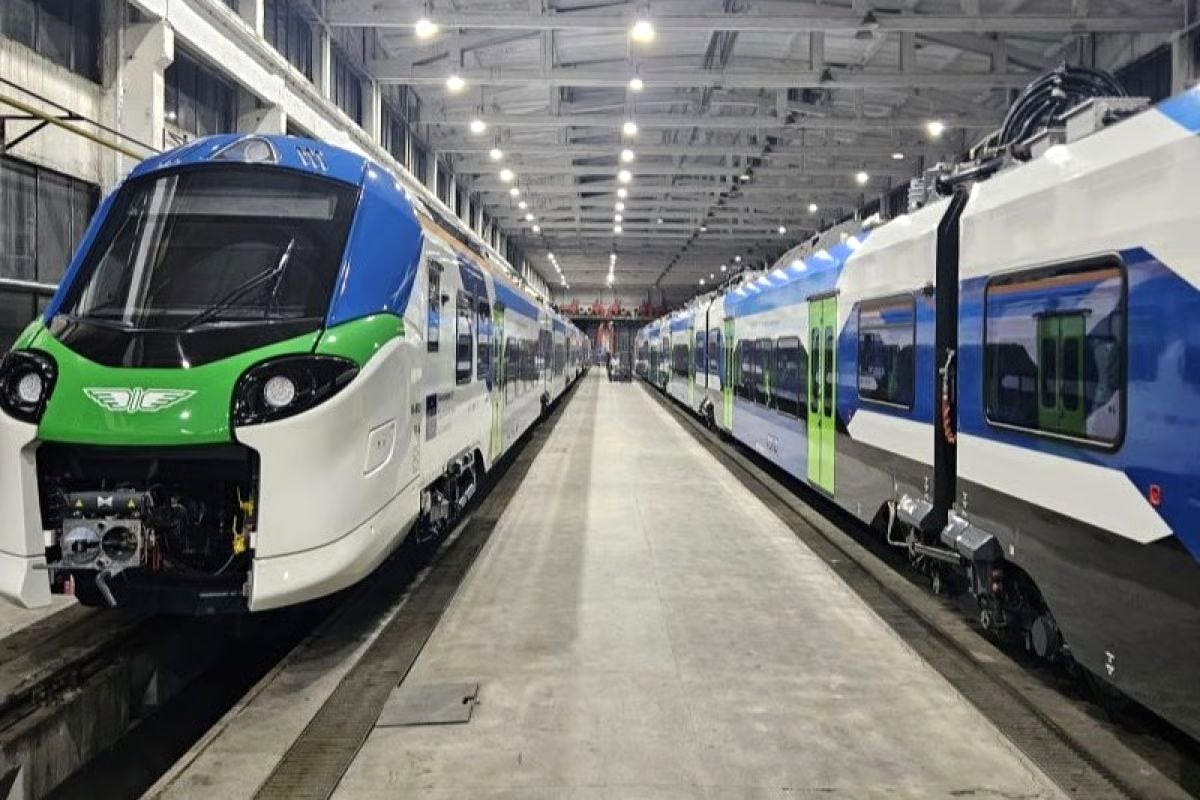
BULGARIA: All twelve EU-funded Alstom Coradia Stream trains have arrived in Bulgaria, with the first two set to enter service in early September. Funding for the remaining 23 sets is not secured.
Transport Minister Georgi Peev presented the first set at Sofia Central Station on 25 August. All twelve sets financed by the EU Recovery and Resilience Facility (RRF) have been delivered and certification procedures are under way, he said, according to news agency BTA.
The first two trains will run on Pernik–Sofia–Plovdiv–Svilengrad, the route with the most sections cleared for 160 km/h. The 23 remaining sets on order are to be ready by mid-2027, according to Alstom.
The minister wants them financed through Bulgaria’s plan under the EU Social Climate Fund, a plan he says is not yet finalised. In the meantime the 2026 state budget holds a temporary interest-free loan of EUR 92.88m from the finance ministry to the transport ministry to cover payments to Alstom.
Twelve sets and the August milestone
The twelve RRF sets, valued by the transport ministry at just under EUR 155m, count towards the milestones in Bulgaria’s recovery plan, which must be met by 31 August. Deputy Prime Minister Atanas Pekanov, who attended the presentation, said the investment had still been at risk in May.
Around 40 drivers have been trained on the new sets, five of them as instructors. The ministry has set up a working group with the interior ministry on protecting the trains from vandalism, mapping the sections of the network where earlier incidents occurred.
Andrew DeLeone, Alstom’s president for Europe, said all 35 sets will be delivered by mid-2027 and that a new depot near Sofia will be the fleet’s main base, with around 50 Bulgarian engineers and technicians in training. Further purchases under the contract were too early to discuss, he said. Each six-car set has a capacity of 325 passengers, full air conditioning, four toilets and space for bicycles.
Financing for the remaining 23
“We are actively working to have the financing for these 23 trains placed in the social climate plan,” the minister said in an interview with news site economic.bg published on 24 August. “The interest-free loan is included as a form of protection if that does not succeed.” In June he put the sum still needed for the 23 sets at EUR 356m.
The Social Climate Fund pays out through national plans that the Commission has to approve. The deputy prime minister expects EUR 2–3bn from it, part of it for transport. The loan covers about a quarter of the EUR 356m.
Two operators from December
The trains are state property and will be allocated between two operators when Bulgaria’s new public service contracts take effect on 13 December. The transport ministry signed the twelve-year contracts in February.
State-owned operator BDŽ keeps around 75% of the services, including western Bulgaria and the Sofia–Varna and Sofia–Burgas routes. Private operator Ivkoni Express takes the northern and southern regions, with under 3 million train-km a year.
