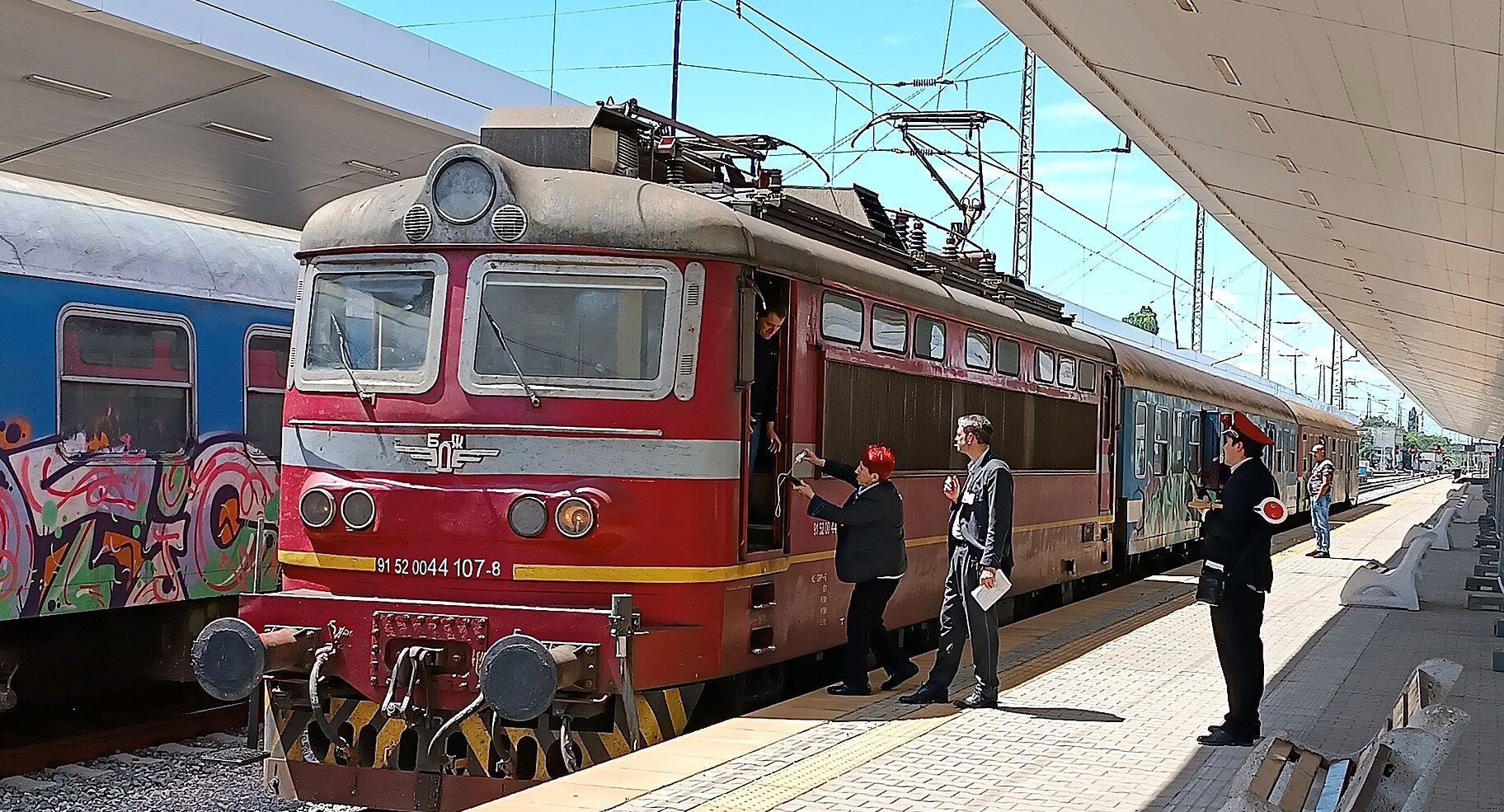
Bulgaria is buying 60 new trains in under two years, with two suppliers and EU money on a deadline, while EU investigators are looking into 19 of the same ministry’s earlier rail contracts.
By Pernille Nygaard
At 14:30 on 25 August a six-car Alstom Coradia Stream stood at Sofia Central Station, with Transport Minister Georgi Peev, Deputy Prime Minister Atanas Pekanov and Alstom’s president for Europe, Andrew DeLeone, in front of it. The deputy prime minister congratulated the supplier and the ministry on an investment that, he said, had still been at risk in May.
The set is one of twelve financed by the EU Recovery and Resilience Facility (RRF), all of them now in the country six days before the 31 August deadline for the milestones in Bulgaria’s recovery plan. A further 20 Škoda Group RegioPanter sets are entering service, five more are on order, and 23 more Alstom sets are on order. That is 60 trains, bought by a ministry with 19 earlier contracts under EU investigation.
The ministry buys the trains, owns them and decides which operator runs them. It is the same ministry whose earlier contracts the investigators are examining.
The August deadline
The EU money pays only for trains delivered by the end of August 2026. On 7 March 2025 the then transport minister Grozdan Karadjov told parliament that the European Commission had confirmed the deadline and that later sets would fall to the state budget.
Tenders had been launched and stopped since August 2023, and by the time the contract for 35 sets was signed on 25 April 2025 only twelve could be built within the window. The RRF money for the other 23 was lost.
“On 18 June the minister announced that EPPO is investigating 17 infrastructure contracts signed between 2019 and 2021, and that OLAF is examining two rolling stock contracts.”
The government had settled the replacement two days before signing. On 23 April 2025 the council of ministers decided that the twelve sets, at EUR 185.8m, would be financed by the RRF, and that the remaining 23, at EUR 356m, would be placed in Bulgaria’s plan under the Social Climate Fund, to keep the cost off the state budget. Sixteen months later that placement is still an application.
On 16 March this year Alstom's consortium warned the ministry that the twelve might not arrive in time, daily Sega reported from the government's status report on the recovery plan. Alstom later confirmed it could deliver on time. On 25 August all twelve were in the country, valued by the ministry at just under EUR 155m, with the first two entering service in early September.
On 25 August all twelve were in the country, valued by the ministry at just under EUR 155m, with the first two entering service in early September.
Twenty-three sets without secured money
The remaining 23 Alstom sets are due by mid-2027, Alstom’s Europe president said on the platform. In June the minister put the sum still needed for them at EUR 356m. His predecessors counted on a residual pool under the Transport Connectivity programme that did not exist, or on a Social Climate Fund plan that did not yet exist, he has said.
In an interview with news site economic.bg published on 24 August the minister said the ministry is working to have the financing “placed in the social climate plan”, and that an interest-free loan “is included as a form of protection if that does not succeed”.
The fund is financed from the EU’s new emissions trading system for buildings and road transport and pays out through national plans the Commission has to approve. Member states were due to submit their plans by the end of June 2025. Bulgaria’s is not yet finalised, the minister said, and the deputy prime minister expects EUR 2–3bn from it, part of it for transport.
The loan is already in place. The 2026 state budget holds a temporary interest-free loan of EUR 92.88m from the finance ministry to the transport ministry, routed through the National Fund, to cover the urgent payments to Alstom for the 23 sets. It is to be repaid, and it covers about a quarter of what the minister says is needed.
Nineteen contracts under investigation
On 18 June the minister announced that the European Public Prosecutor’s Office (EPPO) is investigating 17 infrastructure contracts signed between 2019 and 2021, and that the European Anti-Fraud Office (OLAF) is examining two rolling stock contracts. Together they put up to EUR 400m in EU funds at risk.
“That makes the ministry buyer, owner and allocator of the fleet, and at the same time the counterparty in the investigations of its own earlier contracts.”
The suspicions are procurement fraud, misuse of funds and money laundering. EPPO’s known actions have been on the Sofia–Plovdiv–Burgas corridor, the same axis the new Alstom trains are meant to serve.
No procedural step by EPPO has been made public since. In January 2025 EPPO brought charges over a EUR 94.5m signalling contract on Plovdiv–Burgas. Whether that case is among the 19 has not been confirmed.
13 December: state trains, two operators
From 13 December the fleet is split between two operators under twelve-year public service contracts the ministry signed in February. State-owned BDŽ keeps around 75% of the services, including western Bulgaria and the Sofia–Varna and Sofia–Burgas routes. Private operator Ivkoni Express takes the northern and southern regions, under 3 million train-km a year.
The trains stay state property and the ministry allocates them. That makes the ministry buyer, owner and allocator of the fleet, and at the same time the counterparty in the investigations of its own earlier contracts.
Three processes run at once inside one ministry. The RRF milestones close on 31 August, EPPO’s next step has no date, and the market opening on 13 December needs trains that are certified and operators that are ready. The twelve sets in Sofia settle the first. The 23 sets without money, the 19 contracts and the operator handover on 13 December are the tests that follow.

