

Welcome to Tuesday Briefing — the first of The Rail Agenda’s two weekly newsletters (Tuesday and Friday). Here’s today’s edition.
Top: Siemens Vectron cleared for 230 km/h passenger runs
Siemens Mobility says the EU Agency for Railways (ERA) has authorised the Vectron locomotive for passenger services at speeds of up to 230 km/h in several Central European countries.
The clearance covers Germany, Austria, the Czech Republic, Slovakia, Poland and Hungary, with Denmark listed as “in preparation”.
The approval widens the operating envelope for locomotive-hauled passenger services on upgraded main lines where 230 km/h is permitted, without requiring a dedicated high-speed trainset.
Siemens says the first operator to use the approval is Czech operator ČD (České dráhy), which has a 50-locomotive Vectron MS order.
2. Poland opens first construction procurement for its 350 km/h CPK line
Poland’s Centralny Port Komunikacyjny (CPK), the state-owned project company behind the country’s high-speed rail programme, has launched its first construction procurement for a section designed for up to 350 km/h.
CPK is running a competitive dialogue for a roughly 13 km segment of Line 85 between Kotowice and the future airport junction in Mazovia.
The procurement is structured in two stages: first, contractors apply to participate; then CPK invites a limited number of bidders into dialogue before final offers.
The winning contractor is expected to deliver both detailed design and construction works, marking an early “plan-to-market” step in the Warsaw–Łódź backbone of the planned “Y” network.
3. EU and EIB back EUR 175.6 million upgrade of Montenegro’s Bar–Golubovci line
The European Union is providing a EUR 175.6 million financial package for the reconstruction of the 39 km Bar–Golubovci railway line in Montenegro.
The package combines an EIB loan of EUR 63 million with an EU grant of EUR 112.6 million.
The project targets speed, reliability, safety and capacity improvements on a strategic section linking the Port of Bar to the inland network and onward routes towards Serbia and Central Europe.
The project is part of the extended TEN-T Core Network and is intended to shift freight and passenger traffic from road to rail on a key corridor segment.
4. Bulgaria secures EU funding for new intermodal terminal in Ruse
Bulgaria has secured European funding for a new intermodal terminal in Ruse, a Danube-border city positioned for multimodal freight flows.
The project budget is around EUR 60 million, with nearly EUR 50 million expected to come from European funds.
Ruse sits on the Danube at the Romanian border, making it a natural candidate for a combined-transport node with strong cross-border relevance.
The terminal is intended to strengthen rail-linked logistics capacity in a region where terminal performance and handover points can be decisive for route choice.
5. PKP Cargo agrees Cargotor sale to infrastructure manager PKP PLK
PKP Cargo has finalised an agreement to transfer Cargotor to PKP PLK, moving the Małaszewicze-related terminal operator under Poland’s national infrastructure manager.
The parties say they intend to finalise the transaction by the end of the first quarter of 2026.
Cargotor manages assets tied to the Małaszewicze border crossing area, a key gateway for rail freight flows on Poland’s eastern flank.
The deal forms part of PKP Cargo’s restructuring and consolidates infrastructure responsibilities under PLK.
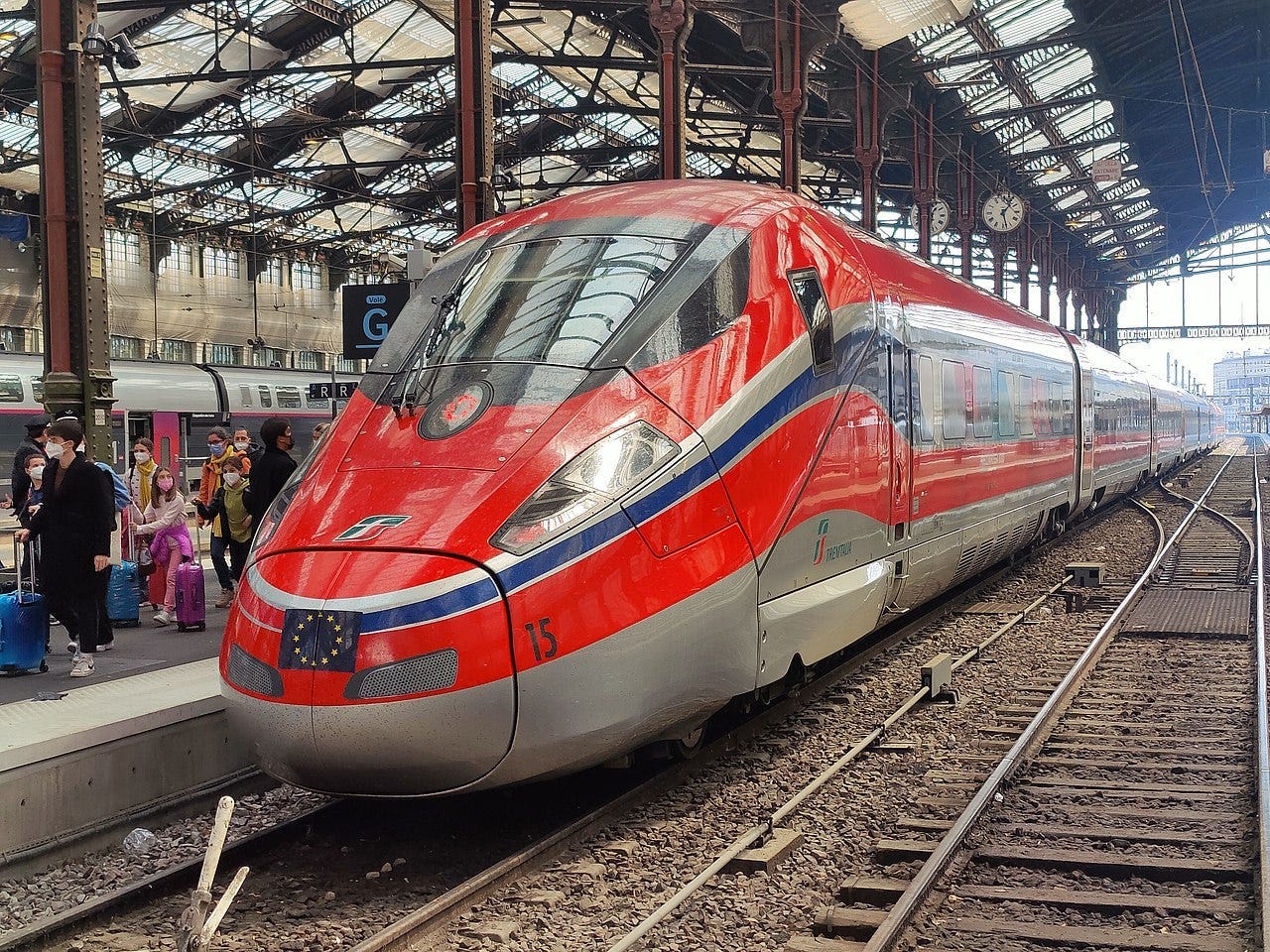
Catch up: Italian FS keeps 2029 Paris–London launch plan alive

Explainer: How Digital Automatic Coupling Works — Europe’s Freight System Upgrade
Thank you for reading The Rail Agenda’s newsletter. If you found it valuable, consider forwarding it to someone who might enjoy it.