

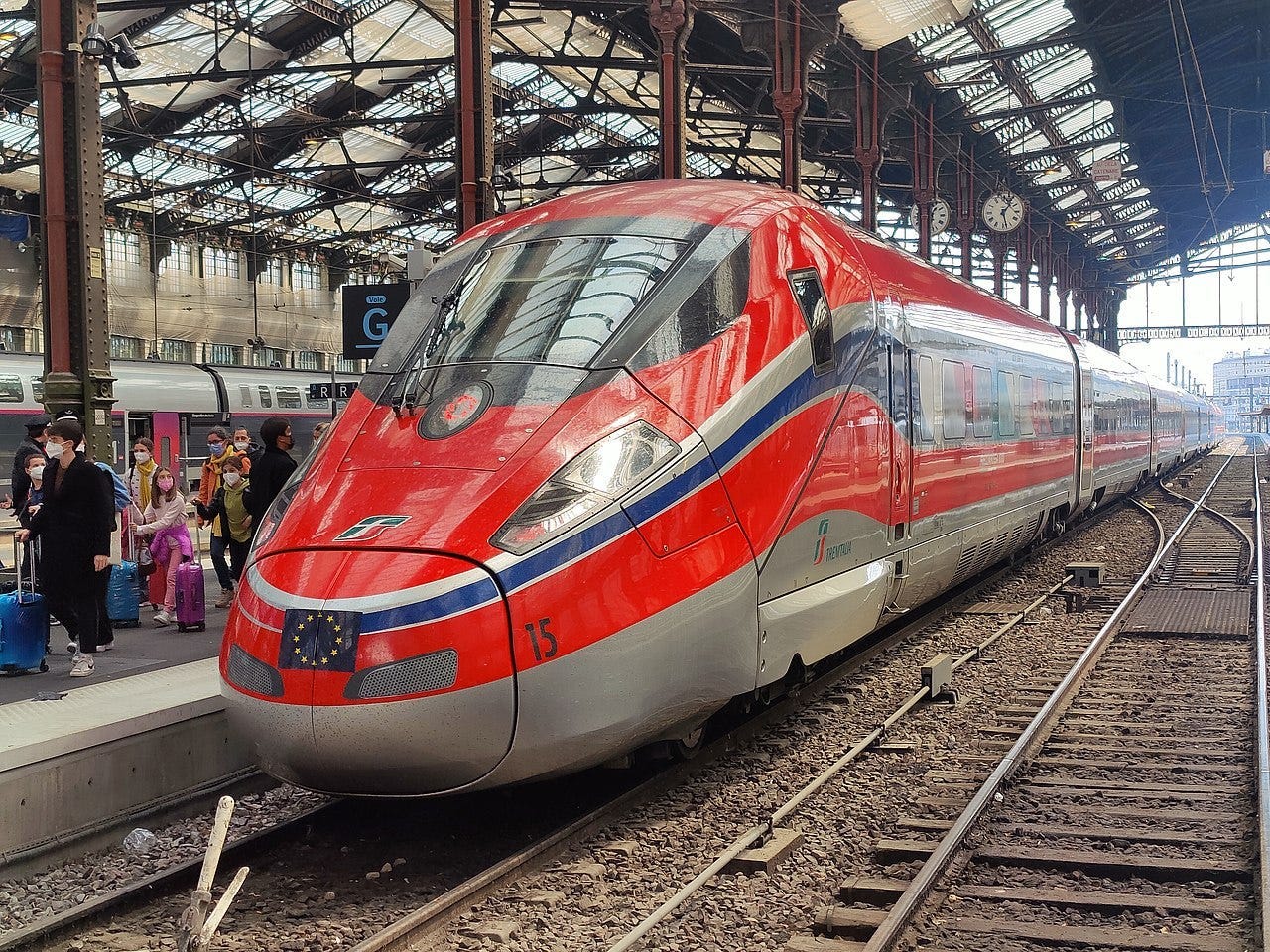
Italy’s state-owned rail group Ferrovie dello Stato Italiane (FS) says it is still targeting a 2029 launch for high-speed passenger services between Paris and London, despite being rejected in the UK regulator’s 2025 decision on access to the Temple Mills International depot in east London.
The latest trigger is a new partnership with US investment firm Certares, announced on 29 December 2025. FS says the deal supports a EUR 1 billion investment plan in France and the UK and will support Trenitalia France’s expansion, with Paris–London listed as a specific objective.
FS had already publicly set out a Paris–London 2029 plan earlier in 2025. The Certares deal adds a named financial and commercial partner as new entrants try to translate regulatory processes into workable operations.
Temple Mills: what FS lost
On 30 October 2025, the UK’s Office of Rail and Road (ORR) approved Virgin’s application for access to Temple Mills, while rejecting applications from other prospective Channel Tunnel entrants, including FS’ Trenitalia unit.
ORR said depot capacity is only sufficient for one new operator on top of Eurostar’s existing use and judged Virgin’s plan the best use of that space. The practical consequence for other entrants is that London-side stabling and light-maintenance capacity remains scarce, and Temple Mills has been treated as the main London-side depot option.
ORR also described depot access as an important early step towards operating cross-Channel services, rather than a standalone green light.
What Certares changes — and what it does not
FS says the Certares partnership is tied to Trenitalia France’s growth plans. The group sets out operational items it wants to fund or support: expanding the fleet to at least 19 trainsets, developing a new maintenance facility near Paris, and increasing frequencies on existing routes.
FS also says Certares will help with distribution and commercial partnerships. The focus is both corporate and leisure travel.
None of that resolves the central UK constraint: a Paris–London service still needs a reliable London-side stabling and light-maintenance arrangement. With Temple Mills allocated to Virgin in the ORR process, FS must either secure an alternative London-area solution or support a route to additional capacity if it wants to keep a 2029 start date credible.
A wider international programme
FS is positioning the Channel Tunnel plan as part of a broader international high-speed agenda, not a single-corridor move. Beyond France and the UK, FS has also announced plans to extend Frecciarossa services into central Europe in cooperation with Deutsche Bahn and ÖBB.
FS has said that, from December 2028, it aims to build up to 10 Italy–Germany high-speed connections via Austria, including routes such as Milan–Munich and Milan–Berlin. FS has also pointed to the Brenner Base Tunnel as a future step-change, saying journey times would fall further once it opens. The project is due to open in 2032.
For FS, the pattern is consistent: expand fleet and maintenance capacity, then add international city-pairs where rail can compete directly with short-haul flying — provided operational bases at each end can be secured.
Why it matters: The Channel Tunnel market is often framed as a question of tunnel capacity and track access. The Temple Mills decision shows how quickly entry can become a competition for scarce service facilities — and how those constraints can determine who reaches the market first.