

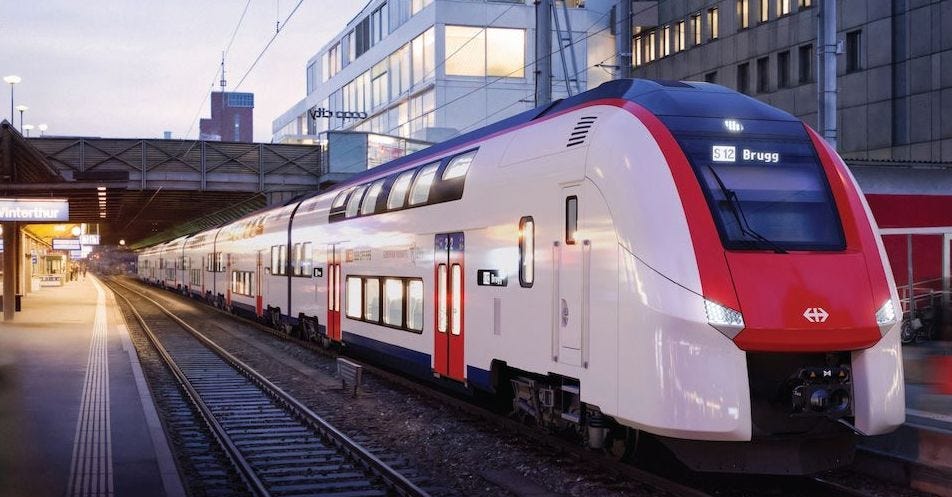
Stadler drops SBB appeal, clearing Siemens contract
SWITZERLAND: Stadler Rail has withdrawn its legal challenge to SBB’s award of a framework contract for up to 200 double-deck trains to Siemens Mobility, making the procurement legally binding.
The withdrawal ends a dispute that had kept the contract in legal uncertainty since November 2025. SBB can now proceed with delivery planning for fleet entry from December 2031.
The outcome turns on a procedural constraint: Swiss procurement law permitted SBB and Siemens to withhold commercially sensitive sections of court documents from Stadler, leaving the challenger without the evidentiary basis to continue.
For the Zürich S-Bahn network, the ruling out of further challenge confirms Siemens as the supplier for 95 replacement units — a fleet renewal programme that had been on hold pending the appeal.
Alstom acquires Cummins fuel cell unit for hydrogen fleet
INDUSTRY: Alstom has acquired the rail hydrogen fuel cell operations of U.S. supplier Cummins to bring maintenance and development of its existing hydrogen train fleets under direct control.
The acquisition covers the engineering, product and support capabilities Cummins supplied for the Coradia iLint programme — the fleet that experienced repeated failures in Germany from 2022. Alstom confirmed the deal on 2 April; no financial terms were disclosed.
Alstom paused further hydrogen development in November 2025 after French state funding was discontinued. The Cummins acquisition addresses the delivery obligations that remain in Germany, France and Italy.
Renfe gives up on Barcelona–Paris high-speed plan
SPAIN: Renfe has withdrawn its capacity reservations to run services north of Lyon, ending the Spanish operator’s plans to connect Barcelona and Paris by high-speed rail.
Renfe has held certification for Barcelona–Lyon and Madrid–Marseille since 2023. Authorisation for the Lyon–Paris segment — where the TVM 300 signalling system posed compatibility problems for earlier Renfe trainsets — has not been granted. The S-106, the Talgo-built Avril trainset developed as the solution, has not received certification for that stretch.
Trenitalia France obtained authorisation for the same Lyon–Paris corridor with its Frecciarossa 1000. Renfe’s existing French services continue to operate once daily each.
EU court rules Germany’s rail charging unlawful
GERMANY: The European Court of Justice (CJEU) has ruled that Germany’s track access charge system violates EU law — a decision expected to trigger compensation claims from freight and long-distance passenger operators.
The ruling, delivered 19 March, takes immediate effect. The CJEU rejected Germany’s request to limit retroactive application, leaving charges for both 2025 and 2026 open to challenge. The German Rail Freight Association estimates compensation claims could reach several hundred million EUR.
Germany’s Federal Transport Ministry has indicated it is preparing a reform, without specifying a timeline.
The price gap that wasn’t just about efficiency
COMMENTARY: Czech Railways bid 77 % more than Leo Express for the same contract. The instinct is to ask whether that gap reflects a bid that cannot be sustained. The better question is who is actually standing behind it.
Renfe holds 50 % of Leo Express and has leased purpose-acquired ex-Deutsche Bahn coaches to the operator through its own leasing subsidiary for the Prague–Munich route. The service is due to launch in December 2026.
Two operational questions — the German carrier partnership terms and traction for the non-electrified Plzeň–Domažlice section — remain unresolved.
That’s The Rail Agenda for today. If someone in your network should be reading this, send it their way.