

COMMENTARY: Czech Railways bid 77 % more than Leo Express for the same contract. The instinct is to ask whether that gap reflects a bid that cannot be sustained. The better question is who is actually standing behind it.
By Dan Jensen
The Czech Ministry of Transport awarded Leo Express a five-year contract in March 2026 to operate eight daily services on the Czech section of the Prague–Munich route from December 2026. Leo Express bid CZK 427 million. Czech Railways bid CZK 757 million. A gap of that size demands an explanation.
Three layers, not one
The instinct when a private operator undercuts a national railway so significantly is to reach for one of two explanations: either the private operator is genuinely more efficient, or the bid is unsustainable and the service will eventually fail.
The first layer is legitimate structural efficiency. Czech Railways employs more than 21,000 people across a heavily unionised legacy operation. Leo Express runs with roughly 300 staff and no comparable collective bargaining obligations.
ČD must allocate proportional costs from nationwide repair facilities, supervisory structures and legacy systems to every individual contract it holds.
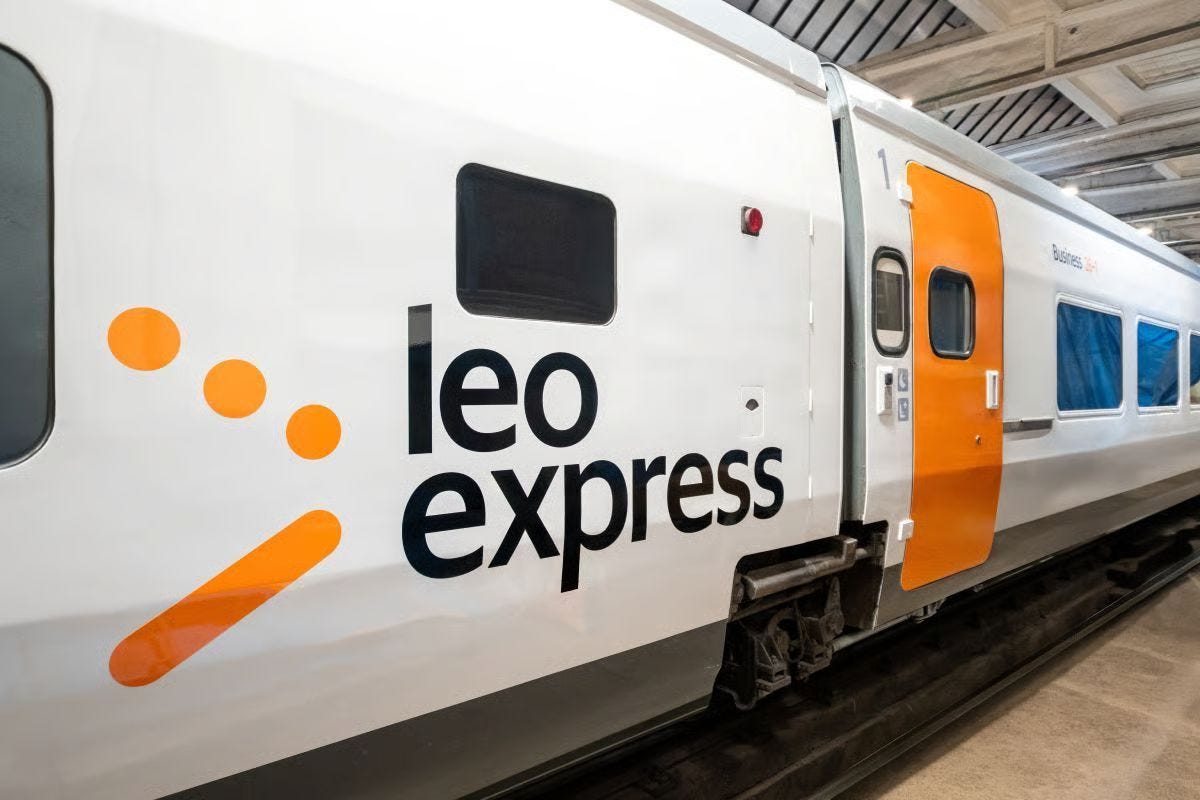
The second layer is more interesting. Leo Express will deploy ex-Deutsche Bahn coaches on the route, acquired by Renfe and leased to Leo Express through Renfe’s wholly-owned leasing subsidiary under a 15-year agreement.
The coaches are RIC-compliant and certified for cross-border operation across Europe at up to 200 km/h. The lease is a transaction between a major shareholder and an operator it half-owns.
The third layer is strategic pricing. Leo Express has chosen to win this contract at a price that leaves little room for error — a calculation that a shareholder with deep pockets makes easier. Prague–Munich is the most visible cross-border PSO in Central Europe. For an operator with ambitions across the region, that visibility has a value that does not show up in the contract figure.
The question behind the question
Leoš Novotný founded Leo Express in 2010. The company is named after him. He still sits on the board as vice-chairman. Leo Mobility s.r.o. — the original founders’ vehicle — holds 44% of the shares. The company grew out of a tech-disruption instinct, not a railway tradition: Uber partnerships, door-to-door mobility, multimodal integration, a lean commercial culture built over 13 years of Czech operations.
Whether by design or by the logic of the structure, the arrangement achieves something a direct Renfe bid could not. A Spanish state railway bidding openly on Czech PSO contracts would face cost structures and political constraints that its Czech partner does not. At 50% ownership, Renfe carries a direct share of any losses Leo Express incurs.
The model solves all of these problems simultaneously. Local brand, local labour costs, local regulatory familiarity — with Spanish capital and purpose-acquired rolling stock available when needed.
Trenitalia enters some markets under its own name, others through local vehicles. Either way, it arrives with its full institutional weight. The Leo Express model is designed for something different.
Lean market entry into complex, mid-scale markets — where the local operator’s agility is the competitive advantage, and the shareholder’s resources are the insurance policy.
Whether this becomes a template for how European PSO markets develop is an open question. This tender suggests it might.
The comparison that matters
Denmark’s GoCollective lost its regional rail contract in September 2025 after persistent service failures. What failed was not the principle of private operation. Arriva — GoCollective’s predecessor — had operated Danish regional services competently for more than two decades, first as a standalone listed company and then under Deutsche Bahn ownership.
What failed was an ownership transition. DB sold the Danish operation to Mutares — a German private equity fund specialising in restructuring underperforming businesses — as part of a broader disposal of non-core markets. Mutares is a financial investor, not a railway operator. There was no institutional backstop of the kind that a state railway shareholder provides.
The insurance policy
Leo Express has the opposite structure. Its major shareholder is a state railway with decades of operational experience and a direct financial interest in the Czech operator’s success. When the Prague–Munich service encounters the first operational crisis — and it will — that structure matters.
Two operational questions also remain open. Leo Express has indicated it will operate in cooperation with the German carrier on the Bavarian section, though the terms have not been made public. And for the non-electrified Plzeň–Domažlice section, Leo Express has indicated it will use a diesel or bi-mode locomotive, though the specific arrangement has not been detailed publicly.
Both need to be resolved before December 2026. Neither is insurmountable — but both carry cost and timing risk that a low base bid leaves little room to absorb.
Leo Express has beaten state operators in PSO tenders before — in the Czech Republic and Slovakia. But Prague–Munich is a different order: cross-border, high-profile, and operationally unresolved in ways that a regional contract is not.
Whether the model holds here is the question this contract will answer. The December 2026 launch date is the first data point. The track record over five years will be the verdict.
Related:
Leo Express beats Czech Railways for Prague-Munich contract