

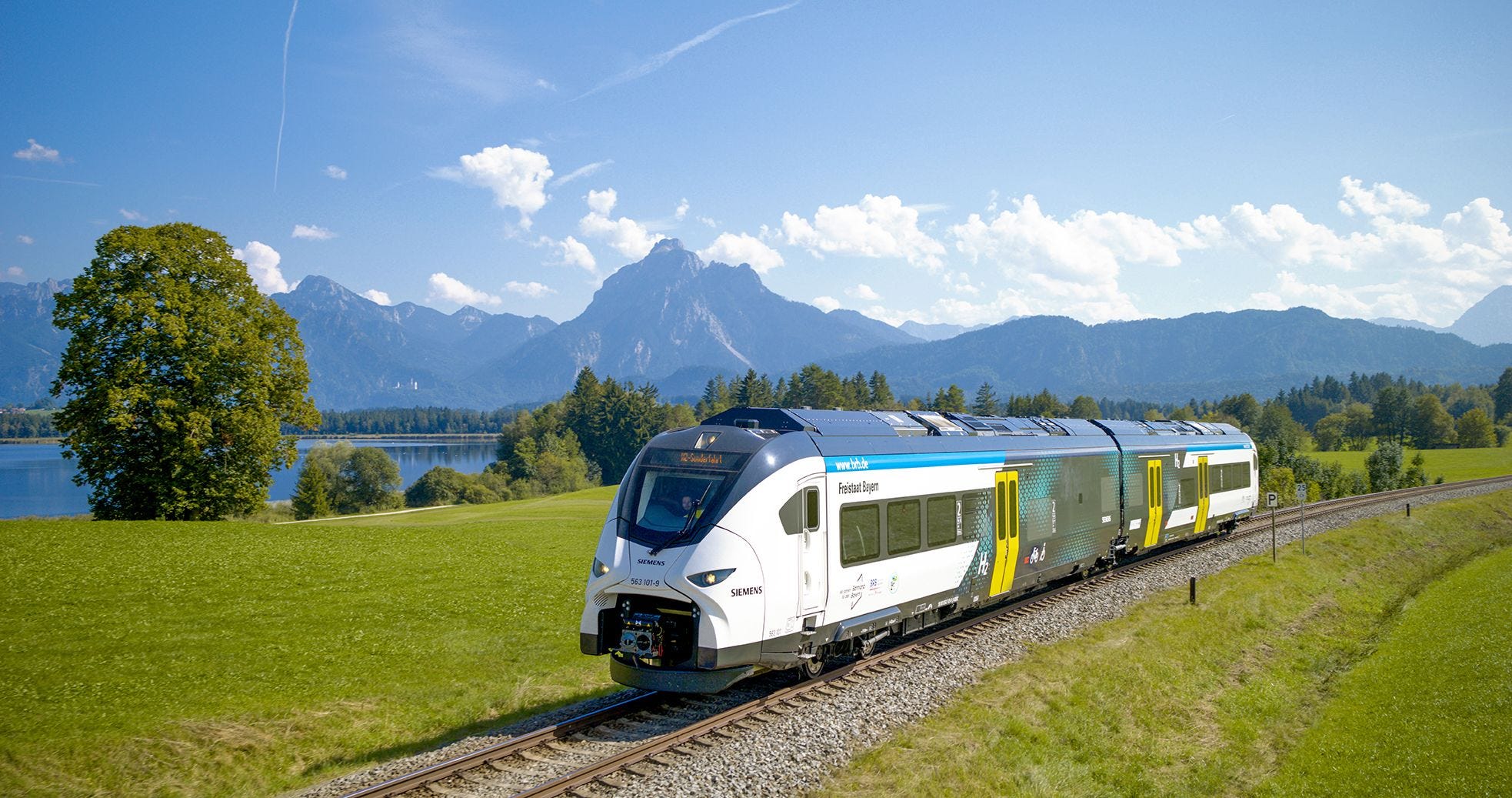
Romania awards Siemens contract for 12 hydrogen trains
ROMANIA: State rail authority ARF has awarded Siemens Mobility a EUR 325 million contract to supply 12 hydrogen multiple units after three previous failed tender rounds, including a 30-year maintenance period.
The Mireo Plus H trainsets will serve non-electrified PSO routes across several regional corridors. ARF selected hydrogen traction over electrification or battery alternatives.
The Siemens consortium was the sole bidder in the final round. PNRR funding tied to the procurement was lost before the contract could be signed; ARF is now seeking alternative financing.
Germany sets up ETCS onboard retrofit coordination office
GERMANY: A national office to coordinate European Train Control System onboard retrofit has been established in Germany, acknowledging the country’s installation backlog in a ministerial statement.
The office, placed with public-sector consultancy PD, holds no disbursement authority. Its mandate is to coordinate — bringing together infrastructure managers, vehicle owners and public bodies around a retrofit financing question that has blocked progress since Germany committed to its ETCS deployment plan.
Germany’s regional rail contracting authorities have described the underlying problem as deflected responsibility: vehicle owners bear the cost of onboard installation while the network captures the operational benefit. An organisational review is set for 30 June 2027. No timeline for resolving the financing question has been set.
ÖBB cargo unit swings to EUR 135.5m loss in freight downturn
AUSTRIA: ÖBB’s Rail Cargo Group recorded a pre-tax loss of EUR 135.5m in 2025, widening sharply from EUR 24.5m the previous year, as industrial recession, road competition and infrastructure disruptions eroded the European freight rail market.
The result includes EUR 81.1m in goodwill writedowns on Hungarian subsidiaries and agricultural logistics operations, compounding trading losses driven by road haulage pricing pressure and extended routing caused by German infrastructure works. The wider ÖBB Group posted earnings before tax of EUR 68m — a 40% decline — despite an 8% increase in group revenue.
ÖBB has announced a savings programme targeting a 10% reduction in controllable planned costs, estimated at around EUR 300m annually. The divergence between Rail Cargo Group’s result and record passenger volumes across the wider group reflects a structural tension running across European state-owned rail operators.
Croatia signs EUR 278.8m Zagreb–Karlovac rail contract
CROATIA: HŽ Infrastruktura has signed a EUR 278.8m contract with Spanish contractor Comsa to upgrade 44 kilometres of line between Zagreb and Karlovac.
The contract, signed 17 April, covers track doubling, electrification and ETCS Level 1 installation on a section of the TEN-T Mediterranean Corridor, with completion targeted for 2029. The upgrade raises line speed to 160 km/h on a route that currently operates as single-track and unelectrified.
The Zagreb–Karlovac section forms the first leg of the Mediterranean Corridor route toward the Adriatic port of Rijeka, making it a precondition for faster freight and passenger movement between Rijeka and Central Europe. The project is co-funded under the EU Competitiveness and Cohesion Programme 2021–2027.
For eight hours, Denmark’s rail network had a potentially deadly fault. Nobody knew.
COMMENTARY: On 14 April, a defective bracket on Zealand’s main line hung too low. That happens on railways. What followed — 38 damaged trainsets, a live wire on a passenger train roof, eight hours of cascading failure — happened because nothing in Denmark’s rail monitoring architecture was able to detect it.
Banedanmark’s control centre monitors the 25 kV traction network for electrical faults. It does not monitor catenary geometry. A suspension fitting hanging centimetres below its nominal height produces no electrical signal, no alarm — it is invisible to the system until a contact wire physically falls. That is what happened near Slagelse on 14 April.
The Great Belt corridor — Denmark’s busiest inter-regional rail link, and the location of the defective suspension — has no wayside pantograph monitoring. Banedanmark co-developed the technology now deployed by operators including Deutsche Bahn, Network Rail and RATP.
On its own network, it is installed at four locations. The Great Belt is not among them.
That’s The Rail Agenda for today. If someone in your network should be reading this, send it their way.