

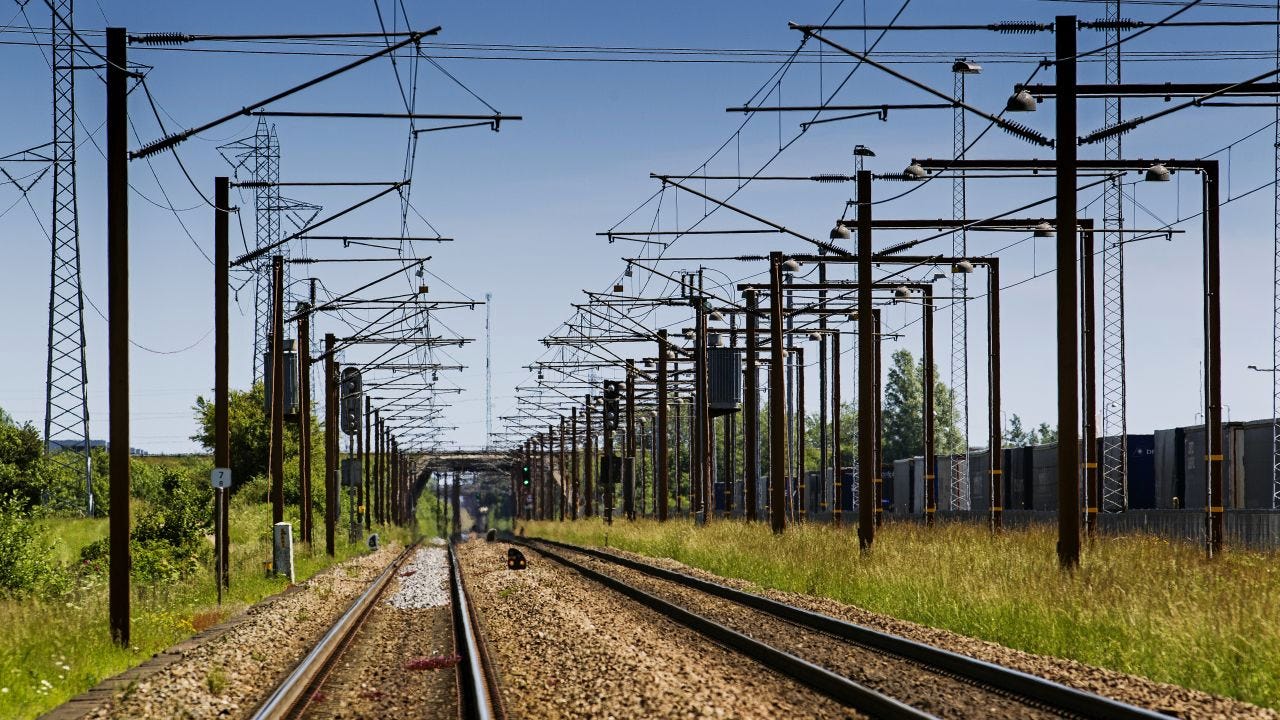
COMMENTARY: On 14 April, a defective bracket on Zealand's main line hung too low. That happens on railways. What followed — 38 damaged trainsets, a live wire on a passenger train roof, eight hours of cascading failure — happened because nothing in Denmark's rail monitoring architecture was able to detect it.
By Dan Jensen
For eight hours, electric trains passed the same point near Slagelse, each pantograph taking a blow, carbon strips wearing down progressively — undetected.
The first visible consequence came at 09:30, when a contact wire came down near Ringsted. Denmark’s infrastructure manager Banedanmark closed that section and kept the rest of the network running.
The second came in the late afternoon, when an intercity train outside København H wound itself into a live overhead wire.
Banedanmark realised the two incidents were connected and shut down all rail traffic in eastern Denmark. The root cause, a defective suspension near Slagelse, was located overnight during a manual inspection covering many kilometres of track.
When the wire comes down
Passenger Niels Urban Hansen was on that train in Copenhagen that afternoon. He told Danish broadcaster TV 2 that a massive bang rang out, sparks flew in all directions, and something fell onto the roof.
A fallen overhead line carrying 25,000 volts is not a disruption. It is a life-threatening hazard. The established response is immediate: warn passengers not to leave the train, not to touch the doors, not to make contact with any metal surface.
According to passenger accounts reported to TV 2, that warning took 45 minutes to reach those on board. They sat for three hours — 500 metres from Denmark’s largest station — before evacuation was complete.
No signal
This was not a freak accident. It was the predictable result of a monitoring architecture that cannot see the failure mode that caused it.
Banedanmark’s control centre monitors the 25 kV traction network for electrical faults — short circuits, relay trips, voltage anomalies. It does not monitor catenary geometry. It does not detect progressive pantograph damage.
A suspension fitting hanging centimetres below its nominal height produces no electrical signal. It produces no alarm. It is invisible to the system until a contact wire physically falls.
Rolling stock without a safety net
DSB’s IR4 fleet — the primary electric multiple unit on Zealand, delivered in the 1990s — carries no automatic device to detect and lower a damaged pantograph before it can tear down the overhead wire. Newer rolling stock across Europe is increasingly fitted with such devices.
Rail expert Kristian Madsen told Danish engineering journal Ingeniøren that better monitoring of pantograph condition across the fleet would be relevant to consider.
In practice, damage is discovered at the depot or when a train entangles itself in the overhead line. On 14 April, 38 trainsets were pulled from service with damaged pantographs.
Another technology exists. Denmark helped build it.
Wayside pantograph monitoring offers another way to prevent damage and accidents caused by defective pantographs. These systems are installed along the track and scan passing trains in real time, detecting damage and geometry anomalies before they can propagate.
The technology was in fact co-developed by Banedanmark and PantoInspect, a Danish company whose PantoSystem platform has been deployed by operators including Deutsche Bahn, RATP, Network Rail and Sydney Trains.
On Banedanmark's own infrastructure, the latest Network Statement lists seven PantoSystem units across four locations — three around Copenhagen and one in southern Jutland.
The Great Belt corridor — Denmark’s main inter-regional rail link, and the location of the defective suspension — is not among them.
Several questions. No answers yet.
Banedanmark has announced an internal root cause analysis. As infrastructure manager, it is required by law to have notified Havarikommissionen — the Accident Investigation Board under the Danish Ministry of Transport — but whether the board will open a formal independent investigation remains to be seen.
Several questions have not yet been asked collectively. When was the Slagelse suspension last inspected, and by what method? Which of the 38 damaged trainsets carried pantograph protection, and did it activate?
And why was the Great Belt corridor — Denmark’s busiest inter-regional rail link — not among the priorities when Banedanmark drew up its monitoring plan in 2010?
A network that cannot see its own faults
Folketing member Marlene Harpsøe has called for a parliamentary hearing with the transport minister.
Denmark is in the process of forming a new government. The transport minister remains in post as part of a caretaker administration. The incoming minister will inherit not just a railway — but a network that cannot see its own faults.
Sources
The incident — primary sources
TV 2, 14 April 2026 — Liveblog: Train chaos across the country https://nyheder.tv2.dk/live/samfund/2026-04-14-togkaos-i-hele-landet
TV 2 Øst, 14 April 2026 — Second wire down, København H https://www.tv2east.dk/sjaelland-og-oeerne/flere-tog-holder-stille-flere-steder-pa-sjaelland-52863
TV 2, 15 April 2026 — Passenger Niels Urban Hansen https://nyheder.tv2.dk/samfund/2026-04-15-passager-saa-gnister-uden-for-vinduet-og-saa-advarede-dsb-om-livsfare
Nordjyske/Ritzau, 15 April 2026 — Anders Barratt, Banedanmark, on the defective suspension https://nordjyske.dk/nyheder/danmark/beskadiget-ophaeng-med-koerestroem-er-formentlig-skyld-i-togforstyrrelser/5998909
TV 2, 15 April 2026 — Tony Bispeskov, DSB, on damaged trainsets https://nyheder.tv2.dk/live/samfund/2026-04-14-togkaos-i-hele-landet?entry=d19057ed-83aa-4f7d-94ea-8faefc124fa0
Technical and monitoring background
Ingeniøren, 15 April 2026 — Rail expert Kristian Madsen on pantograph monitoring (subscription required) https://ing.dk/artikel/togkaos-lammede-hele-oestdanmark-nu-peger-jernbane-ekspert-paa-en-mulig-aarsag
Ingeniøren, 15 April 2026 — Anders Barratt, Banedanmark, root cause interview (subscription required) https://ing.dk/artikel/banedanmark-har-sporet-togkaos-til-en-straekning-der-er-en-samlet-aarsag
Pantograph monitoring technology
Banedanmark’s latest Network Statement
https://www.bane.dk/Jernbanevirksomhed/Netredegoerelser/Netredegoerelse-2027
PantoInspect A/S — developer of the core technology
Accident investigation body
Havarikommissionen for Civil Luftfart og Jernbane