

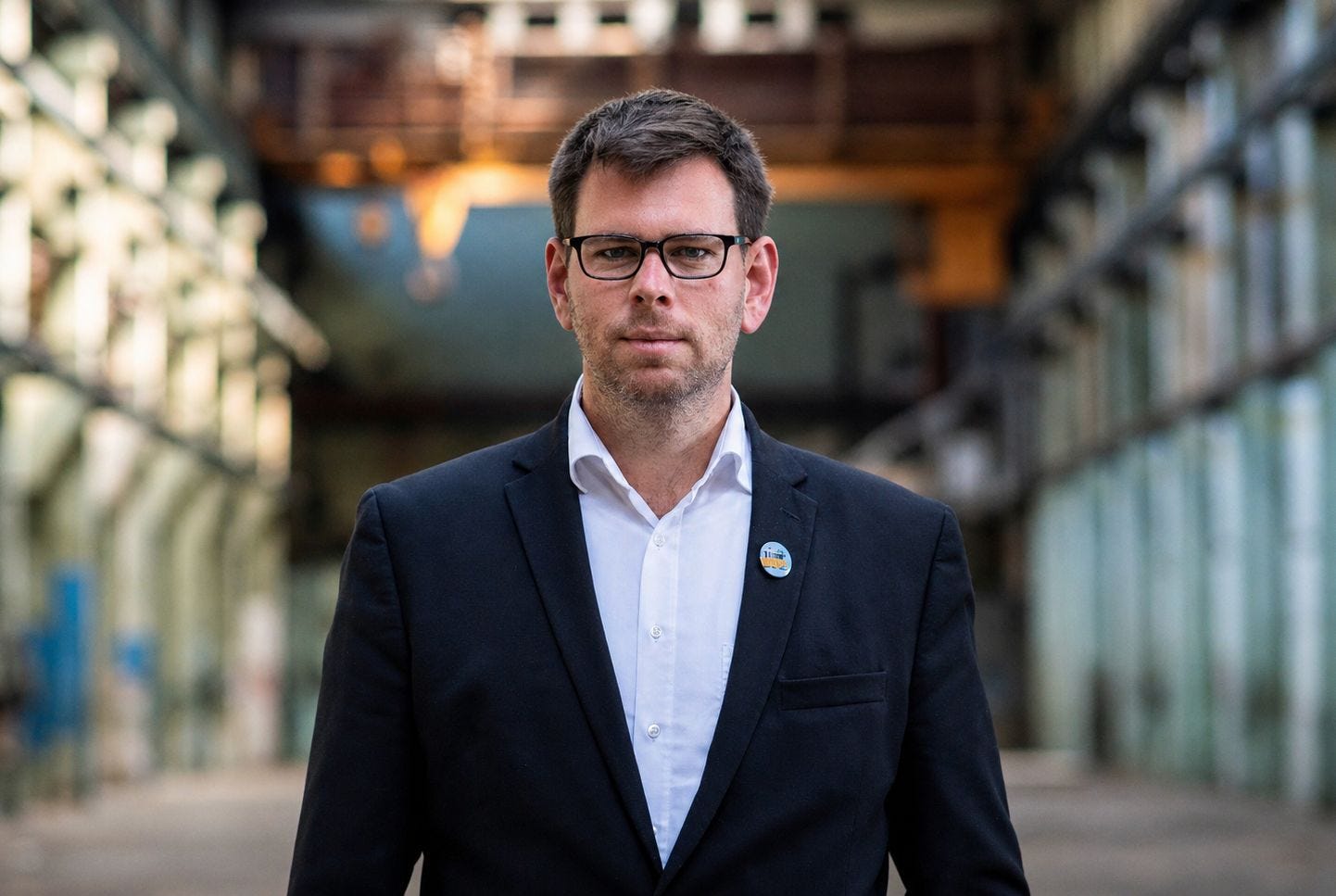
Hungary appoints rail reformer as transport minister
HUNGARY: Budapest transport chief Dávid Vitézy has been nominated as Hungary’s minister of transport, giving the incoming Magyar government a reform-oriented operator with a direct mandate over MÁV and EU rail funding.
Vitézy’s immediate task is twofold: stabilising MÁV, which has not acquired new vehicles in years and is entering another difficult operating summer, and restoring access to EU infrastructure funds frozen under the previous government.
The appointment marks a structural shift in how Hungary approaches rail governance — from political management to operational accountability.
Magyar’s government is not yet formally in office.
CPK launches second HSR tender on Warsaw–Łódź line
POLAND: CPK has launched its second optimise-and-build tender for Poland’s planned high-speed rail network, part of the country’s flagship infrastructure programme combining a new central airport with a high-speed rail connection west of Warsaw.
The procurement covers a 14.3 km section between the Airport Junction and Bolimów on Line 85, with expressions of interest due by 12 June. Three further tenders remain before the full Warsaw–Łódź corridor is under contract.
Line 85 will operate at 350 km/h on 25 kV AC — a new traction standard for Poland, which currently runs on 3 kV DC nationwide.
Industry: Too few ETCS suppliers, no explanation for high prices
EU: Europe’s rail supply associations disagree with the European Commission’s explanation for why on-board signalling costs have doubled. The EU Commission believes there are too few suppliers and this is negatively affecting the market.
The cost of fitting a train with ETCS on-board equipment rose from around EUR 450,000 to EUR 900,000 per vehicle between 2018 and 2022. UNIFE and its signalling arm UNISIG attribute the increase to national specification variants and interface complexity, not supplier concentration.
The disagreement was set out at the ERA ERTMS conference in Valenciennes on 24 April. The diagnosis determines the remedy — and with roughly 10% of the TEN-T network equipped with ETCS trackside infrastructure, the stakes for deployment policy are material.
Belgium diverts EUR 124.5m from two delayed rail projects
BELGIUM: Belgian infrastructure manager Infrabel has redirected EUR 124.5m from two stalled projects — Rail Ghent-Terneuzen and the Antwerpen-Berchem redevelopment — into a new investment package backed by European subsidies.
Rail Ghent-Terneuzen loses EUR 87.5m and Antwerpen-Berchem loses EUR 37m, with both original projects pushed to 2030 at the earliest. The reallocation was confirmed by transport minister Jean-Luc Crucke on 24 April.
The freed capital is redistributed across battery infrastructure, port connectivity, station accessibility and ETCS upgrades, drawing EUR 52m in European subsidies.
Has Europe misunderstood diesel’s necessary comeback?
COMMENTARY: On 14 April, a defective bracket on Denmark’s main Zealand corridor hung centimetres below its nominal height and progressively damaged the pantographs of more than 30 trainsets over eight hours — a civil failure that exposes the vulnerability: the continent has no reliable fallback at scale when the electrified network goes down.
The freight sector has not waited for policy. Stadler’s EuroDual reached 100 units delivered in September 2025; Siemens’ Vectron Dual Mode is operating in volume across DB Cargo’s fleet. The market is moving toward dual-mode capacity — while EU taxonomy rules continue to treat diesel-capable traction as outside the sustainable investment classification, regardless of emissions standard.
CER has called explicitly for EU funding of dual-mode locomotives for military mobility. The political level has not followed.
That’s The Rail Agenda for today. If someone in your network should be reading this, send it their way.