

COMMENTARY: On 14 April, a defective bracket on Denmark's main Zealand corridor hung centimetres below its nominal height and progressively damaged the pantographs of more than 30 trainsets over eight hours — a civil failure that exposes the vulnerability: the continent has no reliable fallback at scale when the electrified network goes down.
No saboteur, no storm. A fitting invisible to Denmark’s real-time monitoring until the damage was done. It shut all rail traffic in eastern Denmark for close to 24 hours, and disrupted services for the better part of three days.
A fully electrified, fully optimised railway has no reliable fallback at the scale the moment requires when the wire comes down.
The case for off-wire capacity
Traction that operates without overhead lines continues to function when infrastructure is damaged or deliberately targeted. It can move heavy loads on non-electrified routes. In a crisis, it works.
None of that requires classic diesel. Dual-mode delivers all of it.
A dual-mode locomotive delivers exactly the same off-wire capability — and adds full electric performance where the wire is intact. It is not a step backward. It is the rational answer to a system that has left itself with no fallback when the overhead wire fails.
The market has drawn its conclusion
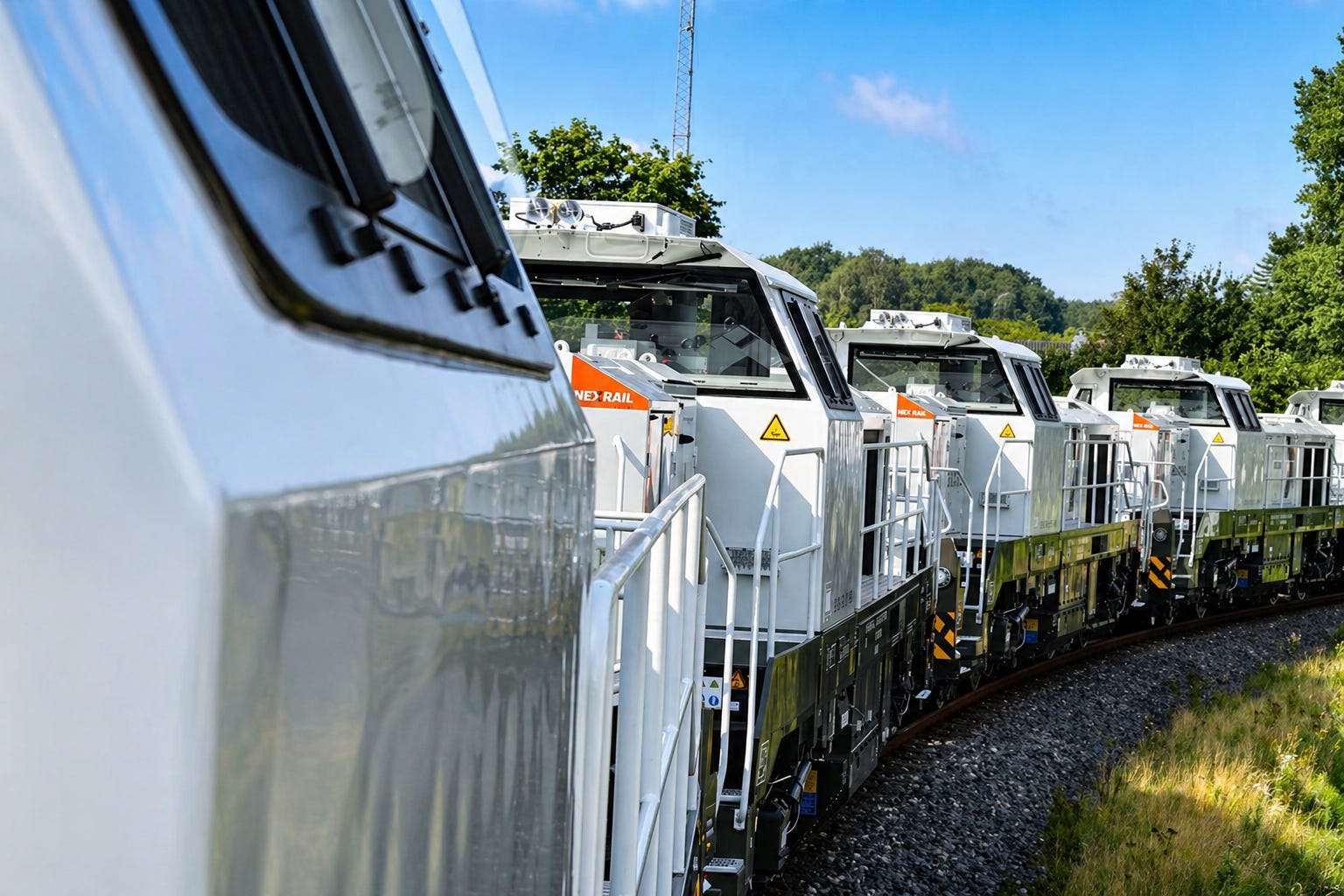
The freight sector has not waited for a political signal. Stadler’s EuroDual reached its 100th unit delivered in September 2025. Siemens’ Vectron Dual Mode is moving in volume — 146 units in DB Cargo’s fleet. Nexrail has built an entire leasing business on the premise that Stage V hybrid traction for non-electrified corridors is necessary now.
The Vectron Dual Mode variant planned for Poland, Czechia, Slovakia and Hungary — the corridors Europe's eastern flank logistics actually run through — arrives in 2027, 2028 for Polish infrastructure. The market is delivering.
The policy framework looks elsewhere
Europe’s Military Mobility Package, presented in November 2025, is the most ambitious step yet toward what the Commission has called a military Schengen for transport. It proposes a binding framework for cross-border movement permissions, harmonised procedures, and infrastructure protection.
It explicitly identifies flatbed wagons and ro-ro ferries as scarce capabilities. Traction technology is not on the agenda.
The Community of European Railway and Infrastructure Companies (CER) has called explicitly for EU funding of dual-mode locomotives for military mobility. The political level has not followed.
“Banks that turn their noses up”
Johannes Huesgen, who leads rail finance at Deutsche Leasing Gruppe, was plain in a recent LinkedIn post:
“On the German market, there are already banks that turn their noses up at diesel locomotives and reject them.”
His institution is not among them. Deutsche Leasing continues to finance Stage V diesel — while acknowledging the asset class is under increasing pressure as sustainability targets tighten.
The consensus on the green agenda is still there. What has changed is the concrete geopolitical threat picture. The financing market has not adjusted to that shift.
Has Europe misunderstood its own needs?
Under the EU taxonomy — the bloc's framework for classifying sustainable investments — a dual-mode locomotive operating on its diesel engine does not qualify as a substantive contribution to environmental objectives.
The banks pulling back from diesel financing that Huesgen describes are not making an ideological choice. They are following a regulatory signal.
That signal does not distinguish between a 1960s diesel and a Stage V dual-mode hybrid that produces significantly lower emissions and can run on HVO fuel. To the taxonomy, if it burns diesel, it is not green.
A contradiction that should be articulated
The military mobility package requires military transport capability. The taxonomy devalues the technology that delivers it. A contradiction that should be articulated.
No one has made a conscious choice to leave the network vulnerable. But a financing regime that treats dual-mode diesel as indistinguishable from classic diesel, and a policy framework that has not addressed traction technology, have left the network with less resilience than the threat warrants.
The question is not whether diesel will make a comeback. It is whether Europe has understood that the comeback it actually needs — dual-mode, hybrid, cleaner — is being discouraged by the rules Europe itself has written.
And yes, there is the security of supply of fuel. But that is another story.
For eight hours, Denmark’s rail network had a potentially deadly fault. Nobody knew.

COMMENTARY: On 14 April, a defective bracket on Zealand's main line hung too low. That happens on railways. What followed — 38 damaged trainsets, a live wire on a passenger train roof, eight hours of casc…