

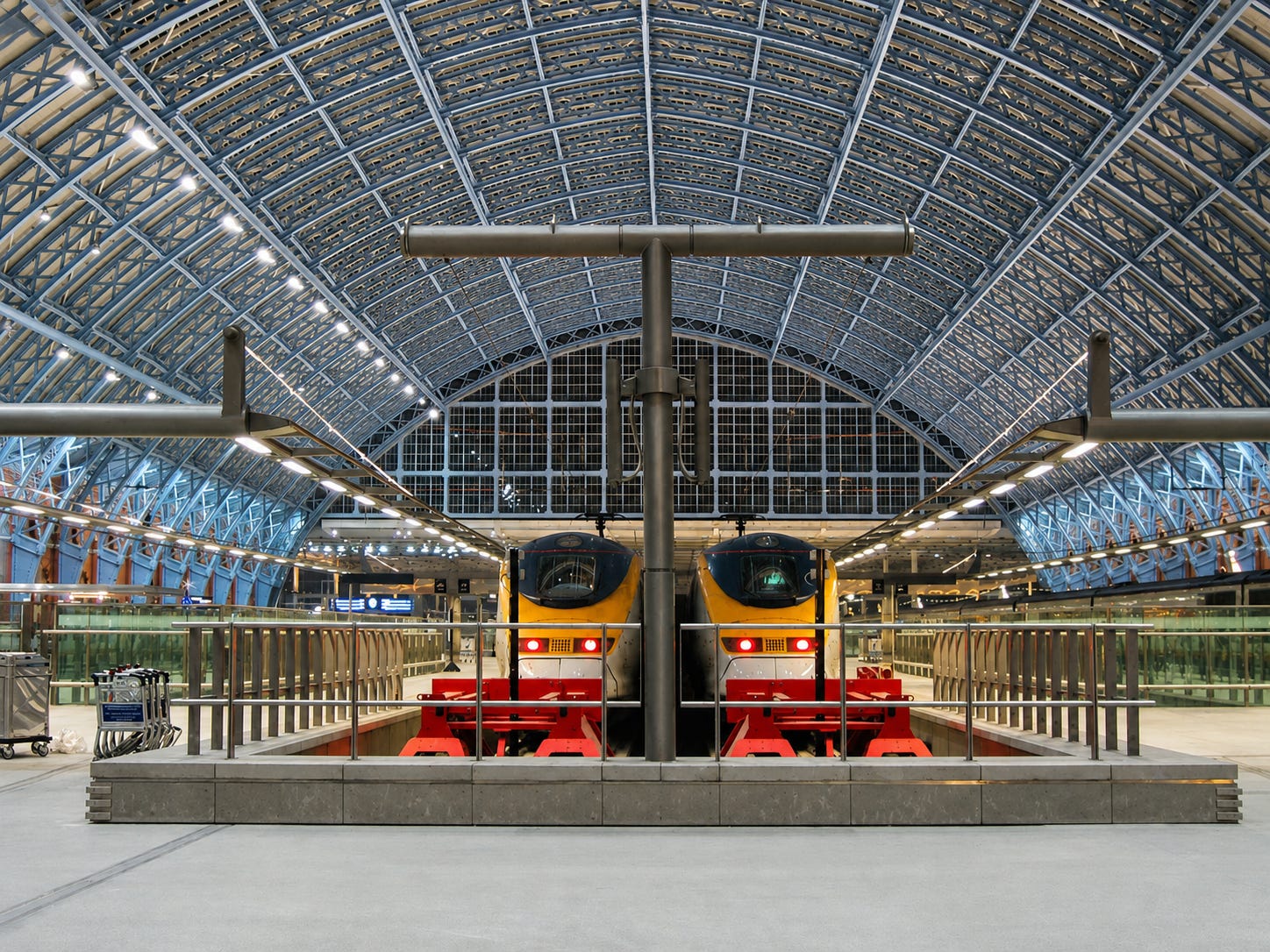
Eurostar, SBB and SNCF plan direct Switzerland–London services
CROSS-BORDER: Three of Europe’s major rail operators have committed to developing direct trains between Switzerland and London, signing a memorandum of understanding that moves the project from intergovernmental intent to operational planning.
The 11 May MoU commits Eurostar, SBB and SNCF to joint timetable studies and operational concepts — but does not bind any party to a service launch, rolling stock order or funding arrangement.
Border control at the Channel Tunnel remains the structural constraint. UK passport and customs requirements apply to all cross-Channel services, and the existing terminal infrastructure was built for Eurostar’s current operation alone.
Rolling stock and train paths through France are also unresolved. Direct services are not expected before the early 2030s at the earliest.
MI20 completes first full run at Alstom-CAF plant
FRANCE: The first complete MI20 trainset has run under its own power at the Alstom-CAF facility in Crespin, marking a production milestone for the EUR 2.5bn fleet ordered to replace ageing stock on Paris’s RER B.
Île-de-France Mobilités, Alstom and CAF presented the trainset on 7 May — the first time a fully assembled MI20 unit has moved under its own power. Previous showings involved individual car sections or static displays.
Delivery of the 146-train fleet to RER B is now targeted for late 2028. Before revenue service, the sets must complete a testing and homologation programme on live infrastructure.
First of 30 dual-voltage regional sets enters Franco-German service
CROSS-BORDER: A new dual-voltage regional trainset built by CAF on the Coradia Polyvalent platform has entered service on the Strasbourg–Offenburg corridor, the first of 30 sets ordered under a EUR 388m contract backed by the three German partner Länder and part-funded by the EU’s Interreg programme.
The first set entered commercial service 4 May. German network certification, granted in late January 2026, was the final regulatory step before cross-border service could begin.
Cross-border operations are scheduled to continue phasing in through 2027. SNCF operates the service under a public service contract with Grand Est.
Europe’s new rail standard: is this the VHS moment?
Four major European operators have independently chosen the same Spanish long-distance train — and together they have created a default no one declared.
DB, DSB, FlixTrain and Trafikverket have all contracted Talgo for its 230 platform — a locomotive-hauled intercity train built around a single-axle running gear system first patented in 1941. No one chose it as a default. It became one.
The convergence carries a structural risk: Talgo 230 is a patent, not an open standard. The carriages are built at Talgo’s facilities in Spain, by a company whose order book has never been larger and whose financial position has rarely been more fragile.
Direct Oslo–Copenhagen–Berlin service to launch in 2028
CROSS-BORDER: Norwegian operator Vy, Denmark’s DSB and Deutsche Bahn have announced a direct rail service linking Oslo, Copenhagen, Hamburg and Berlin from summer 2028. The service will be one of Europe’s longest direct rail connections and the first between Norway and Denmark in more than two decades.
The three operators announced the partnership 9 May. DB’s ICE L rolling stock will be used on the full route, with Vy crews operating the Oslo–Copenhagen leg. Two daily return services are planned year-round.
The Oslo–Berlin journey will take approximately 14 to 15 hours — in day coaches with no sleeping accommodation.
That’s The Rail Agenda for today. If you found this newsletter useful and relevant, please forward it to someone you know.