

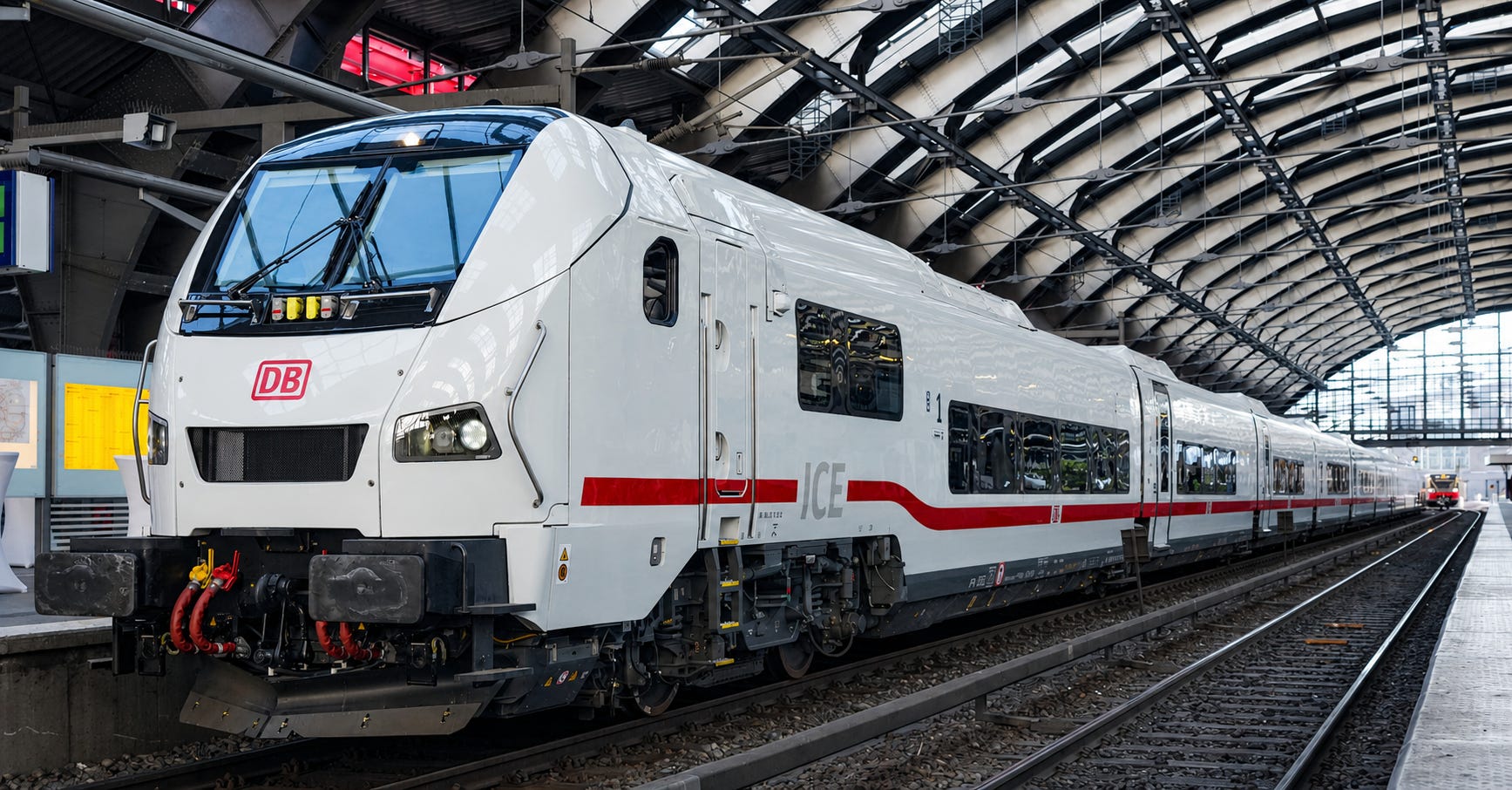
CROSS-BORDER: Norwegian operator Vy, Denmark’s DSB and Deutsche Bahn have announced a direct rail service linking Oslo, Copenhagen, Hamburg and Berlin from summer 2028. The service will be one of Europe’s longest direct rail connections and the first between Norway and Denmark in more than two decades.
The three operators announced the partnership 9 May. The service will run using DB’s ICE L rolling stock, with Vy crews operating the Oslo–Copenhagen leg. Two daily return services are planned year-round.
The Oslo–Berlin journey will take approximately 14 to 15 hours, with stops including Gothenburg, Malmö, Copenhagen Airport and Copenhagen before continuing via Hamburg.
Three operators, four countries
Vy will staff the train between Oslo and Copenhagen. DB’s ICE L sets — 17 coaches, 562 seats, with a restaurant car, family section and first class — will be used on the full route.
Planned stops on the Norwegian and Swedish leg include Moss, Fredrikstad, Sarpsborg, Halden, Trollhättan, Gothenburg, Halmstad, Helsingborg, Lund and Malmö before crossing into Denmark via Copenhagen Airport.
From Copenhagen, the service continues via Odense, Kolding and Padborg into Germany, stopping at Hamburg before terminating in Berlin.
A corridor restored
The direct Oslo–Copenhagen connection was abandoned in the early 2000s as low-cost airlines made the route commercially unviable. More than two decades later, the three operators are betting that rising fuel costs and growing demand for international rail travel have changed the economics.
Tickets, precise departure times and rolling stock approvals for Norway and Sweden have not yet been announced. The partnership said further details would follow.
Fehmarn Belt as accelerator
The corridor’s commercial logic will strengthen further when the Fehmarn Belt fixed link opens, cutting journey times between Copenhagen and Hamburg significantly. The tunnel is currently under construction and expected to open in the early 2030s — after the Oslo–Berlin service is due to launch, but within its operational horizon.
The fixed link will not affect the 2028 launch, but it reframes the route’s long-term viability. A journey that takes 14 to 15 hours today could become meaningfully shorter within the service’s first decade.
The sleeper question
At 14 to 15 hours, the Oslo–Berlin journey sits in an awkward middle ground. The service uses day coaches with no sleeping accommodation.
The format has worked on shorter long-distance corridors. No sleeping accommodation on a 14 to 15-hour route is the service’s most obvious commercial risk.