

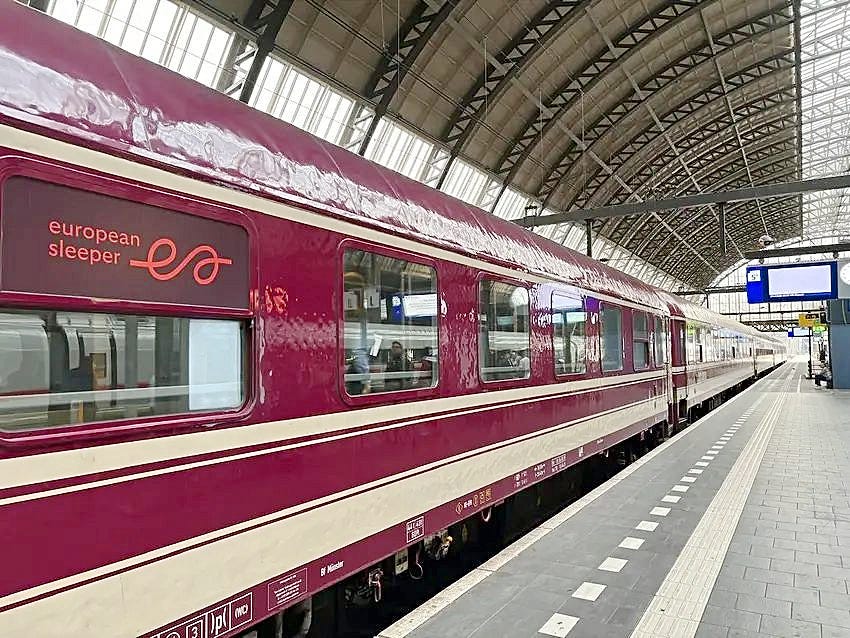
European Sleeper signs Italian traction deal for Milan service
NIGHT TRAINS: European Sleeper has confirmed Arenaways as its Italian traction partner for the Brussels–Milan night train launching 9 September, completing the operational setup for the route ahead of a debut that was once expected in June.
Arenaways — the commercial brand of Longitude Holding, partly owned by Renfe Proyectos Internacionales — will handle locomotive services on the Italian section. The agreement fills the last operational gap before a three-times-weekly service begins from Milano Porta Garibaldi.
From December 2026, the route extends to Antwerp, Breda and Eindhoven, adding three Dutch cities to the overnight network.
Rail Baltica publishes first rulebook for future operators
CROSS-BORDER: Rail Baltica’s three national infrastructure managers have published the first Network Statement for the cross-border line linking Estonia, Latvia, Lithuania and Poland. The document sets out access and operating conditions for railway undertakings — even as the project’s financing and timeline remain unresolved.
The statement, published 11 June under the RailNetEurope framework, covers infrastructure characteristics, ERTMS Level 2 signalling and access conditions for the standard-gauge (1,435 mm) corridor. It was produced jointly by Rail Baltic Estonia, Eiropas Dzelzceļa Līnijas in Latvia and LTG Infra in Lithuania.
Rail Baltica’s own leadership has recently indicated that the original 2030 completion target is no longer realistic, with 2035 now under discussion.
Chinese-built CRRC train cleared to run in Romania
ROMANIA: A CRRC Sifang train ordered by private operator Astra Trans Carpatic has received type and placing-in-service authorisation from Romania’s rail safety authority ASFR. The approval clears nearly five years of legal disputes over China’s access to the Romanian market and opens the way for commercial service.
ASFR issued the authorisations to Astra Vagoane Călători, the Arad-based sister company of Astra Trans Carpatic. Commercial service on the Bucharest–Brașov route is expected to begin in July, subject to a maintenance entity certificate still outstanding from ASFR.
The Romanian case proceeded under EU procurement law — not the Foreign Subsidies Regulation — after a court found the original 2021 exclusion of the CRRC consortium incompatible with EU rules.
One of Europe’s biggest infrastructure projects just got more complex
The Fehmarnbelt tunnel — an 18 km fixed link carrying trains and cars beneath the Baltic Sea — will open in two stages, with rail following road by at least a year. Denmark is building it. The delay is on the German side.
By Dan Jensen
Femern A/S confirmed on 18 May that the road section will open first. The Fehmarnsund tunnel — a separate 1.7 km connection between the island of Fehmarn and the German mainland — is not expected to be complete before the end of 2032, a year after the main tunnel’s 2031 target.
No date has been set for rail opening. The tunnel’s rail section has received EUR 1.29bn through the EU’s Connecting Europe Facility.
Tended expands geofencing safety system to Dutch rail network
INDUSTRY: British safety technology firm Tended has partnered with Dutch infrastructure provider Safelines BV to extend its geofencing system across the Netherlands’ rail network. The system replaces manual trackside marker boards with digital alerts.
The partnership was announced 9 June. Safelines BV, part of the ATR Group, has operated in Dutch railway safety for more than two decades and is described by Tended as the country’s largest provider of trackside safety solutions.
It is Tended’s second partnership in the Netherlands, following a 2024 collaboration with Dual Inventive.
That’s The Rail Agenda for today. If you found this newsletter useful and relevant, please forward it to someone you know.