

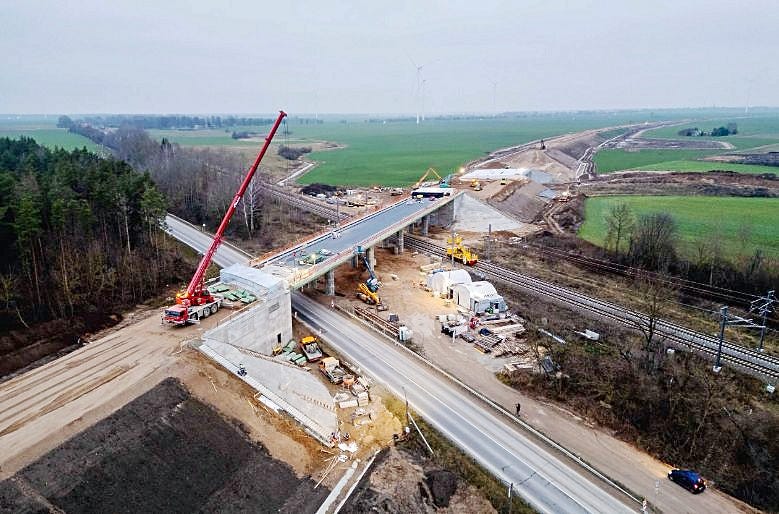
CROSS-BORDER: Rail Baltica’s three national infrastructure managers have published the first Network Statement for the cross-border line linking Estonia, Latvia, Lithuania and Poland. The document sets out access and operating conditions for railway undertakings — even as the project’s financing and timeline remain unresolved.
RB Rail AS, together with Rail Baltic Estonia, Eiropas Dzelzceļa Līnijas (EDZL) in Latvia and LTG Infra in Lithuania, published Version 1 of the Network Statement on 11 June. The document follows the RailNetEurope framework used across Europe to harmonise cross-border access rules.
It is the first consolidated reference for operators on the new standard-gauge line, covering infrastructure characteristics, ERTMS Level 2 signalling and access conditions. The publication gives operators a formal basis to engage with the project ahead of commissioning.
A rulebook for a line still under construction
The Network Statement gives operators a single reference point for how the future line will work. It describes a standard-gauge (1,435 mm) corridor running through Estonia, Latvia and Lithuania, connecting onward to Poland, built to ERTMS Level 2 with FRMCS as the underlying communications layer.
For railway undertakings, this marks a shift in what Rail Baltica represents. Until now, the project has existed mainly as a construction site. A reference framework for access and operations turns it into something operators can plan around — track conditions, technical parameters, the rules they will eventually need to comply with.
The publication comes as Rail Baltica is also being discussed as a priority corridor for military mobility, as one of several cross-border routes flagged for troop and equipment movements.
Rules arrive before the money does
The timing creates a contrast. Rail Baltica’s own leadership has recently acknowledged that the original 2030 completion target is no longer realistic, with a 2035 horizon now under discussion. The European Commission has separately terminated funding for a bridge project on the line after construction failed to begin within the required timeframe.
A Network Statement does not require a finished railway to exist — it is a planning document for infrastructure managers and a reference for operators preparing years in advance. But its publication now means Rail Baltica is simultaneously defining how the line will operate and acknowledging that defining when it will operate is still unresolved.
For operators weighing future services on the corridor, the document answers the technical question. The financial and scheduling question remains open.