

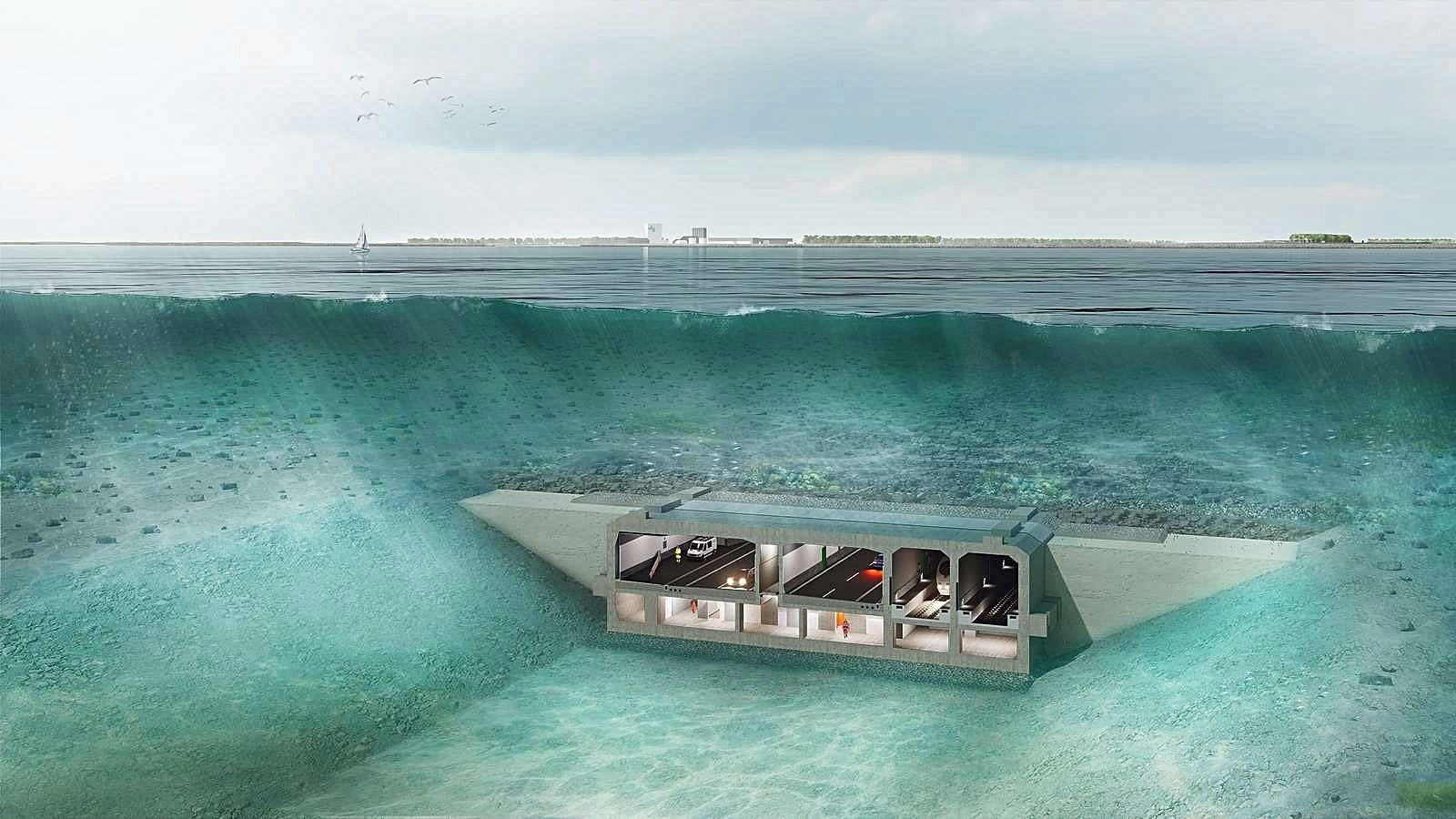
The Fehmarnbelt tunnel — an 18 km fixed link carrying trains and cars beneath the Baltic Sea — will open in two stages, with rail following road by at least a year. Denmark is building it. The delay is on the German side.
By Dan Jensen
Femern A/S confirmed on 18 May that the road section will open first, with rail following once Germany’s own approach infrastructure is complete. The Fehmarnbelt crossing has two parts: an 18 km tunnel beneath the Baltic Sea between Rødbyhavn on the Danish island of Lolland and Puttgarden on the German island of Fehmarn, and a separate 1.7 km tunnel connecting Fehmarn to the German mainland.
The split follows a German assessment that the Fehmarnsund tunnel — the connection between Fehmarn and the German mainland — will not be ready before the end of 2032, a year after the main tunnel’s 2031 target. The large tunnel is on schedule; the small one is not.
What the tunnel actually is
The Fehmarnbelt tunnel is an immersed tunnel built from 89 prefabricated concrete elements. Four tubes run through each element: two for a four-lane motorway, two for an electrified double-track railway, plus a service corridor. When complete, it will be the longest immersed tunnel in the world.
The elements are cast in a purpose-built factory at Rødbyhavn, towed out and lowered into a trench dredged across the seabed.
Financing model similar to Great Belt and Øresund
Femern A/S, a subsidiary of the Danish state-owned Sund & Bælt, is building and will operate the tunnel. The financing model — state-guaranteed loans repaid through tolls — is the same used for the Great Belt fixed link and the Øresund crossing.
The Great Belt link is a purely Danish project; the Øresund crossing is a joint Danish-Swedish undertaking. The Fehmarnbelt tunnel is Danish-built and Danish-financed, with Germany responsible for its own hinterland connections.
The European Union has designated the link as one of the priority cross-border projects on the Scandinavian-Mediterranean Core Network Corridor, with the rail section receiving EUR 1.29bn through the Connecting Europe Facility.
Element by element
Construction began in 2021. The factory at Rødbyhavn where the tunnel elements are cast has been operating for years — each element takes months to produce before it is ready to be towed out and lowered into position on the seabed.
The first element was placed on 7 May 2026, with 88 remaining. The marine works alone are expected to run well into 2027.
The main tunnel is targeted for completion in 2031, a date that has already slipped once from the original 2029 target. On current progress, the element-by-element assembly is the longest phase of what remains.
The German bottleneck
The Fehmarnsund bridge connects the island of Fehmarn to the German mainland. It carries two road lanes and a single rail track — and studies concluded as early as 2012 that it cannot handle the traffic volumes expected after the Fehmarnbelt tunnel opens.
Germany’s answer is a new tunnel at Fehmarnsund — 1.7 km of immersed tunnel for road and rail, under contract since late 2025 with construction scheduled to begin in 2026, but not expected to be complete before the end of 2032.
Legal challenges to the routing through Schleswig-Holstein have added further uncertainty to the German timeline. No new date for the rail opening has been set — only that it follows road, and that the German link is not expected before late 2032 at the earliest.
A corridor still being assembled
Once open, the tunnel cuts the rail journey between Copenhagen and Hamburg from around four and a half hours to roughly two and a half. That reduction holds regardless of the staged opening — it simply arrives later for trains than for road traffic.
The Fehmarnbelt link is part of the Scandinavian-Mediterranean Corridor, the EU’s designated spine connecting Scandinavia to central and southern Europe. The corridor already has one completed fixed link: the Øresund crossing between Denmark and Sweden, in operation since 2000.
The drawing board
A third link is on the drawing board. A Swedish government inquiry recommended in March 2026 that Denmark and Sweden develop a joint project basis for a new fixed connection across the Øresund — primarily a tunnel to Copenhagen — ahead of a possible formal investigation in 2027.
Vy, DSB and Deutsche Bahn announced a direct Oslo–Copenhagen–Berlin service in May 2026, targeting a 2028 launch — three years before the Fehmarnbelt tunnel’s road section opens, and well ahead of a rail connection that depends on a German link not expected before 2032.
The corridor between Scandinavia and continental Europe is being built in pieces — one finished, one under construction and now opening in stages, one still on paper.