

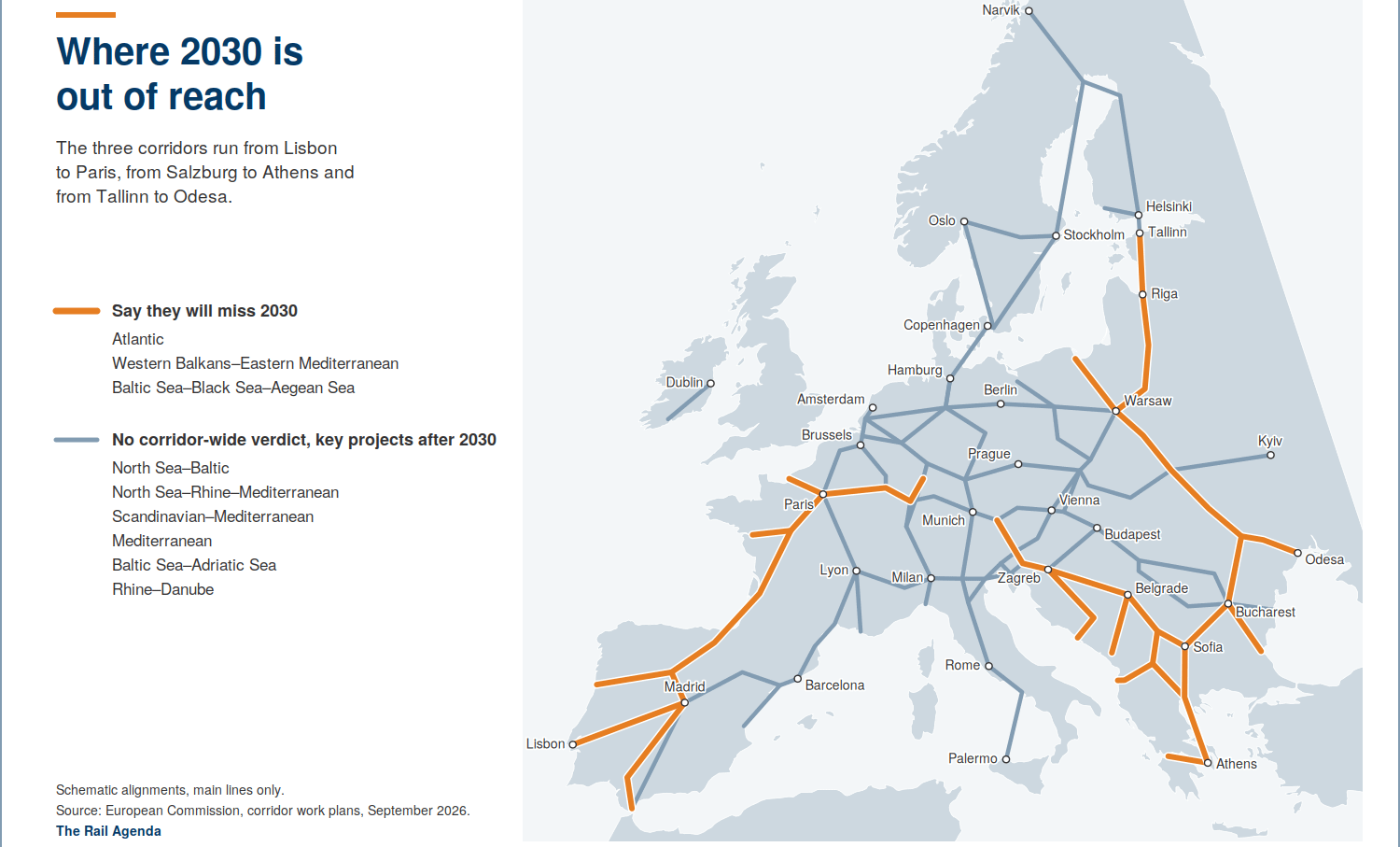
EU: Three of the nine TEN-T corridors will not meet the 2030 deadline, according to new European Commission work plans. Officially, the other six give no corridor-wide verdict. In practice, they will miss it too: each plan names at least one key project not due by 2030.
The Commission published the plans on 30 September. They are the official status report on each corridor: drawn up by its European coordinator, approved by the member states on the corridor and the basis for a Commission implementing decision on it.
The European Court of Auditors warned in a report earlier this year that the 2030 deadline for the core network “will not be met”. Now the Commission’s own coordinators put it in writing, corridor by corridor.
Under the TEN-T Regulation, in force since July 2024, all nine European Transport Corridors must meet common EU standards on their core network by 2030. The standards include ETCS signalling, electrification and room for 740-metre freight trains.
ETCS is in operation on between 5% and 21% of the corridors’ networks in the plans that give a figure, measured at the end of 2024 or in March 2026. The ERTMS coordinator’s separate work plan, published in February, put ETCS at about 10% of the whole TEN-T network at the end of 2024.
Three plans on 2030 compliance
“Full compliance of the core network will not be reached by the 2030 milestone,” the Atlantic corridor plan says. It puts ETCS in operation on 14% of the corridor at the end of 2024.
The Western Balkans–Eastern Mediterranean corridor is “unlikely to achieve complete TEN-T compliance by 2030”, its plan says. Lines able to take 740-metre trains make up 32% of that corridor, and ETCS 10%, as of March 2026.
The Baltic Sea–Black Sea–Aegean Sea plan says planned projects will not be enough to make the corridor fully compliant by 2030, citing implementation delays and projects missing from national agendas. The corridor, which includes Ukraine and Moldova, had ETCS on 5% of its network in March 2026.
Rail projects dated after 2030
The plans give dates beyond 2030 for several major rail projects:
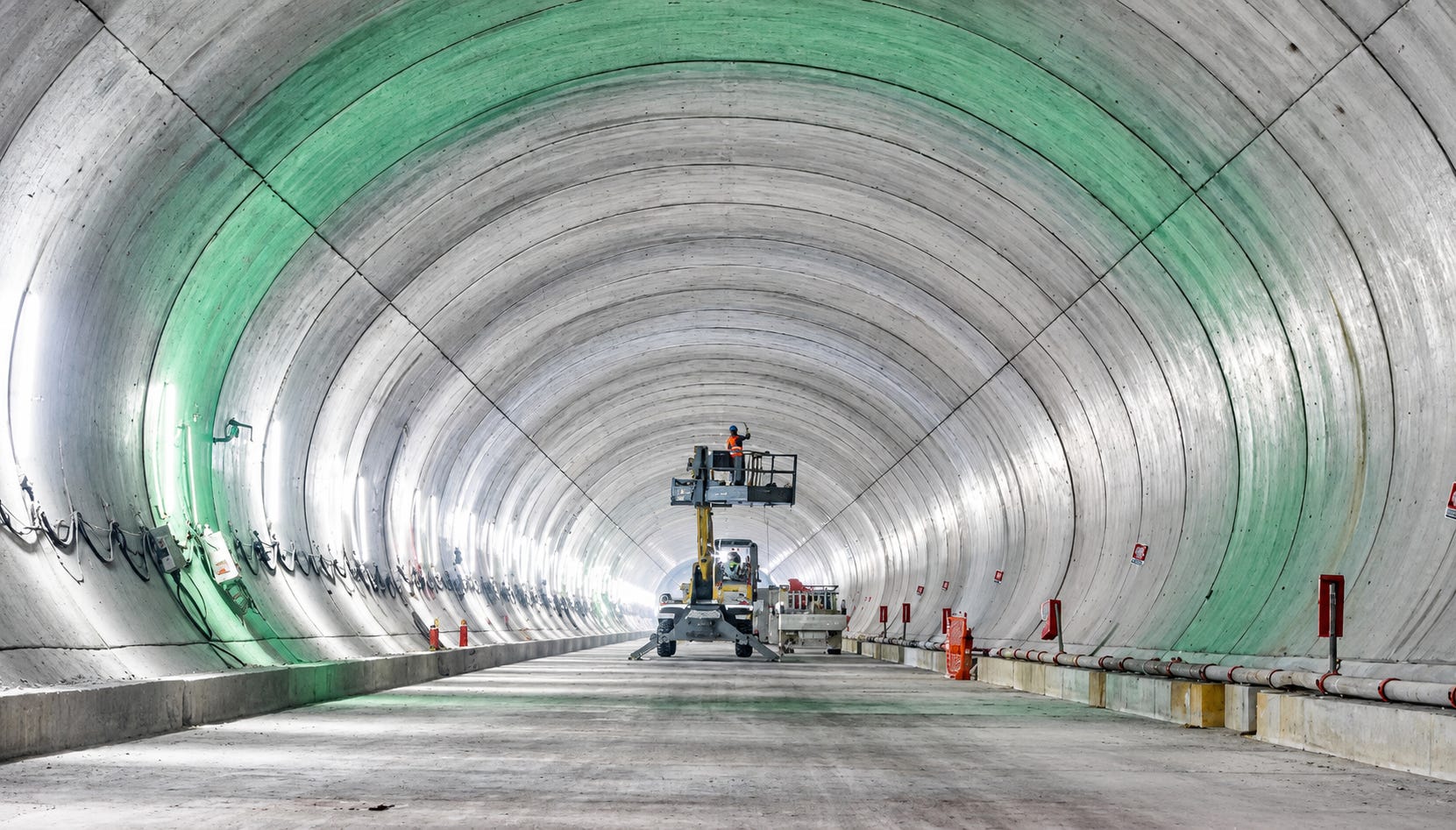
Brenner Base Tunnel – in operation at the end of 2032 (Scandinavian–Mediterranean)
Vicenza–Padova – moved from 2029 to 2034 (Mediterranean)
Karlsruhe–Basel, lots 7 and 8 – after 2035 (North Sea–Rhine–Mediterranean)
Dax–Spanish border – beyond 2040 (Atlantic)
Salzburg–Köstendorf – 2046 (Rhine–Danube)
On the North Sea–Rhine–Mediterranean corridor, 46 core projects have an unknown completion date or one later than 2030. Germany accounts for 25 of them.
The North Sea–Baltic plan considers completion of Hannover–Bielefeld by 2040 unlikely. The Baltic Sea–Adriatic Sea plan says the same about Karlovac–Rijeka by 2030, and the Rhine–Danube plan gives no date for Dresden–Prague, where two sections alone are costed at EUR 10.6bn.
Investment needs
The Western Balkans–Eastern Mediterranean plan puts rail investment needs at EUR 58.5bn, of which EUR 17.6bn is secured. That leaves EUR 40.9bn not yet secured.
The Scandinavian–Mediterranean plan puts total needs at EUR 190.7bn, EUR 159.4bn of it for rail. The Mediterranean plan estimates EUR 145bn, half of it for rail, and the North Sea–Baltic plan EUR 146.2bn. The figures come as EU institutions negotiate the next Connecting Europe Facility for 2028–2034, the EU’s main budget line for transport infrastructure.
The North Sea–Baltic plan lists the first phase of Rail Baltica for the end of 2030. The three Baltic governments said on 22 September that the main line would be operational within the 2028–2034 budget period.