

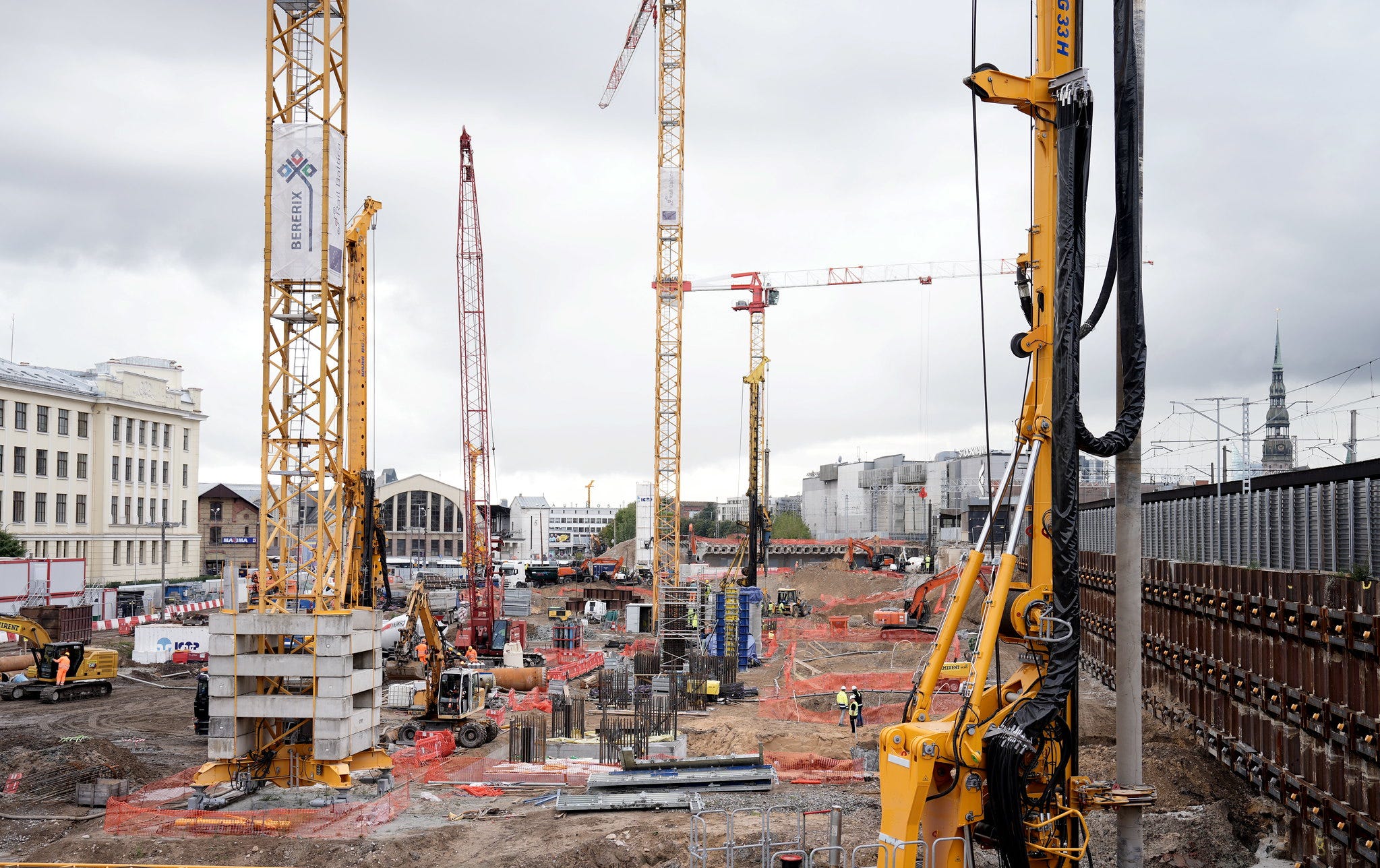
LATVIA: The government will set a ceiling on the state’s spending and then redesign the first phase to fit. An independent assessment found the railway as specified will cost far more than planned and cannot be completed on EU funding alone. Ministries have until 15 September to propose the ceiling and the cuts to technical requirements.
The decision was taken at a meeting of the government’s Rail Baltica committee, chaired by prime minister Andris Kulbergs, according to a statement from the Transport Ministry. The consultants presented three scenarios: continue as planned, reduce requirements, or stop. The government chose the second.
The first-phase scope stays: the main line from the Lithuanian to the Estonian border, plus the airport station and the southern part of Riga Central. The Riga loop is not abandoned but falls outside the first phase, transport minister Rihards Kozlovskis said.
What the consultants found
Alvarez & Marsal, the consultancy commissioned by the cabinet in November 2025, concluded that continuing on the current path would drive full-scope costs in Latvia substantially higher, and that completion with existing EU funding alone will not be possible. The report also faults governance: without a single accountable owner and an experienced project team, successful delivery is unlikely.
The consultants’ sequence is the reverse of the project’s practice to date: fix the annual amount the state budget can commit, then agree minimum technical requirements — above all maximum speed — with Estonia, Lithuania and the European Commission.
Where the savings start
The ministry presented a first cut on the 33 km Misa–Lithuanian border section. It was prepared with the contractors and Eiropas Dzelzceļa līnijas, the state company delivering Rail Baltica in Latvia. Standardised solutions for structures, components and environmental measures would cut future construction costs by 24.8%, or EUR 108m:
Average track elevation lowered by about 3 metres and frost-protection layer reduced by 37%, cutting embankment volume by 46% and excavation and soil replacement by 25%.
Potential removal of 13.2 km of noise barriers.
What happens by 15 September
The Finance Ministry, together with the State Treasury and the transport and economics ministries, must assess how much the state budget can commit in coming years. The Transport Ministry must propose how far technical and material requirements can be reduced within the first-phase scope. The State Chancellery must review the governance model the consultants proposed. The report itself remains a restricted document.
RB Rail, the joint venture coordinating the project, said it had supplied all information requested but had not discussed the scenarios with the consultants and learned of them from public sources. Chief financial officer Ojārs Daugavietis said decisions of this weight must be agreed among all three states, and that the current lack of clarity was already slowing work in Latvia.
