

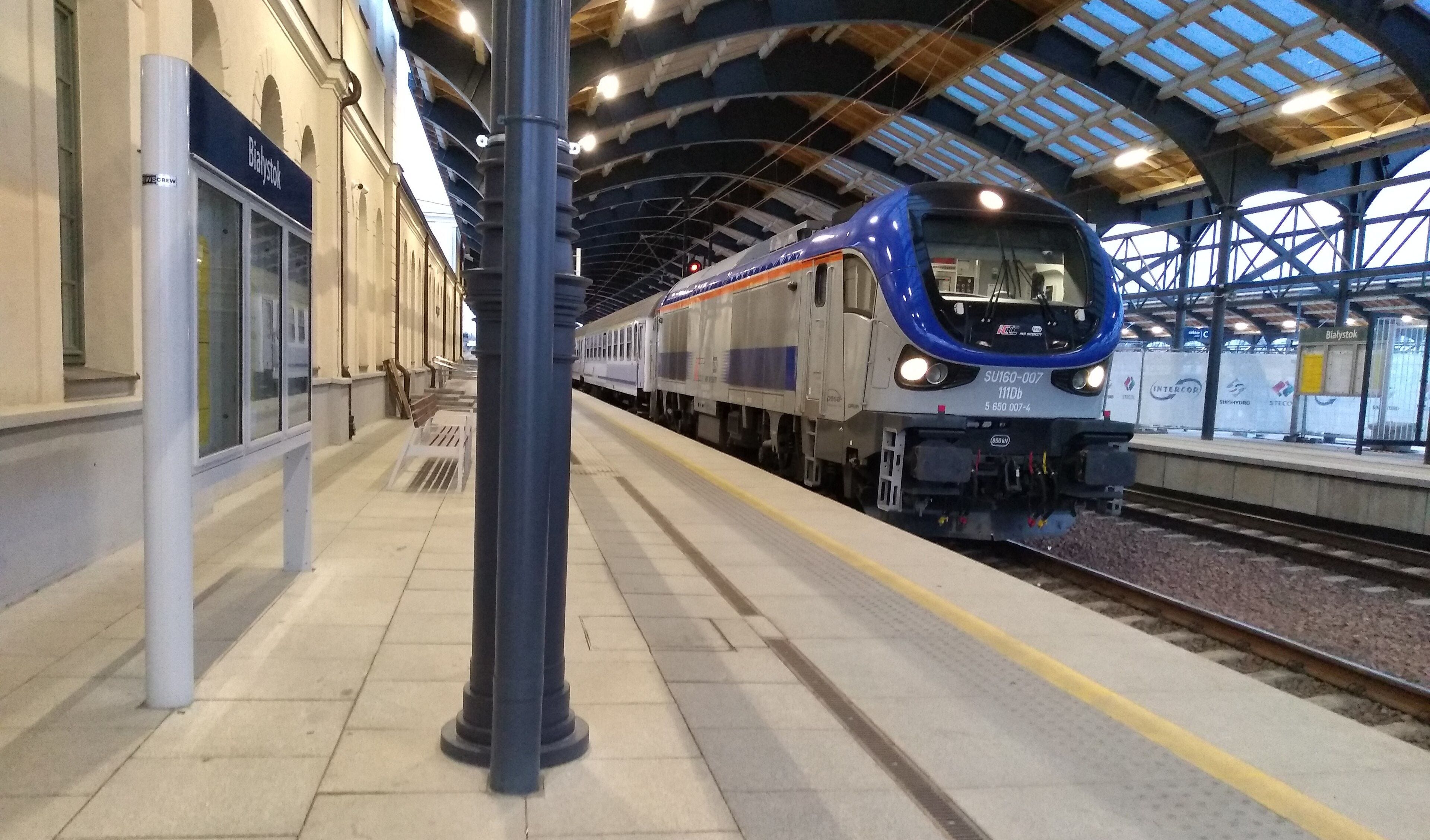
POLAND: Infrastructure manager PKP Polskie Linie Kolejowe has signed a roughly EUR 940m contract to rebuild almost 95 km of the Rail Baltica line between Białystok and Ełk, with completion due in late 2029. The contractor was chosen three times after two awards were overturned.
PKP Polskie Linie Kolejowe signed the contract at Białystok station with a consortium led by Track Tec Construction. The other members are Intop, Intop Infrastruktura, Unibep and Pomorskie Przedsiębiorstwo Mechaniczno-Torowe. The contract is worth roughly EUR 940m net and EUR 1.16bn gross.
The signing moves the section from procurement to construction. The tender was launched in January 2025, and a ruling by the Warsaw Regional Court on 4 September cleared the way for signature. Works are scheduled to run to the fourth quarter of 2029.
What the contract covers
The line will be double-track along its full length and get computer-based interlocking. Eight stations and 10 stops are covered by the works.
Passing stations will be built at Podlasek and Lipińskie Małe to add capacity. Level crossings will be replaced by 32 grade-separated crossings.
Passenger trains will be able to run at 200 km/h on most of the section once all works are finished and the European Train Control System (ETCS) has been commissioned. The Polish infrastructure manager gives no date for ETCS. Freight trains will be able to run at 120 km/h with lengths of 750 m, and the planned Białystok–Ełk journey time is 55 minutes.
Two overturned awards
The infrastructure manager first chose a consortium of Torpol and Mirbud in November 2025, which had submitted the lowest-priced bid. Poland’s public procurement appeals chamber ordered that bid rejected on 19 January 2026 after an appeal from the second-ranked consortium. According to industry reports, Mirbud had not disclosed a 2022 environmental fine in its bid documents.
The second choice was a consortium of Budimex, Porr and Budimex Kolejnictwo, and the Track Tec consortium, ranked third on price, appealed.
According to the reports, it challenged the compliance measures, known as self-cleaning, that Budimex had taken after the appeals chamber found signs of bid coordination between group companies in a separate tender. The appeals chamber ordered the Budimex bid rejected in March, and the Track Tec consortium was chosen in April.
Torpol and Mirbud had already taken their exclusion to court. On 1 June the appeals chamber turned down two further appeals against the April award, from the Torpol-Mirbud consortium and a consortium of Intercor and Trakcja. The Warsaw Regional Court dismissed the Torpol and Mirbud complaint on 4 September and upheld the exclusion.
Signing in Białystok
“This contract is a success. After months of procedures we are finally entering the construction stage of one of the largest railway projects in our country,” said Deputy Infrastructure Minister Piotr Malepszak.
Piotr Wyborski, chief executive of the infrastructure manager, told the press conference that it is the largest single contract in the company’s history, according to news agency PAP. The company’s own press release is headlined as a record contract.
The corridor toward Lithuania
Białystok–Ełk is part of the E75 line, the Polish branch of Rail Baltica toward the Lithuanian border. The deputy minister said the section opens the prospect of fast journeys to Lithuania, Latvia and Estonia.
The works are split into three projects – Białystok–Knyszyn, Knyszyn–Osowiec and Osowiec–Ełk. All three are co-financed by the EU’s Connecting Europe Facility. The grant amount per project is not stated.
In Lithuania, infrastructure manager LTG Infra moved to terminate the construction contract for Rail Baltica’s bridge over the Neris in June. A new tender for the bridge has not yet been published.
Third-country contractors excluded
The chief executive said in the company’s statement that the work goes to contractors that do not come from so-called third countries.
It was the first tender in which the Polish infrastructure manager applied rules derived from a ruling by the Court of Justice of the European Union, according to industry reports. Only companies from the EU, the European Economic Area and countries covered by the World Trade Organization’s procurement agreement could bid.
The European Commission has proposed a European preference in public procurement. The Polish statement does not say whether any bidder was excluded under the third-country condition.