

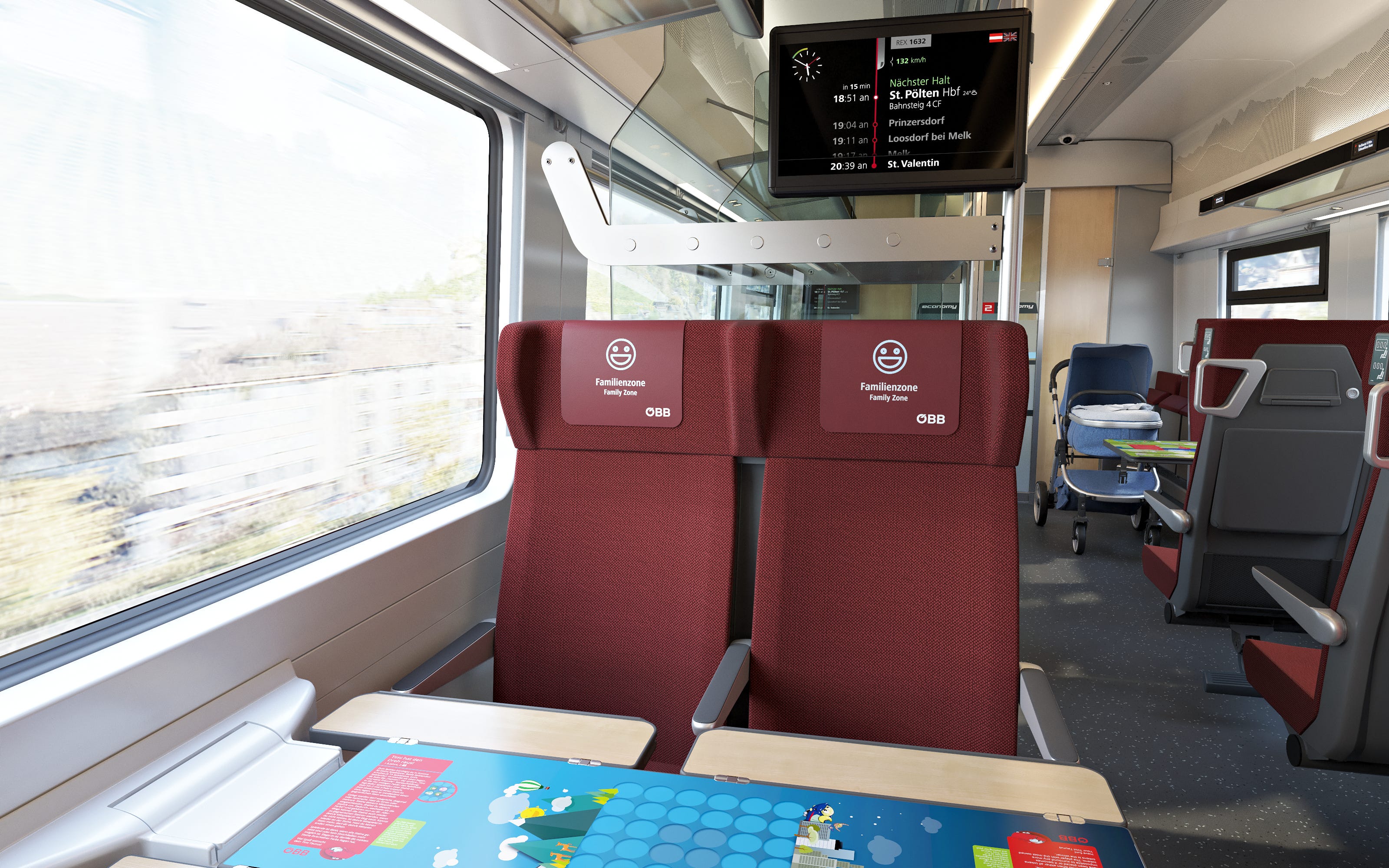
A passenger’s entire experience of a train — boarding, finding information, moving between cars, feeling safe — is delivered by technical subsystems engineered, certified, and maintained as rigorously as the traction equipment beneath the floor.
Passenger-facing systems are sometimes treated as a finishing layer, applied once the structural and mechanical design is complete. In practice, they impose binding constraints on vehicle architecture from the earliest design phase.
Interiors in the vehicle design process
Door positions determine body-section geometry and structural opening sizes. Gangway connections define the inter-car coupling envelope and influence aerodynamic sealing requirements at speed.
Passenger information displays require power routing, network cabling, and integration with the Train Control and Management System (TCMS). Closed-circuit television (CCTV) systems impose storage, bandwidth, and data-retention obligations that interact with cybersecurity frameworks.
The TSI framework for passenger subsystems
These systems are governed by a regulatory layer that overlaps with, but is not identical to, the traction, signalling, and braking standards that dominate rolling stock certification.
The primary instruments are TSI LOC&PAS (Commission Regulation (EU) No 1302/2014, most recently amended by Implementing Regulation (EU) 2025/675) and TSI PRM (Commission Regulation (EU) No 1300/2014, amended in 2023), together with EN 50155:2021 — the base standard for onboard electronic equipment in rolling stock — and a series of component-specific standards.
TSI LOC&PAS addresses passenger-related items in clause 4.2.5, covering interior requirements that affect interoperability: door control logic, door construction, inter-unit doors, and glazing specifications. Step heights and gaps at boarding, and gangway passage dimensions, fall instead under TSI PRM.
TSI PRM adds accessibility requirements for both rolling stock and stations: passenger information displays must deliver visual and audible output, boarding aids must meet specified reach-zone and force-limit parameters, and toilet provision for wheelchair users follows defined dimensional criteria.
Fire safety across passenger systems
EN 45545-2, the fire protection standard for railway vehicles, applies to materials and products used throughout the vehicle.
Hazard Level (HL) requirements apply differentially by design category and operational category, the latter reflecting evacuation conditions: a vehicle running through tunnels or on elevated structures carries higher hazard level requirements than one operating in open-air conditions.
Gangway bellows, interior panels, seat upholstery, and cable insulation must all demonstrate compliance with the applicable HL classification.
Integration and lifecycle constraints
The subsystems in this section share a structural challenge: their service lives differ from those of the vehicle bodies that house them.
Passenger information and CCTV electronics typically require replacement well before the vehicle body reaches mid-life. Door mechanisms are specified for defined operating-cycle lifetimes, and gangway bellows are replaced at intervals governed by material fatigue and UV exposure.
Vehicle bodies are conventionally designed for a service life in the order of 30 to 40 years. Managing the mismatched lifecycles requires modular design, accessible mounting arrangements, and technology-agnostic interfaces — particularly for electronics — so that later-generation hardware can be installed without structural modification.
Europe’s Rail Joint Undertaking (EU-Rail) is working explicitly toward standardised, interoperable onboard networks for next-generation TCMS architecture that can accommodate equipment upgrades without full system replacement.