

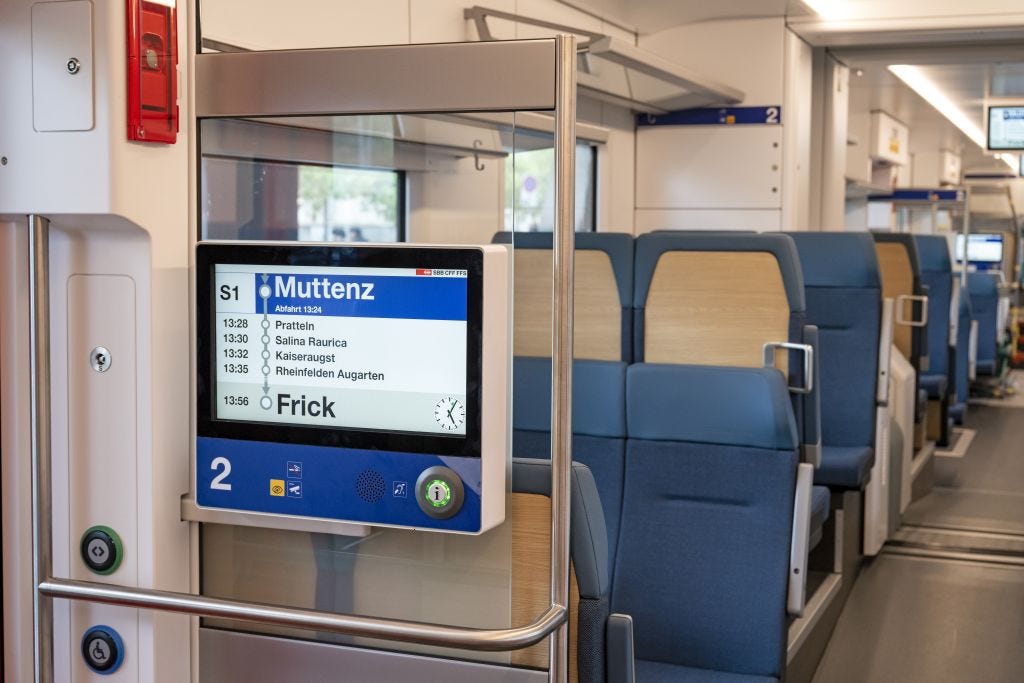
A passenger information system (PIS) is the onboard subsystem that delivers real-time journey information to passengers through visual displays and audio announcements during a train service.
Few onboard passenger systems are as visible to travellers as the PIS. It determines what passengers see and hear about their journey, from the next stop to a disrupted connection.
System architecture
A PIS consists of display units, an audio system, a control server, and data interfaces. Interior displays show next stop, terminus, route map, connection information, and service status.
Exterior displays carry destination and route number, while public address speakers deliver automated announcements with volume adjusted automatically to ambient noise levels.
The control server receives position data from the Train Control and Management System (TCMS) — typically wheel-pulse odometry and GPS — and uses it to trigger location-based announcements and display updates. It also draws door status, speed, and time data from the TCMS.
Integration with onboard closed-circuit television (CCTV) allows passenger emergency call locations to be relayed to the surveillance system. On vehicle types with multiple compartment zones, announcements can be targeted to specific saloon sections independently.
Display technology
Thin-film transistor (TFT) LCD and LED-backlit panels have replaced the flip-disc and LED-matrix units common in rolling stock built before 2005. Exterior destination signs require high-brightness panels to stay legible in direct sunlight, with brightness specifications set at procurement level.
All electronic display and control hardware must meet EN 50155:2021, which specifies operating temperature ranges (typically OT3: −25°C to +70°C), power supply interruption tolerance, shock and vibration resistance per EN 61373, and EMC limits under EN 50121-3-2.
Accessibility requirements
TSI PRM (Technical Specification for Interoperability relating to Persons with Reduced Mobility — Commission Regulation (EU) No 1300/2014, as amended by 2023/1694) requires onboard PIS to announce at least the next stop, the terminus, and any service disruption, both visually and audibly.
Display contrast ratios and character heights are specified to ensure legibility for passengers with visual impairments. Audio clarity requirements address the background noise levels typical of high-speed operation.
Data sources and management
PIS data is maintained in an off-board management platform, typically cloud-hosted, through which operators configure timetables, route information, and real-time updates. Real-time exchange runs over interfaces to national traffic management systems.
PIS electronics have a significantly shorter service life than the vehicle body. Modular replacement without structural modification is therefore a standard procurement requirement for new rolling stock.