

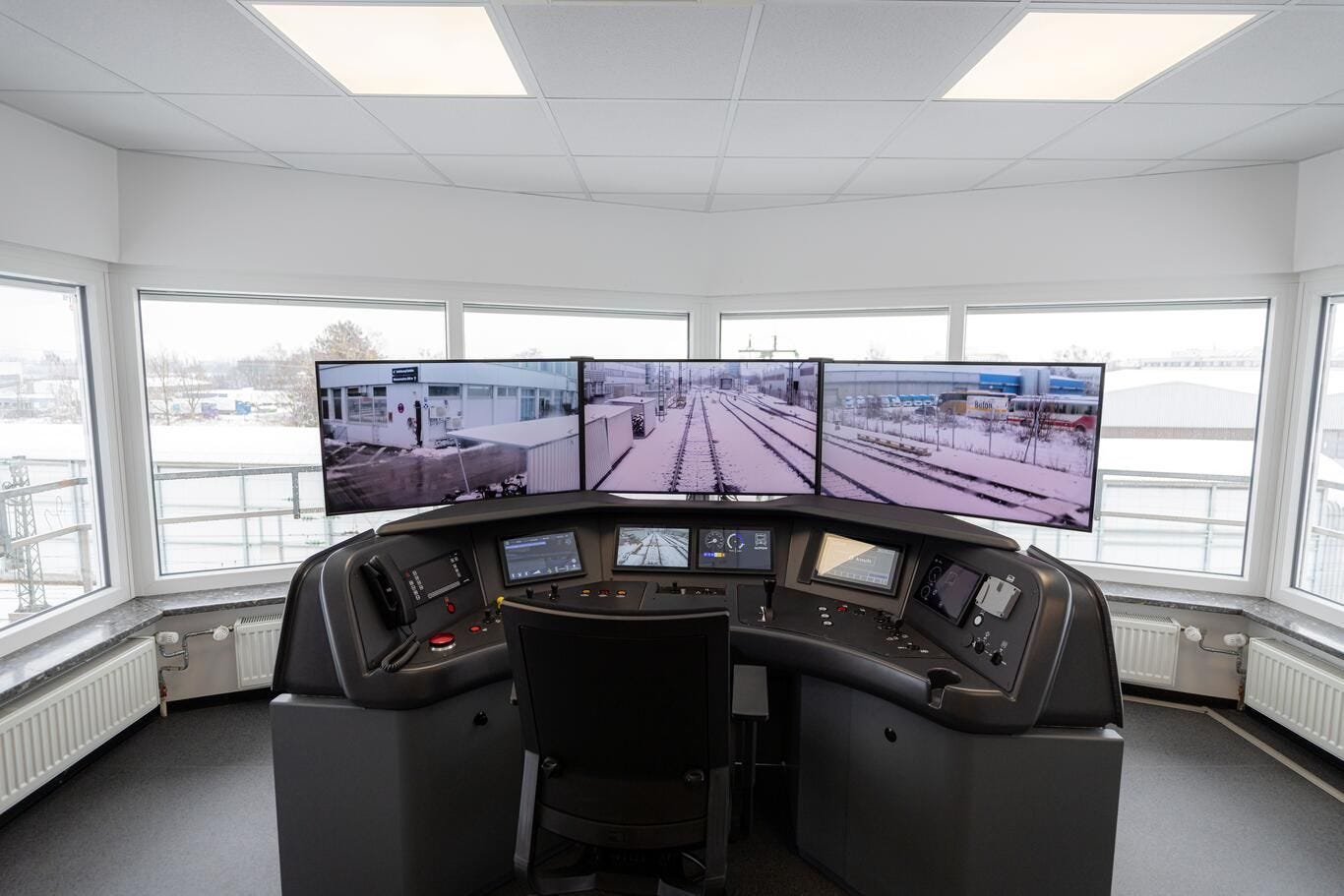
Remote control moves into the depot
Deutsche Bahn and Alstom have completed an initial operational test of remote control for an S-Bahn train inside a depot environment.
The trial covered low-speed shunting and positioning movements, controlled from a remote workstation rather than from the cab.
DB and Alstom focused on the operational basics: safe movement authority, system response, and how remote control fits into a confined, mixed-activity depot setting where staff, vehicles and equipment share the same space.
The aim is not unattended trains, but more flexible handling of non-revenue movements such as stabling, washing, and preparation for maintenance.
If the approach is rolled out more widely, it could reduce the need for drivers to be physically present for routine depot moves and help depots manage peaks more smoothly. Further tests are expected to expand the range of movements and tasks covered by the trials and validate the workflow.
Czechia earmarks EUR 3bn for rail in 2026
The Czech government has set aside CZK 72.2bn (around EUR 3 billion) for rail investment in 2026 via the State Fund for Transport Infrastructure, with delivery through infrastructure manager Správa železnic. The transport ministry says the package covers renewals and day-to-day asset condition work across the network.
Planned allocations include CZK 20bn for track maintenance and CZK 0.75bn for level-crossing safety. The ministry also points to a 2026 start pipeline that includes a 15 km Praha-Ruzyně–Kladno section within the wider Prague–Airport–Kladno scheme, alongside continuing works on corridor upgrades and node capacity projects.
Polregio lines up 22 new EMUs
Poland’s regional operator Polregio has launched a tender for up to 22 factory-new EMUs, with first units targeted to enter service in late 2028 or early 2029. The base contract covers six trains, with an option for 16 more.
Minimum requirements include 310 passengers (190 seats), 160 km/h, and multiple working, plus air conditioning, passenger information systems, Wi-Fi, power/USB, and bicycle space. The bid deadline is 26 February 2026.
Alstom reaches 100-train ERTMS mark
Alstom says 100 trains are now operating with its onboard ERTMS equipment, marking a deployment milestone across multiple European networks. The figure covers both new rolling stock and retrofit programmes on existing fleets.
The company points to mixed-traffic operation, cross-border services and varied national baselines as part of the rollout experience. Alstom frames the milestone as evidence that ERTMS deployment is moving beyond pilot projects and into routine fleet programmes.
Baden-Württemberg secures fresh rail funding
Baden-Württemberg is set to receive around EUR 1.7 billion in federal rail funding, strengthening the state’s pipeline of network upgrades and digitalisation projects. The allocation forms part of Germany’s wider rail investment framework and is tied to specific, approved schemes rather than general budgets.
The funding is expected to support capacity, reliability and ETCS-related measures on heavily used regional corridors, where dense passenger traffic puts pressure on infrastructure. State authorities say the money provides planning certainty and allows projects to move from design into execution over the coming years.
EU wants rail capacity to work like a product
The EU is proposing new capacity rules to make rail planning work more like a planned service — with defined, bookable capacity over a longer horizon.
The shift is away from annual timetable negotiations and towards multi-year planning on key corridors.
Infrastructure managers would have to set out capacity earlier in the planning cycle, coordinate plans across borders, and apply clearer prioritisation rules instead of case-by-case decisions. The proposal also seeks more consistent ways to manage disruptions and temporary capacity restrictions.
The regulation is now in the final legislative stage before adoption, before member states implement the rules and infrastructure managers adjust their planning and allocation processes.
Thank you for reading The Rail Agenda’s newsletter. If you found it valuable, consider sharing it with someone who might find it useful.