

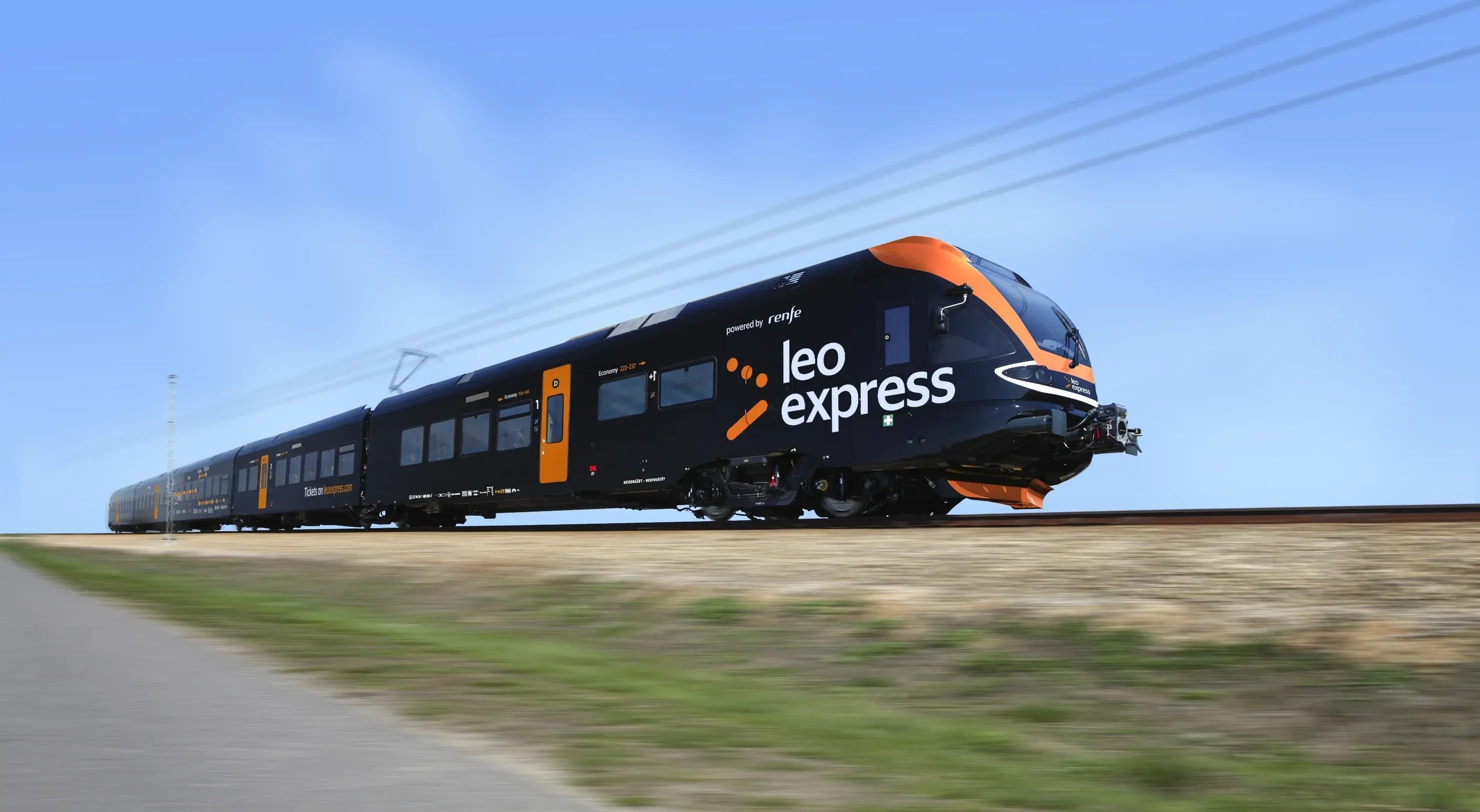
Leo Express beats Czech Railways for Prague-Munich contract
CZECH: Leo Express has been awarded the five-year contract to operate the Czech portion of the Prague-Munich express service from December 2026, selected over incumbent Czech Railways on price.
Leo Express’s winning bid — CZK 427 million against CZK 757 million — represents a gap of roughly 44%, signalling competitive pressure on state operators in cross-border tendering.
The German segment remains unresolved. Without a commercial agreement with Die Länderbahn, Leo Express would face open-access operation in Germany at its own commercial risk from December.
Czech Railways retains the right to contest the award within the 15-day review window that opened 24 March.
SBB and SNCF Voyageurs strengthen cooperation with new agreement
CROSS-BORDER: SBB and SNCF Voyageurs have extended their TGV Lyria commercial agreement to 2032 and committed to exploring new direct services from Switzerland into Europe.
The extension adds five years to a partnership that has run the Franco-Swiss high-speed corridor for more than 45 years. In 2025, TGV Lyria carried 5.7 million passengers across three routes — Paris-Geneva, Paris-Lausanne and Paris-Basel-Zürich — with 17 daily return services.
The new mandate to study additional long-distance connections comes as competition on the Paris-Geneva corridor is expected to increase, with other European operators assessing entry on the route.
Paris-Berlin night train returns under European Sleeper
CROSS-BORDER: Paris and Berlin are connected by night train again — European Sleeper launched its first service on 26 March, three months after ÖBB’s Nightjet withdrawal left the corridor dark.
The Belgian-Dutch cooperative operates three weekly departures in each direction without state subsidy. The French government’s decision not to renew a start-up grant for night train operations triggered SNCF’s exit, which in turn led ÖBB to withdraw from a route it had run since 2023.
From 13 July, a stop at Hamburg-Harburg will be added once track works on the Hamburg–Berlin line are completed.
Renfe issues high-speed tender with China in play
SPAIN: Renfe has issued its largest ever rolling stock tender, covering 30 high-speed trainsets at 350 km/h with an option for 10 more — after months of public signals from Spain’s transport minister that Chinese manufacturers could be in contention.
The base order is valued at EUR 1.36bn, with the full 40-train package at EUR 1.78bn. Delivery speed carries explicit weight in the scoring criteria: the first five trainsets must be incorporated before month 40, a threshold that creates a structural challenge for any bidder without an existing European homologation track.
Renfe and Spain’s transport minister visited manufacturers in China, Germany, Italy, France and Spain ahead of the tender’s formal publication.
Trenitalia adds nine Frecciarossa trains in EUR 260m deal
ITALY: Trenitalia has contracted Hitachi Rail to build nine more Frecciarossa 1000 trainsets in a EUR 260 million deal announced 24 March 2026.
The order exercises a further option under a 2023 framework agreement, bringing the total number of trainsets contracted under that framework to 55. Trenitalia plans to operate 74 Frecciarossa 1000 units by 2031.
The ETR1000 is certified for operation across eight European rail networks, including France, Germany and Spain, supporting Trenitalia’s stated plans for further international corridor expansion.
Akiem takes first battery-electric Vectron for European lease
EUROPE: Locomotive lessor Akiem has ordered the first battery-electric variant of the Vectron platform, opening a battery-electric option for freight services on partially electrified corridors across Europe.
The new Vectron Dual Mode Electric/Battery replaces the diesel engine of the existing Dual Mode with batteries, operating on both overhead-line and battery power at up to 160 km/h. First deliveries are scheduled for 2029, with the variant entering the leasing market rather than going to a single operator — making it available to a broad range of freight users from the point of introduction.
The battery range on non-electrified sections has not yet been disclosed.
Thank you for reading The Rail Agenda — and if you found it useful, please share it with someone who might, too.