

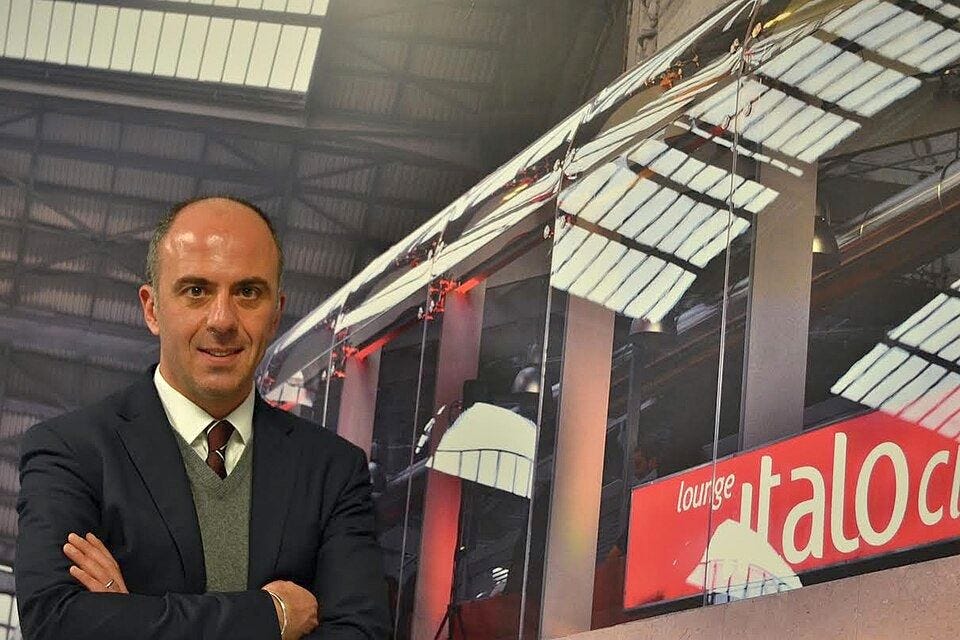
GERMANY: Italo chief executive Gianbattista La Rocca has told Handelsblatt the Italian operator will not delay its planned 2028 entry into Germany — and that a Bundesnetzagentur decision on long-term track access must come by the end of June or the Siemens production slot is lost.
The deadline is structural, not rhetorical. Italo has already deferred Siemens production by ten months and invested more than EUR 25m. A further delay collapses the 2028 entry timeline entirely.
Bundesnetzagentur has no legal basis in the current framework to grant the ten-to-fifteen-year path contracts Italo is demanding. DB and FlixTrain have both signalled they would challenge any bespoke capacity guarantee.
The EU Capacity Management Regulation takes effect from December 2030 — making any interim national model for Italo legally exposed from the moment it is granted.
Hitachi and Pesa team up for Poland’s first high-speed tender
POLAND: Japanese manufacturer Hitachi Rail and Polish rolling stock producer Pesa Bydgoszcz have signed a cooperation agreement to bid jointly for PKP Intercity’s tender for 20 very high-speed trains — Poland’s first procurement at 320 km/h.
The bid is built around Hitachi Rail’s ETR1000 platform — the Frecciarossa 1000 — with initial production at Hitachi’s Italian facilities and a gradual transfer of manufacturing to Pesa’s plant in Bydgoszcz. The Siemens–Newag consortium, previously confirmed, has since dissolved after the two parties failed to agree on cooperation terms.
Bids are due May 2027, with a contract decision targeted for August 2027. The tender includes an option for 35 additional trainsets and 30 years of maintenance.
Austria drops airport link to keep Brenner on time
AUSTRIA: A EUR 19.5 billion rail investment plan for 2027–2032 has been approved by Austria’s government, delaying the Vienna airport rail link by two years to keep the Brenner Base Tunnel’s northern approach on schedule.
The Brenner northern approach in Tyrol — from Radfeld to Kufstein — stays in the programme, with construction starting 2030 and completion targeted for 2039. The Flughafenspange takes the cut instead.
Austria’s plan is now conditional on a decision that has not yet been taken: Germany has not made a binding commitment to its Nordzulauf from Munich through Rosenheim to the Austrian border. Without that, the Brenner Base Tunnel opens in 2032 without a functioning northern approach on the German side.
Poland maps out 4,700 km rail expansion to 2050
POLAND: The country’s first comprehensive long-term rail plan sets out 4,700 km of new lines — including 2,700 km to high-speed standard — as the framework for network development after 2035.
The Integrated Railway Network (ZSK), presented 15 June by Centralny Port Komunikacyjny, PKP Polskie Linie Kolejowe and the Ministry of Infrastructure, is a planning document — not a government decision. Ministerial Council approval is required before it enters formal planning documents and TEN-T mapping, and no date has been announced.
Around 1,000 km are already under construction or in procurement. The remaining 3,700 km are post-2035 investment, estimated at approximately 610 billion zlotys, with no funding source yet identified or committed.
Poland bans Turkish train manufacturer from zero-emission tender
POLAND: Koleje Dolnośląskie, a regional operator in Lower Silesia, has excluded Turkish manufacturer Bozankaya from a tender for zero-emission trains, applying EU rules that allow third-country suppliers without trade agreements with the bloc to be shut out of public procurement. Three European manufacturers advance.
The legal basis is a Polish implementation of EU procurement rules in force from 9 September 2025 — distinct from the Foreign Subsidies Regulation used to remove CRRC from a Lisbon metro consortium in April. That instrument targets state subsidies; this one targets countries not party to the EU’s international procurement agreements. Turkey is not a signatory to the Government Procurement Agreement.
Pesa, Siemens Mobility and Škoda Group advance to the next phase. A successful prototype test triggers a framework order of up to 16 trains.
OnTrain presents first Traxx Universal locomotive
INDUSTRY: OnTrain, a new Polish locomotive leasing platform backed by pan-European infrastructure investor Marguerite, has presented its first Alstom Traxx Universal multi-system electric locomotive at Żmigród — the opening move in a 40-unit fleet build targeting freight and passenger operators across eight Central and Southeast European countries.
The first five units have been available since April 2026. The remaining 35 follow from March 2027 at three locomotives per month, with certification covering Poland, Germany, Austria, Czech Republic, Slovakia, Slovenia, Croatia, Serbia and Hungary across two corridor configurations.
That’s The Rail Agenda for today. If you found this newsletter useful and relevant, please forward it to someone you know.