

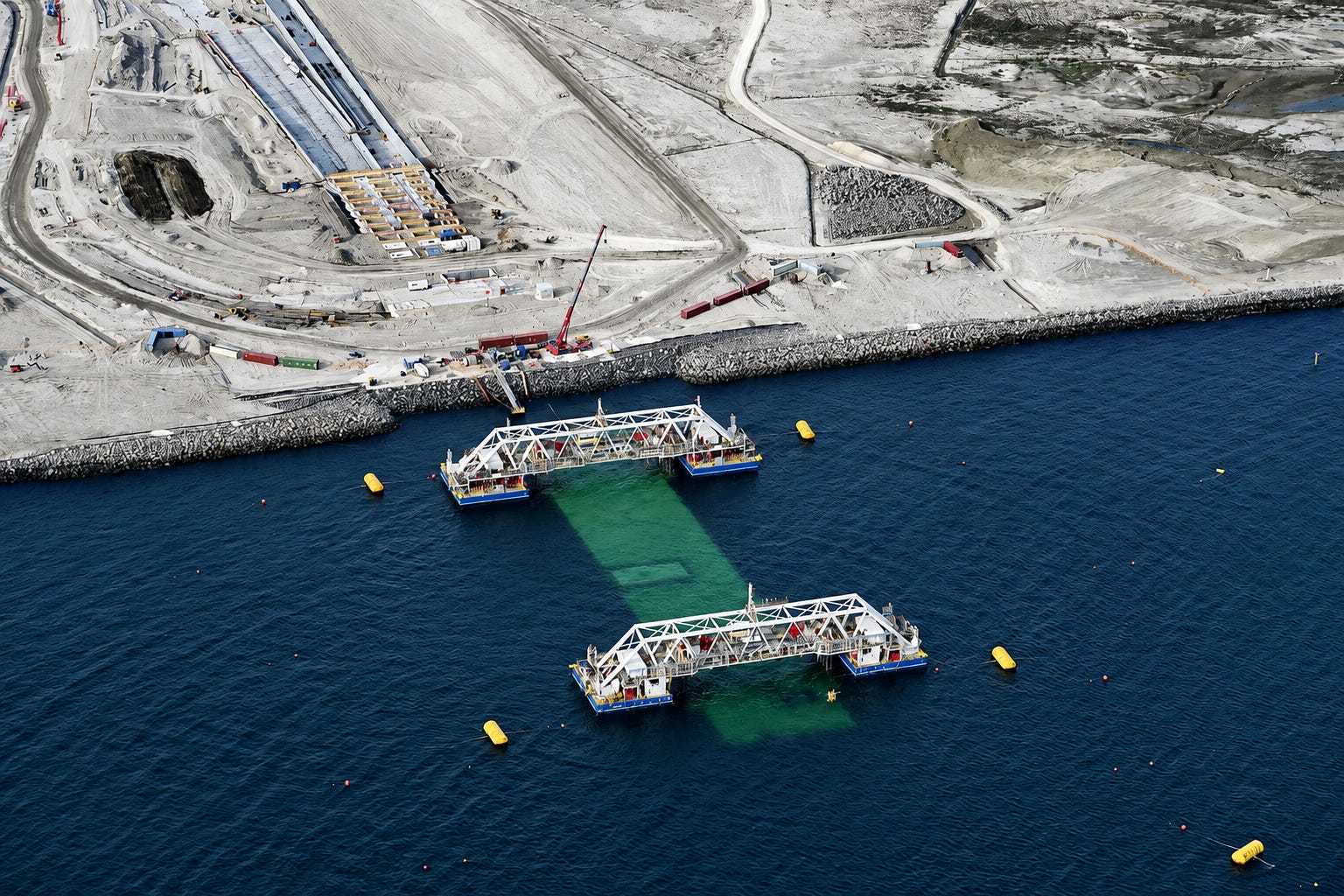
Fehmarnbelt tunnel lays first element
DENMARK/GERMANY: The first of the 217-metre-long tunnel elements for the Fehmarnbelt tunnel is now in place on the seabed. The immersion vessel IVY placed the element on 7 May, opening the construction sequence for an 18 km crossing that will cut the Copenhagen–Hamburg rail journey from around 4.5 hours to 2.5.
The first element is one of 89 required to complete the structure. Each immersion follows the same sequence — transport, positioning, hydraulic connection, and gravel securing — before the next begins.
The tunnel closes a critical gap in the TEN-T Scandinavian-Mediterranean Corridor. Opening is scheduled for 2031.
Each of the five-tube elements carries two road lanes, two single-track rail tubes, and one service passage. At 18 km, the completed tunnel will be the world’s longest immersed tunnel.
GoVolta drops Hamburg after seven weeks
CROSS-BORDER: GoVolta launched Amsterdam–Hamburg on 20 March alongside its Berlin service — and is now suspending it after average occupancy of 60% fell short of what a wholly commercial operation requires.
The last Hamburg departures run at the end of May. From 1 July, GoVolta doubles its Amsterdam–Berlin frequency to six weekly departures and shifts the Berlin terminus from Gesundbrunnen to Spandau.
Amsterdam–Paris launches 14 December via Antwerp and Ghent.
Alstom wins EUR 295m Lausanne metro contract
SWITZERLAND: Alstom has won a EUR 295m contract to deliver new signalling and midlife upgrades across Lausanne’s M2 metro line, Switzerland’s only fully automated urban metro.
The contract, signed 5 May, covers Communications-Based Train Control (CBTC) signalling across the full M2 network and a fleet midlife upgrade programme. CBTC tracks train positions continuously rather than in fixed blocks, allowing shorter headways without expanding the physical network.
Transports publics lausannois has not published a delivery timeline for either workstream.
Two of three Leo Express Talgo sets pulled from service
CZECHIA: Two of Leo Express’s three leased Talgo VI trainsets have been withdrawn from service within a week of their launch on new cross-border services linking Prague with Bratislava and Prešov.
Each Talgo VI set relies on a dedicated diesel generator van for all auxiliary power — heating, cooling, lighting and doors. When the generator ran out of diesel mid-route on one service, all auxiliary systems lost power simultaneously.
Full Praha–Bratislava service is expected to resume 14 May. One set remains covering both corridors in the interim.
Škoda agrees Uzbekistan EMU deal with EU financing
INDUSTRY: Škoda Group has agreed a strategic cooperation deal valued at EUR 120m covering the supply and maintenance of 10 electric multiple units for Uzbekistan Railways — reviving an arrangement that collapsed in 2023 over export financing. The new agreement is backed by the European Investment Bank and designated a flagship initiative under the EU’s Global Gateway programme.
The 10 four-car EMUs are built for the 1,520 mm broad-gauge network and based on the RegioPanter platform in service in Latvia and Estonia. Production will take place at Škoda’s Ostrava facility.
The deal also establishes a joint venture in Uzbekistan for local assembly and maintenance, alongside a Škoda Academy for technical training.
That’s The Rail Agenda for today. If you found this newsletter useful and relevant, please forward it to someone you know.