

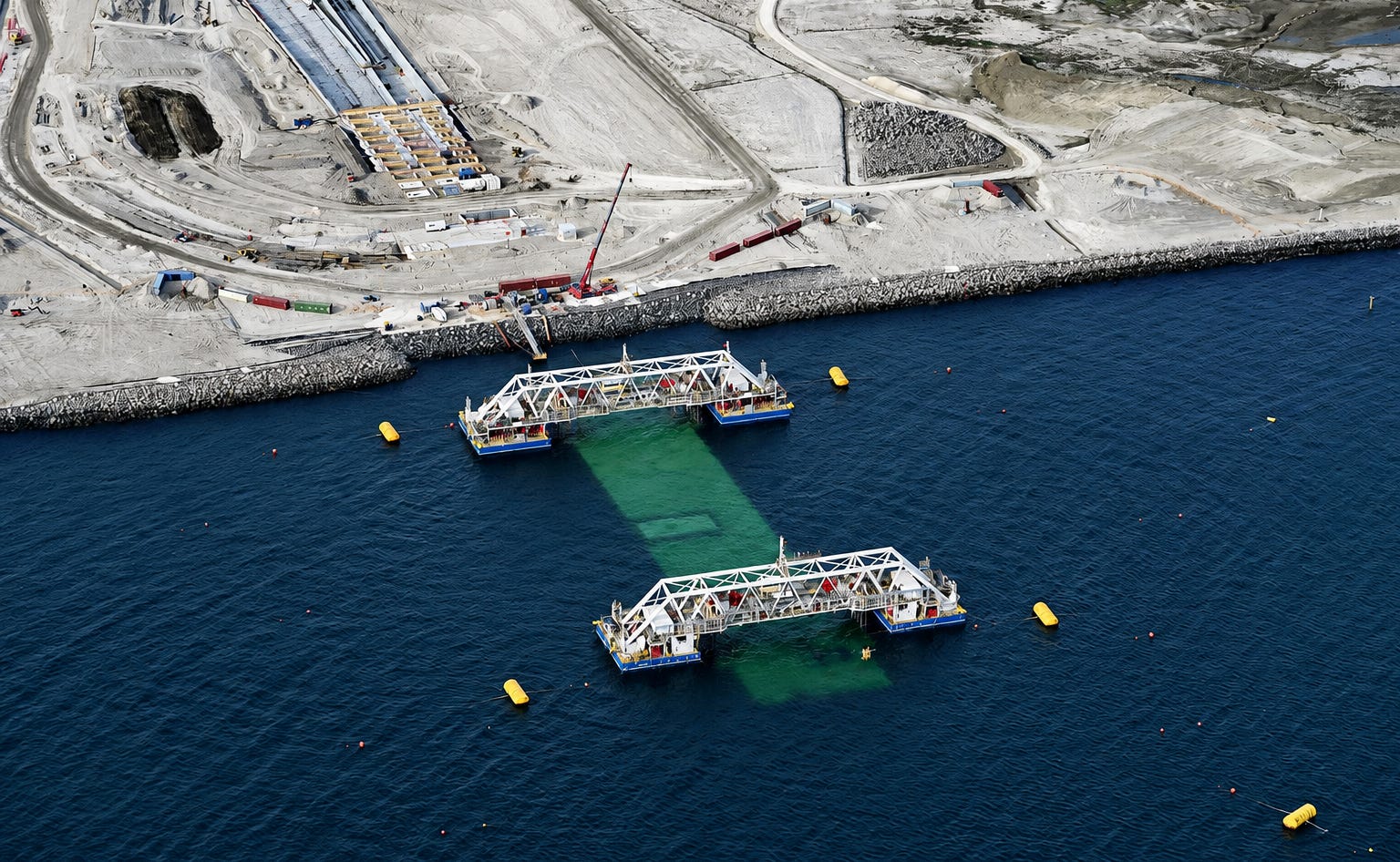
DENMARK/GERMANY: The first of the 217-metre-long tunnel elements for the Fehmarnbelt tunnel is now in place on the seabed. The immersion vessel IVY placed the element on 7 May, opening the construction sequence for an 18 km crossing that will cut the Copenhagen–Hamburg rail journey from around 4.5 hours to 2.5.
Sund & Bælt, the Danish state company managing the project, confirmed the element was positioned precisely in the tunnel trench off the Danish coast after a 14-hour immersion operation, verified by laser measurement inside the element itself.
The completion marks a historic milestone for what will be the first fixed link between Scandinavia and Germany — Northern Europe’s largest infrastructure project.
Operation and next steps
Five tugboats and IVY transported the 73,500-tonne element from the tunnel factory at Rødbyhavn on the Danish island of Lolland before the immersion began around noon on 7 May. Hydraulic arms connected it to the Danish tunnel portal once in position.
The two immersion pontoons will now be replaced by a gravel-placement vessel, which will secure the element by depositing material along its sides. The same sequence will repeat for the remaining 88 elements, each immersed into a trench up to 40 metres below the sea surface.
Each element is divided into five tubes: two dual-carriageway road tubes, two single-track rail tubes, and one service and escape tube. At 18 kilometres, the completed structure will be the world’s longest immersed tunnel. The fixed link will allow a car to cross the Fehmarnbelt in 10 minutes and a train in seven.
Timeline and European dimension
The tunnel is expected to open in 2031. The European Commission has designated Fehmarnbelt a priority project and awarded approximately EUR 1.3bn in construction funding. The tunnel closes a key missing link in the TEN-T Scandinavian-Mediterranean Corridor, one of nine core corridors in the network.
“We are both happy and relieved,” said Mikkel Hemmingsen, CEO of Sund & Bælt. “It is a very big day for the project, for Denmark and Germany and for Europe.”
European Commissioner for Sustainable Transport Apostolos Tzitzikostas described the immersion as a historic achievement, saying the tunnel would connect regions more closely and create new momentum between Malmö, Copenhagen, Hamburg and onwards into Europe.