

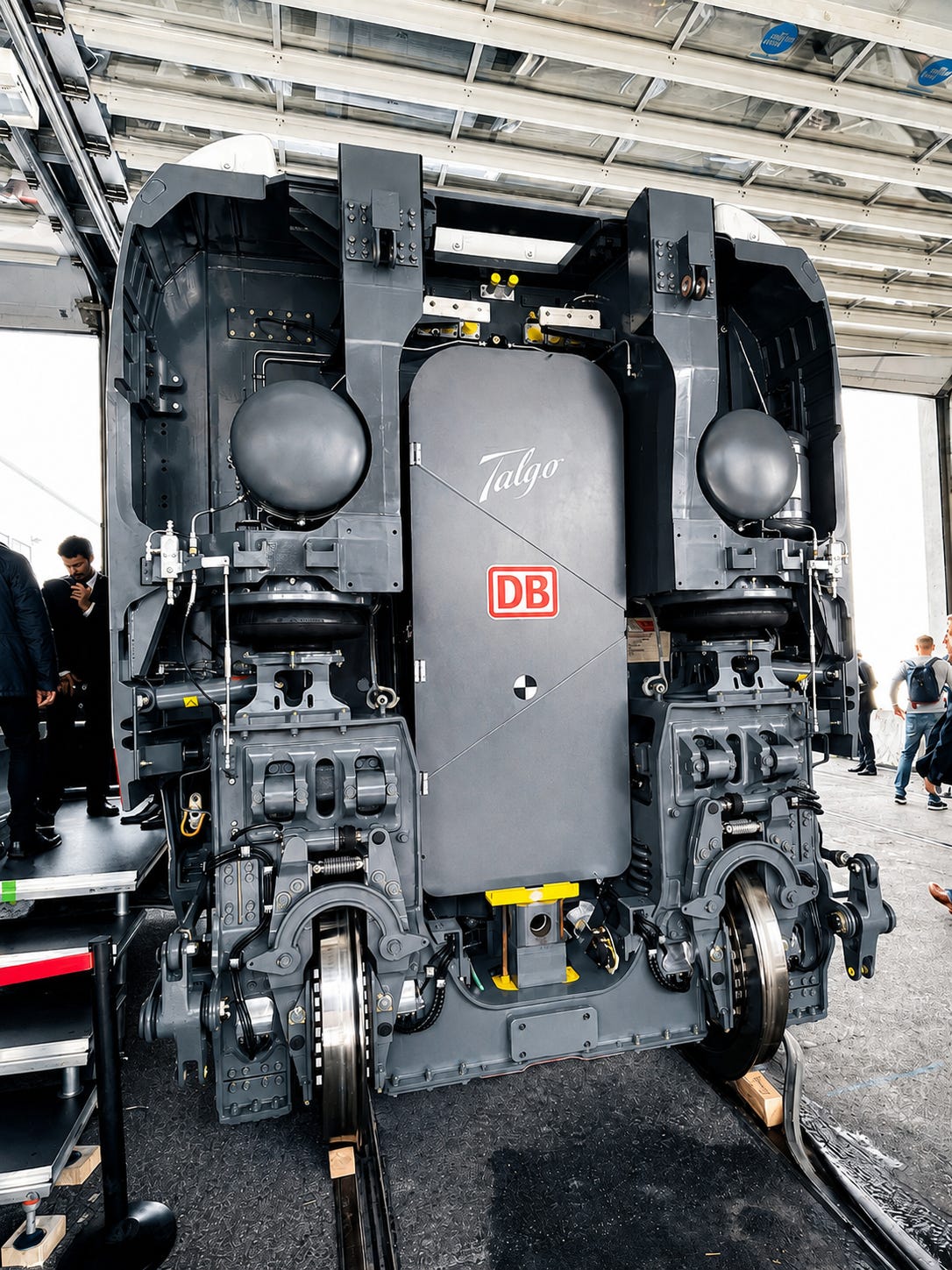
Four European buyers chose the same Spanish train for the conventional network without consulting each other, and a standard nobody declared took shape. The company behind it has a record order book. It has also shown once already that it cannot deliver on its own.
By Dan Jensen
In spring the picture was a manufacturer winning the market between high-speed lines: three state-owned fleets and FlixTrain on order, Saudi Arabia signed, Portugal possible. The July settlement with Renfe has since shown what that position rests on. The customer is paying to have its own trains rebuilt, the penalty for late delivery waits until the banks have been paid, and the Spanish state has stepped in twice to keep the company in Spanish hands.
Four fleets, one factory
The segment Talgo won has a precise shape: long-distance journeys on conventional infrastructure at up to 230 km/h, on routes that high-speed stock does not serve and that often cross borders. No other manufacturer had a product for it, and four buyers chose the same train independently of one another.
DB’s ICE L is due on Oslo–Berlin from 2028. DSB has run Talgo 230 sets on Copenhagen–Hamburg since November 2025 without a spare fleet. Sweden’s transport administration Trafikverket, which buys the trains and leases them to whoever operates them, signed for 20 sets in April at EUR 756m. FlixTrain has contracted for up to 65.
All four fleets come from the same manufacturer, built at its Spanish plants in Rivabellosa in the Basque province of Álava and Las Matas outside Madrid. One company’s capacity and one balance sheet carry them.
Ownership and refinancing
In August 2024 the Spanish government refused to authorise a EUR 619m Hungarian bid for all of Talgo, citing strategic interests and national security. Approaches from Škoda and Poland’s Pesa were examined afterwards and went nowhere.
By then the company had run out of room. It was late delivering the Avril high-speed fleet to Renfe, owed a EUR 116m penalty it disputed, and could not refinance on its own.
A Basque consortium led by steelmaker Sidenor’s owner José Antonio Jainaga, with the Basque government and two banking foundations, bought just under 30% for EUR 156.67m. The seller was Pegaso Transportation, the vehicle holding the stake for the fund Trilantic and part of the founding Oriol family. The operation completed in December 2025.
The state holding company SEPI subscribed a EUR 45m capital increase for 7.9% of the shares and a further EUR 30m in convertible bonds. Talgo signed a EUR 770m syndicated financing with a EUR 500m guarantee line. The Oriol family left the chair after more than eighty years, and the state that had blocked the sale now stands behind the debt.
The Renfe settlement
In the settlement Talgo reported to the securities regulator on 2 July, Renfe pays EUR 132m to convert the 15 fixed-gauge sets of its 30-train Avril fleet to variable gauge with new, more robust bogies. Talgo does the work over 37 months. The maintenance price rises 29%, and Renfe takes over buying spare parts.
The EUR 116m penalty stays on the books, and Talgo starts paying it in 2032, after the restructured bank debt falls due. Around EUR 200m in withheld payments and guarantees was released. Jainaga had told shareholders in June that the agreement would remove any financial uncertainty.
At home, Talgo has a different problem. Renfe doubled bogie inspections on the Avril fleet on 4 September, to every 5,000 km instead of 10,000, after cracks took two more sets out of service in the last week of August. Talgo had blamed the Madrid–Barcelona infrastructure. The two sets had not run on it.
The Avril bogie is Talgo’s own design for one product, and it runs only in Spain. The Talgo 230 that DSB, DB and Trafikverket have ordered is a locomotive-hauled train that does not use it. In the July settlement, a state-owned buyer paid for the fix when Talgo could not deliver on time, and the state stood behind the money.
Order book, capacity and oversight
Talgo’s order book stood at EUR 6.2bn at the half year, with EUR 1.3bn from Saudi Arabia Railways and EUR 756m from Trafikverket. In June the company said production had to double to deliver it. The Avril conversion adds 15 trains’ worth of work over the next three years.
DSB is already feeling the strain. Its own figures show the EuroCity sets ran under 2,000 km between failures in January and over 4,600 km in February, and the operator has no reserve.
Safety authorities in two countries are now involved with the same supplier. In Spain the Avril monitoring plan was drawn up with the national rail safety agency in 2025, and drivers’ union Semaf has asked the agency to intervene after the latest cracks. In Czechia the rail authority has set Leo Express a deadline over its safety and maintenance documentation for the older Talgo coaches, and none has carried passengers since 31 July.
Pending decisions
The Czech authority has not ruled on Leo Express, and no return date is confirmed for its Talgo sets. In Portugal, national operator Comboios de Portugal (CP) received two applications for its Lisbon–Porto high-speed fleet and is due to decide by 14 September which of them qualify. It has not named the applicants. Further out lie the first converted Avril from month 15 and the first Talgo 230 deliveries to Trafikverket.
Talgo will not run out of orders. The question for its customers is whether it can build them fast enough, and the Renfe settlement shows what happens when it cannot: the customer pays.
In spring that market position was the whole story. Since then the state has become a shareholder, the penalty has been pushed past the bank debt, and three more years of conversion work have been added to the order book. The dates to watch are deliveries.