

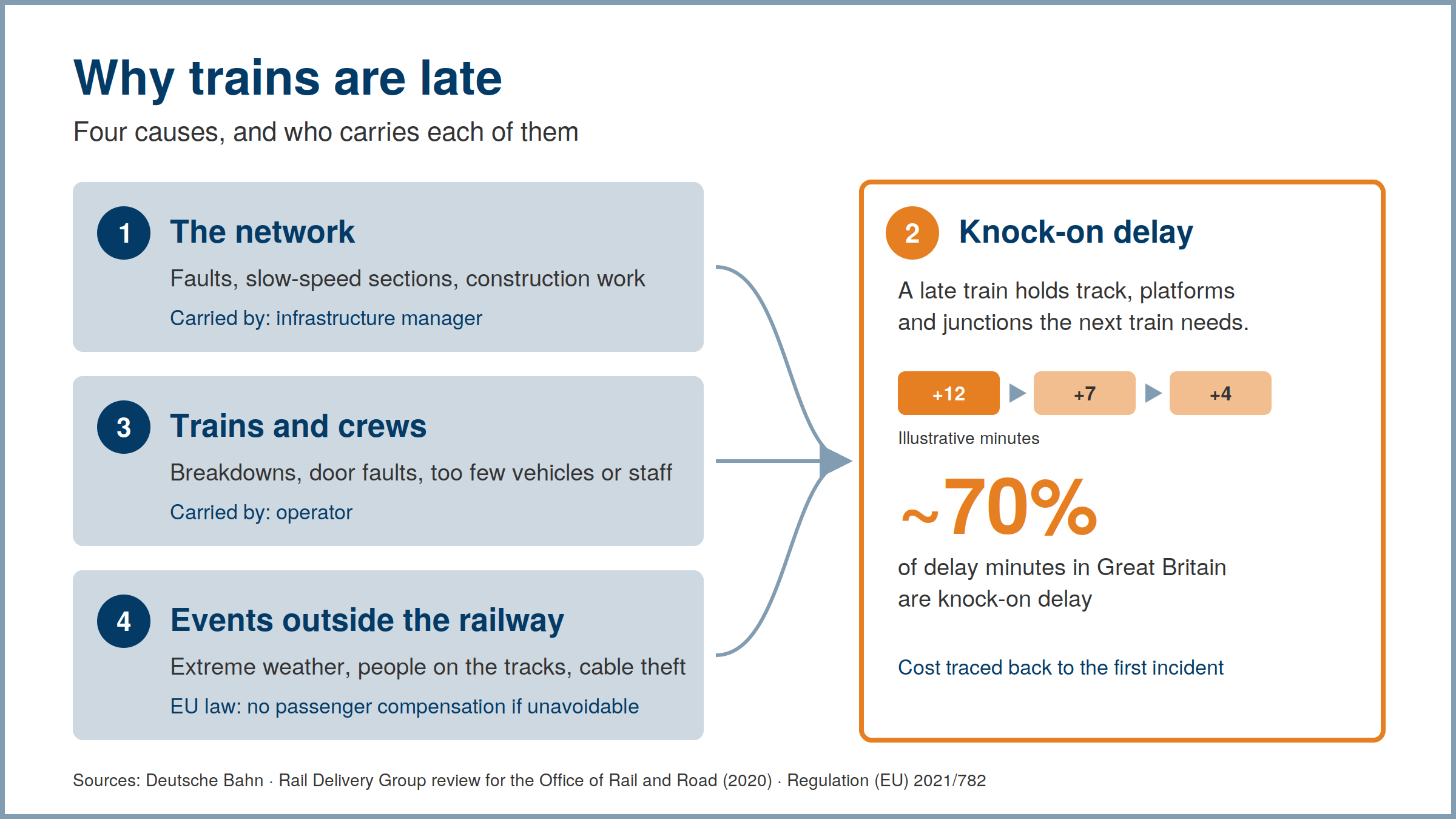
Deutsche Bahn’s long-distance trains were on time at 60.1% of their stops in 2025, measured against a threshold of 6 minutes. Behind that figure sit four causes: the infrastructure, knock-on delay, trains and crews, and events outside the railway.
Railways record each of these causes separately, because the cause decides who pays. An infrastructure manager, an operator and a passenger can all be owed money for the same late train. Performance schemes settle the bill between the companies, and EU passenger rights settle it with the traveller.
The balance between the four differs from country to country and moves with investment, weather and traffic growth. Swiss Federal Railways (SBB) reported 94.1% punctuality for 2025 on a stricter rule, with trains counted as late from 3 minutes.
How delays are counted
Every delay starts as a gap between the timetable and the train. Where the line is drawn varies by country. DB counts a stop as punctual if the train is less than 6 minutes late, and SBB draws the line at 3 minutes.
Each recorded delay is then given a cause code. The recast Directive 2012/34/EU requires performance schemes that penalise disruption and compensate those who suffer from it, and every delay must be assigned to one of the classes listed in the directive’s Annex VI. Those classes are based on a coding system developed by the International Union of Railways (UIC).
Passengers work with a different threshold. Under Regulation (EU) 2021/782 on rail passengers’ rights, compensation starts at 60 minutes, with 25% of the ticket price for a delay of 60 to 119 minutes and 50% from 120 minutes. DB also publishes a passenger measure that counts missed connections and uses a threshold of 15 minutes, and it stood at 65.5% for long-distance travellers in 2025.
The network
The first cause is the infrastructure itself. Signals, switches, overhead lines and track fail more often as they age, and worn sections are given speed restrictions that add minutes to every train passing through. In its punctuality report for August 2026, DB said persistent heat in the first half of the month had caused many equipment failures and an unusually high number of slow-speed sections.
Repairing the network is also a source of delay. Construction work closes tracks, diverts trains and slows them past worksites, and the same August report named corridor renovation along the Rhine, work on Hamburg’s connecting line and the closure of Berlin’s Stadtbahn. A DB spokesperson told the German news agency dpa in early 2025 that 80% of long-distance delays were due to outdated, failure-prone and overloaded infrastructure.
Germany is the clearest case because it is renovating its busiest lines while running trains on them. Every infrastructure manager with a maintenance backlog faces the same trade-off between closing lines now and losing minutes for years. Closures are planned well in advance, but on a network with little spare capacity the diversions run over lines that are already busy.
Knock-on delay
The second cause is the delay one train passes to another. A late train occupies a section of track, a platform or a junction that the next train needs, and the next train waits. The industry calls this secondary or reactionary delay.
On a busy network it becomes the largest single category. In Great Britain, reactionary delay made up about 70% of all delay minutes, according to a 2020 review by the Rail Delivery Group for the Office of Rail and Road, up from roughly 60% a decade earlier. Each of those minutes is traced back to the incident that started the chain, so the original cause carries the cost.
Timetables include recovery time to absorb small losses, and traffic growth uses it up. DB has named rising traffic and a network at its capacity limits as a main reason for its 2025 decline, and the effect is stronger where fast trains share tracks with regional and freight services. How closely trains can follow one another is set by the signalling system, which is one reason digital signalling features in capacity planning.
Trains and crews
The third cause sits with the operator. Trains break down, doors fail to close, and a shortage of vehicles or staff can leave a service waiting at its first station. Long stops at crowded platforms add further minutes.
EU law places these delays on the operator. Under the passenger rights regulation, a railway undertaking cannot escape compensating passengers by pointing to strikes by its own staff or to another operator using the same tracks. Under the performance schemes, the infrastructure manager can in turn charge operators for disruption they cause to the network.
Trains that cross borders carry this risk on every network they use. A delay picked up in one country travels with the train into the next, where it meets another infrastructure manager’s timetable and another set of slots. Each infrastructure manager records the delay on its own section of the route.
Events outside the railway
The fourth cause comes from outside. Extreme weather, people on the tracks, cable theft, emergencies on board and police operations all stop trains, and none of them is under the railway’s direct control. Storms and falling trees are seasonal, and infrastructure managers plan vegetation work and winter readiness around them.
The passenger rights regulation treats this group differently. An operator does not have to pay compensation if it can show that a delay was the direct result of such events and could not have been avoided with due care. The exemption does not cover failures by the infrastructure manager, so the operator remains liable to passengers for a broken signal it does not own.
The boundary with the first cause is thin. Heat is classed as an external event, and on an ageing network it turns into equipment failures and slow zones. The railway cannot control the weather, and the other three causes are the ones investment in track, signalling and fleets can reduce.